
Daily Bible Devotionals
written by
Pastor Steve Wiggins
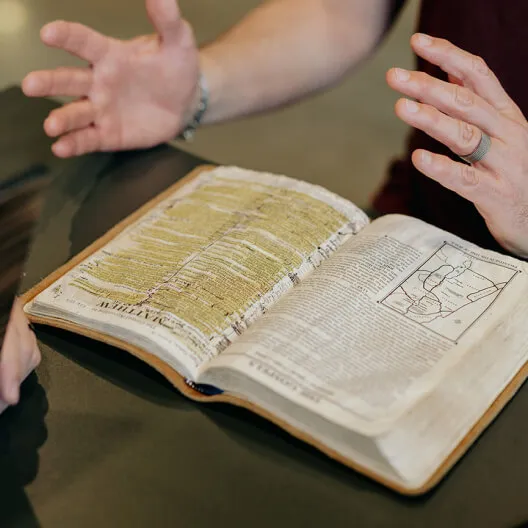


Daily Bible Devotionals


Psalm 17
“Concerning the works of men, by the word of Your lips, I have kept away from the paths of the destroyer. Uphold my steps in Your paths, that my footsteps may not slip. I have called upon You, for You will hear me, O God; incline Your ear to me, and hear my speech. Show Your marvelous lovingkindness by Your right hand, O You who save those who trust in You from those who rise up against them. Keep me as the apple of Your eye; hide me under the shadow of Your wings, from the wicked who oppress me, from my deadly enemies who surround me.” Psalm 17:4-9 (NKJV)
Satan has a three-fold agenda: Steal, Kill, Destroy. (John 10:10) He wants to steal God’s sheep (us) by promising a better life if we reject God. He seeks to kill by stealing the seeds of the gospel, sown through evangelism. (Matthew 13:19). By doing so, Satan’s ultimate goal is to destroy any hope that we may have of a joy-filled life and eternity with God. So, how does David stay away from the Destroyer (Satan)? By staying off the Destroyer’s path!
“Your word is a lamp to my feet and a light to my path.” Psalm 119:105 (NKJV)
And how does one ensure they do not travel in the Destroyer’s path, aka: “the path of sinners”? By seeking and obeying God’s Word, “the Word of Your lips.”
“Blessed is the man who walks not in the counsel of the ungodly, nor stands in the path of sinners, nor sits in the seat of the scornful; but his delight is in the law of the Lord, and in His law he meditates day and night.” Psalm 1:1-2 (NKJV)
We must remember that while there are many “paths” promising to lead us to a joyful relationship with God (and many of those paths are seemingly trustworthy simply because they are ancient), there is only ONE true path.
“This is what the Lord says: Stand by the roadways and look. Ask about the ancient paths: Which is the way to what is good? Then take it and find rest for yourselves. But they protested, “We won’t!”’ Jeremiah 6:16 (see also: John 14:6; Matthew 7:13-14) (HCSB)
Notice how David communicates that while he stands blameless before the Lord when he wrote this psalm, he is not counting on his personal righteousness to deliver him. He relies on God’s right hand (Isaiah 41:10-13), confident that he is the apple of God’s eye (Zechariah 2:8-9) and will be gathered under His “wing .”Are you willing to be gathered?
“Jerusalem, Jerusalem, who kills the prophets and stones those who are sent to her. How often I wanted to gather your children together, the way a hen gathers her chicks under her wings, but you were unwilling!” Matthew 23:37 (NASB)
Psalm 18
“They cried out, but there was none to save; even to the Lord, but He did not answer them. Then I beat them as fine as the dust before the wind; I cast them out like dirt in the streets. You have delivered me from the strivings of the people; you have made me the head of the nations; a people I have not known shall serve me. As soon as they hear of me they obey me; the foreigners submit to me. The foreigners fade away, and come frightened from their hideouts. The Lord lives! Blessed be my Rock!Let the God of my salvation be exalted. It is God who avenges me, and subdues the peoples under me; He delivers me from my enemies. You also lift me up above those who rise against me; You have delivered me from the violent man. Therefore I will give thanks to You, O Lord, among the Gentiles, and sing praises to Your name. Great deliverance He gives to His king, and shows mercy to His anointed, to David and his descendants forevermore. Psalm 18:41-50 (NKJV)
The title & direction ascribed to Psalm 18 is “God the Sovereign Savior (To the chief musician. A Psalm of David the servant of the Lord, who spoke to the Lord the words of this song on the day that the Lord delivered him from the hand of all his enemies and the from the hand of Saul…)”. If we are paying attention, we should focus on the phrase “…delivered him from all his enemies and from the hand of Saul”, because David quickly moves beyond his immediate deliverance and transcends to Messiah and His deliverance. (Luke 20:43; Acts 2:35; Matthew 22:44; Psalm 110:1) We must remember that one of the titles of Messiah (Jesus) is “Son of David.”
“The book of the genealogy of Jesus Christ, the Son of David, the Son of Abraham….” Matthew 1:1 (NKJV)
Another item to note is how David distinguishes between “Enemies” and “Foreigners.” There is a false idea that God (in the Old Testament) hates foreigners. That is not so. God hates foreign gods. Whenever a foreigner (in the Old Testament or New) renounces their foreign gods and embraces both the God and people of “Israel,” they are no longer considered “foreign,” even though they are not descended from a Hebrew family.
“Also the sons of the foreigner who join themselves to the Lord, to serve Him, and to love the Name of the Lord, to be His servants - everyone who keeps from defiling the Sabbath, and holds fast My covenant - even them I will bring to My holy mountain, and make them joyful in My house of prayer. Their burnt offerings and their sacrifices will be accepted on My altar; for My house shall be called a house of prayer for all nations.” The Lord God, who gathers the outcasts of Israel, says, “Yet I will gather to Him others besides those who are gathered to Him.” Isaiah 56:6-8 (NKJV)
Why would the Gentiles praise the God of Israel? Because He has defeated the enemies of Messiah. And HOW? By the grace and mercy of God. When a Gentile converts to the Lord, he not only ceases to be an enemy of Israel, but he becomes gathered (along with the outcasts of Israel) to God’s flock! (John 10:14-16)
Psalm 19
“The heavens declare the glory of God; and the firmament shows His handiwork. Day unto day utters speech, and night unto night reveals knowledge. There is no speech nor language where their voice is not heard. Their line has gone out through all the earth, and their words to the end of the world. In them He has set a tabernacle for the sun, which is like a bridegroom coming out of his chamber, and rejoices like a strong man to run its race. Its rising is from one end of heaven, and its circuit to the other end; and there is nothing hidden from its heat.” Psalm 19:1-6 (NKJV)
I can understand how Christians have different religious views and even that other people would follow after false religion. What is completely baffling to me is how a person could claim to be an atheist to deny that God exists at all. All people, everywhere, receive nature’s testimony (also see Romans 1:20)! Therefore, the atheist is a “fool.”
“The fool has said in his heart, ‘There is no God.’” Psalm 14:1a (NKJV)
Today’s psalm tells us that God’s glory is declared by nature itself! No honest, open-minded person could deny the existence of a creator because creation shouts, “Believe!” So, does that mean a person is saved, apart from trusting in Jesus, by simply by taking a trip to Yosemite? Absolutely not! (Acts 4:12) Creation prompts people to search for a Creator, but that search always leads them first to His perfect Law. When we get closer to God, we must face the fact that He is holy and has articulated a standard through which communion (fellowship) with Him is possible. That is why Psalm 19 moves from nature’s revelation to Scriptural revelation.
“The law of the Lord is perfect, converting the soul; the testimony of the Lord is sure, making wise the simple; the statutes of the Lord are right, rejoicing the heart; the commandment of the Lord is pure, enlightening the eyes; the fear of the Lord is clean, enduring forever; the judgments of the Lord are true and righteous altogether. More to be desired are they than gold, yea, than much fine gold; sweeter also than honey and the honeycomb. Moreover by them Your servant is warned, and in keeping them there is great reward.” Psalm 19:7-11 (NKJV) (see also: 1 Corinthians 14:1)
Once nature says there is a God, and Scripture tells us how Holy He is, we face a dilemma: We are not holy at all! Therefore, something (or Someone) must cleanse us from our iniquity! (1 John 1:9) Enter Jesus. In Him, alone, are we saved.
“Who can understand his errors? Cleanse me from secret faults. Keep back Your servant also from presumptuous sins; let them not have dominion over me. Then I shall be blameless, and I shall be innocent of great transgression. Let the words of my mouth and the meditation of my heart be acceptable in Your sight, O Lord, my strength and my Redeemer.” Psalm 19:12-14 (NKJV)
“But God demonstrates His own love toward us, in that while we were still sinners, Messiah died for us.” Romans 5:8 (NKJV)

Psalm 21
“For the king trusts in the Lord, and through the mercy of the Most High he shall not be moved.” Psalm 21:7 (NKJV)
Psalm 21 has thirteen verses. The first six verses deal with God’s salvation of David, with strong Messianic overtones. For instance, David speaks of the recipient of God’s salvation as having his days extended “forever and ever” and that he is “blessed forever .”Also to consider is that Jesus’ Name in Hebrew is Yeshua, which means “God saves.”
“He asked life from You, and You gave it to him - length of days forever and ever. His glory is great in Your salvation; honor and majesty You have placed upon him. For You have made him most blessed forever; You have made him exceedingly glad with Your presence.” Psalm 21:4-6 (NKJV)
For a moment, let’s consider that David was not speaking about Messiah. David’s words, then, indicate he believed in the resurrection and anticipated to spend eternity in God’s presence, that his earthly deliverances were only foreshadowing of a permanent heavenly one.
The last six verses of Psalm 21 focus on the judgment of God’s enemies. Fire and arrows are His tools of wrath. Arrows are silent, swift, and come from afar. God says that His enemies are hit when they least expect it, and His judgment comes quickly. Of course, we see fire as a means of judgment throughout Scripture. Shadrach, Meshach & Abed-Nego were saved through the furnace (without even smelling of smoke), while the men who threw them into the fire were burned alive. (Daniel 3) Most notably, the “Lake of Fire” (alongside the Word of God/the sword from Jesus’ mouth) is the final instrument of judgment in the Revelation.
“They went up on the breadth of the earth and surrounded the camp of the saints and the beloved city. And fire came down from God out of heaven and devoured them. The devil, who deceived them, was cast into the lake of fire and brimstone where the beast and the false prophet are. And they will be tormented day and night forever and ever.” Revelation 20:9-10 (NKJV)
If we are not cautious, we can scan today’s psalm and see it in two parts: God saves the righteous and punishes the unrighteous. But is anyone righteous before God on their own merit? (Romans 3:10) Don’t we all deserve punishment for sinning and falling short of God’s glory? (Romans 3:32) So, how can anyone be considered righteous? Smack in the middle of Psalm 21 is verse 7. David trusted in the Lord, and in His MERCY, God delivered him. David was not righteous, but his applied faith in God’s Word was counted as righteousness. Therefore, God chose to bestow MERCY (not getting what he deserved). And that is how we are saved today. God’s Grace (gift) is that we receive MERCY when we place our faith in the Living Word (John 1:1-14), Jesus, turning from our sin and committing to follow Him. (Ephesians 2:8-9)
Psalm 22
“My God, My God, why have You forsaken Me? Why are You so far from helping Me, and from the words of My groaning? O My God, I cry in the daytime, but You do not hear; and in the night season, and am not silent. But You are holy, enthroned in the praises of Israel. Our fathers trusted in You; they trusted, and You delivered them. They cried to You, and were delivered; they trusted in You, and were not ashamed. But I am a worm, and no man; a reproach of men, and despised by the people. All those who see Me ridicule Me; they shoot out the lip, they shake the head, saying, ‘He trusted in the Lord, let Him rescue Him; let Him deliver Him, since He delights in Him!’ But You are He who took Me out of the womb; You made Me trust while on My mother’s breasts. I was cast upon You from birth. From My mother’s womb, You have been My God.” Psalm 22:1-10 (NKJV)
It is a fairly common occurrence that whenever I discuss the idea of Messiah with Jewish non-believers, in order to get the conversation started, I propose some ground rules. They will not speak from the Talmud (a collection of extra-Biblical rabbinic opinions), and I will not speak from the New Testament. After all, if Jesus is the Messiah, then He should be clearly seen in the TANAKH (Hebrew Old Testament). “Fair enough,” they say, and off we go. But it never fails that whenever I read Isaiah 53 and Psalm 22, the Jewish non-believer says, “STOP! You said you would not speak from the New Testament, and you are obviously talking about Jesus!” I simply turn the Bible around and show them that King David could describe Messiah Jesus more clearly hundreds of years before His crucifixion than their rabbi can see Him today, 2000 years after the fact.
One of the most misunderstood statements that Jesus made from the cross was, “My God, My God, why have You forsaken Me?” Often, so-called “experts” put forth that in the midst of the trauma of crucifixion, Jesus stammered in His faith and lost sight of the goal. I overheard (and quickly corrected) one Israeli non-believing tour guide who taught his tour group, “Every prayer Jesus prayed, God answered, except for His selfish prayer that the “cup would be removed” from Him in the garden. Then Jesus caught Himself and said, ‘Nevertheless…’ Even on the cross, He was unsure of God’s deliverance and asked, ‘Why have You forsaken Me…?’” Let me say, that guide was not at all happy when I stepped in to give the proper Biblical understanding of the passage.
So, what did Jesus mean when He asked, “Why…?” Well, what is the subject matter of the psalm? It is the prophetic confession of Messiah, Who would bear the sin of both Israel and the world. Jesus was not confused, and His faith had not faltered. He was quoting a psalm about Himself - not only His unjust punishment but also the hope of His resurrection! Anyone who knew the first part of the psalm knew the rest.
“You have answered Me. I will declare Your name to My brethren; in the midst of the assembly I will praise You. You who fear the Lord, praise Him! All you descendants of Jacob, glorify Him, and fear Him, all you offspring of Israel! Psalm 22:21b-24
Psalm 23
“The Lord is my shepherd; I shall not want. He makes me to lie down in green pastures; He leads me beside the still waters. He restores my soul; He leads me in the paths of righteousness for His name’s sake.” Psalm 23:1-3 (NKJV)
As perhaps the best-known psalm in the world (definitely one of the most familiar passages in the Bible for believers and non-believers alike), Psalm 23 covers both fear of the present and hope for the future in their greatest extremes. So, how do we unpack the gravity of this passage in a few short paragraphs? Frankly, it cannot be done, but let’s try to anyway!
Everyone, everywhere, regardless of their station of life or ethnicity, resonates with the idea that they are sheep in need of a shepherd. After all, “We all, like sheep, have gone astray.” (Isaiah 53:6). Sadly, most of the people who apply for the job of shepherd (religious and political leaders) fall short of God’s standard. At best, they are flawed shepherds. We can all agree the world is weary of self-serving “bad shepherds”; those whose care for the flock only extends to their provision of mutton and wool! That is why Jesus introduced Himself as the Good Shepherd, the long-awaited Messiah. (John 10:11-18). His feeding of the 5000 (Mark 6:30-44) is a direct parallel with Psalm 23, right down to making His followers lie down in the green grass. It is easy to accept a shepherd who feeds, cares for, and guides us, but where is a good shepherd during hard times? Does He abandon his flock? Absolutely not! Even in the midst of life’s greatest hardships, His is right here with us.
“Yea, though I walk through the valley of the shadow of death, I will fear no evil; for You are with me; Your rod and Your staff, they comfort me.” Psalm 23:4 (NKJV)
Where else do we find this “shadow of death” concept in the Bible?
“Give glory to the Lord your God before He causes darkness, and before your feet stumble on the dark mountains, and while you are looking for light, He turns it into the shadow of death and makes it dense darkness. But if you will not hear it, my soul will weep in secret for your pride; my eyes will weep bitterly and run down with tears, because the Lord’s flock has been taken captive.” Jeremiah 13:16-17 (NKJV)
The “shadow of death” is a condition we bring about ourselves. It does not refer to a sickness or disease, per se. The “shadow of death” is the result of our idolatry. The fact that Psalm 23 informs us that the Good Shepherd is with us in the “valley of the shadow” is a sign of His mercy and willingness to forgive us from our lowest places. Lastly, once we are restored, we dwell in His presence by His grace!
“You prepare a table before me in the presence of my enemies; You anoint my head with oil; My cup runs over. Surely goodness and mercy shall follow me all the days of my life; and I will dwell in the house of the Lord, forever.” Psalm 23:5-6 (see also: Jeremiah 52:31-34; Revelation 21:3-4; John 14:2-3) (NKJV)
Psalm 24
“The earth is the Lord’s, and all its fullness, the world and those who dwell therein. For He has founded it upon the seas and established it upon the waters. Who may ascend into the hill of the Lord? Or who may stand in His holy place? He who has clean hands and a pure heart, who has not lifted up his soul to an idol, nor sworn deceitfully. He shall receive blessing from the Lord, and righteousness from the God of his salvation. This is Jacob, the generation of those who seek Him, who seek Your face. Selah” Psalm 24:1-6 (NKJV)
Today’s psalm begins with a very obvious, yet often overlooked, fact when people consider the various world religions and how the adherents of those religions coexist in society: There is only ONE TRUE GOD…and He is the God of all men, everywhere. There is only one true God, and He has articulated through the Bible how mankind must worship Him and that all other religion, regardless of how ancient they may be (or how sincere their followers are), is false. The apostle Paul addressed this very issue.
(Paul speaking) “‘God, who made the world and everything in it, since He is Lord of heaven and earth, does not dwell in temples made with hands. Nor is He worshiped with men’s hands, as though He needed anything, since He gives to all life, breath, and all things. And He has made from one blood every nation of men to dwell on all the face of the earth, and has determined their pre-appointed times and the boundaries of their dwellings, so that they should seek the Lord, in the hope that they might grope for Him and find Him, though He is not far from each one of us; for in Him we live and move and have our being, as also some of your own poets have said, ‘For we are also His offspring.’ Therefore, since we are the offspring of God, we ought not to think that the Divine Nature is like gold or silver or stone, something shaped by art and man’s devising. Truly, these times of ignorance God overlooked, but now commands all men everywhere to repent, because He has appointed a day on which He will judge the world in righteousness by the Man whom He has ordained. He has given assurance of this to all by raising Him from the dead.’ And when they heard of the resurrection of the dead, some mocked, while others said, ‘We will hear you again on this matter.’ So Paul departed from among them. However, some men joined him and believed, among them Dionysius the Areopagite, a woman named Damaris, and others with them.” Acts 17:24-34 (NKJV)
God is exclusive in His divinity, yet he liberally desires for all men to be saved.
“Also the sons of the foreigner who join themselves to the Lord, to serve Him, and to love the name of the Lord, to be His servants - everyone who keeps from defiling the Sabbath, and holds fast My covenant - even them I will bring to My holy mountain, And make them joyful in My house of prayer. Their burnt offerings and their sacrifices will be accepted on My altar; for My house shall be called a house of prayer for all nations.” The Lord God, who gathers the outcasts of Israel, says, “Yet I will gather to him others besides those who are gathered to him.” Isaiah 56:6-8 (NKJV)
Psalm 25
“Show me Your ways, O Lord; teach me Your paths. Lead me in Your truth and teach me, for You are the God of my salvation; On You I wait all the day. Remember, O Lord, Your tender mercies and Your loving kindnesses, for they are from of old. Do not remember the sins of my youth, nor my transgressions; according to Your mercy remember me, for Your goodness’ sake, O Lord. Good and upright is the Lord; therefore He teaches sinners in the way. The humble He guides in justice, and the humble He teaches His way. All the paths of the Lord are mercy and truth, to such as keep His covenant and His testimonies. For Your name’s sake, O Lord, pardon my iniquity, for it is great.” Psalm 25:4-11 (NKJV)
Today’s psalm, a psalm of David, is titled “A Plea for Deliverance And Forgiveness.” There is something both comforting and irritating about God’s mercy. It is comforting because we all need it. Apparently, we need it often because the Bible says God’s mercies are new every morning (Lamentations 3:22-23). While each of us receives God’s mercy, delivered daily to our doorsteps, we typically are slow to dispense mercy to others. We tend to want to see people “learn their lessons” rather than give them a fresh start. In today’s psalm, David is not simply looking for forgiveness; he wants to learn from his circumstances so that he will not sin again. David shows himself to be a man after God’s own heart because his plea to learn God’s Word, His “paths,” echoes the heart of God, speaking through Jeremiah.
“Thus says the Lord: Stand in the ways and see, and ask for the old paths, where the good way is, and walk in it; then you will find rest for your souls. But they said, ‘We will not walk in it.’” Jeremiah 6:16 (NKJV)
The process of adopting a value system that aligns with God’s Word is not merely the byproduct of listening to sermons or taking notes during classroom lectures. We learn to value God’s Word when we obey it. We also learn when we don’t obey it, we suffer the consequences. God’s mercy is so wonderful in that it allows us to experience the pain of the consequences of disobedience, but not to the extent as to destroy any chances of our full restoration and Kingdom usefulness.
“Who is the man that fears the Lord? Him shall He teach in the way He chooses. He himself shall dwell in prosperity, and his descendants shall inherit the earth.” Psalm 25:12-13 (NKJV)
David’s declaration reminds us of the “Son of David,” Messiah Jesus, and lends understanding to Jesus’s beatitude message.
“Blessed are the meek, for they shall inherit the earth.” Matthew 5:5 (NKJV)
Meekness means “power under submission.” David’s psalm gives us the source of that “earth inheriting” meekness: Obedience to God’s Word, the ancient path that leads to life. Not just life for the individual but for the entire nation. (Psalm 25:22)
Psalm 26
“Vindicate me, Lord, because I have lived with integrity and have trusted in the Lord without wavering. Test me, Lord, and try me; examine my heart and mind. For Your lovingkindness is before my eyes, and I live by Your truth. I do not sit with the worthless or associate with hypocrites. I hate a crowd of evildoers, and I do not sit with the wicked. I wash my hands in innocence and go around Your altar, Lord, raising my voice in thanksgiving and telling about Your wonderful works. Lord, I love the house where You dwell, the place where Your glory resides. Do not destroy me along with sinners, or my life along with men of bloodshed in whose hands are evil schemes and whose right hands are filled with bribes. But I live with integrity; redeem me and be gracious to me. My foot stands on level ground; I will praise the Lord in the assemblies.” Psalm 26:1-12 (HCSB)
Vindication is needed whenever a person has been unjustly accused of a crime. We do not know the crime of which David was accused, but we know there was a time when he was unjustly pursued by Saul’s army. Saul had to convince his army that David deserved to be punished, so we can be certain the basis for that pursuit was a lie. However, vindication works both ways. Vindication not only clears the innocent; it also makes accusations certain. For instance, if you unjustly accused your neighbor of stealing your lawnmower, your neighbor would be vindicated if the police found your lawnmower in your own garage. Likewise, if your neighbor accused you of stealing his lawnmower, although you are typically an upstanding citizen and your neighbors did not believe the accusation, your neighbor would be vindicated if the police found his lawnmower in your garage.
So, what kind of retribution is David pleading? In some ways, BOTH. David wants vindication because he is innocent, but his accusations about his enemies’ guilt are also proven right. As with many psalms, David’s words also remind us of Jesus, the “Son of David,” who was unjustly accused.
The word “lovingkindness” in verse 3 (translated as “faithful love” in other Bible versions) is more akin to “mercy.” That is, David is a man, hence, not perfect. His plea for vindication is based more on God’s mercy than his own righteousness. For instance, he also pleads in verse 9, “Do not destroy me along with sinners….” David knows he deserves judgment, so he seeks retribution from God. (Ephesians 2:8-9) David has placed his faith in God and His Word. David’s works are merely evidence of his faith, but His vindication must come from God alone.
“Therefore, having been justified by faith, we have peace with God through our Lord Jesus Christ, through whom also we have access by faith into this grace in which we stand, and rejoice in hope of the glory of God. And not only that, but we also glory in tribulations, knowing that tribulation produces perseverance; and perseverance, character; and character, hope. Now hope does not disappoint because the love of God has been poured out in our hearts by the Holy Spirit who was given to us.” Romans 5:1-5 (NKJV) (see also: Romans 5:6-11)
Psalm 28
“Do not take me away with the wicked and with the workers of iniquity, who speak peace to their neighbors, but evil is in their hearts. Give them according to their deeds, and according to the wickedness of their endeavors; give them according to the work of their hands; render to them what they deserve. Because they do not regard the works of the Lord, nor the operation of His hands, He shall destroy them and not build them up.” Psalm 28:3-5 (NKJV)
Grace is a gift. It’s getting something we do not deserve. Mercy is more closely attached to punishment. Mercy means we do not get what we deserve, at least to the extent that the law says we should have gotten it. Mercy is always at the discretion of the judge or the person offended. Often, after having arrested a perpetrator in a domestic dispute, the police will ask the person offended if they want to press charges. Whenever the person offended says “no,” the perpetrator has received mercy. Whenever a jury recommends a life sentence for a convicted felon, and the judge reduces that sentence, the felon has received mercy. Neither the judge nor the person offended is under any compulsion to extend mercy, and neither would be at fault for demanding the full extent of the law to fall upon an offender. Still, the law allows for mercy. When our eternities are on the line, with God’s standard being perfection and us falling short, I am certainly glad God is willing to extend His mercy toward us through Messiah Jesus!
David’s psalm combines both his personal plea for mercy, “...Do not take me away with the wicked and with the workers of iniquity...”, and his demand for his enemies’ justice, “...give them according to their deeds, and according to the wickedness of their endeavors...”. That’s pretty much where we live: in need of mercy yet demanding justice. What separated David as a human from his enemies, i.e., what separates sinners like us from sinners like them? David faithfully believed the Lord’s Word and received salvation by grace, in addition to God’s mercy. David acknowledged that it was the Lord who had established him and glorified Him. David’s enemies refused to “acknowledge the works of the Lord, nor the operation of His hands.” We are reminded of Peter’s response to Jesus’ provision of the “great haul of fish,” even though Peter cast the net. The difference between believers & unbelievers is how believers know Who deserves the credit for their salvation.
“Then He got into one of the boats, which was Simon’s, and asked him to put out a little from the land. And He sat down and taught the multitudes from the boat. When He had stopped speaking, He said to Simon, ‘Launch out into the deep and let down your nets for a catch.’ But Simon answered and said to Him, ‘Master, we have toiled all night and caught nothing; nevertheless at Your Word I will let down the net.’ And when they had done this, they caught a great number of fish, and their net was breaking. So they signaled to their partners in the other boat to come and help them. And they came and filled both the boats, so that they began to sink. When Simon Peter saw it, he fell down at Jesus’ knees, saying, “Depart from me, for I am a sinful man, O Lord!” Luke 5:3-8 (NKJV)
Psalm 29
“The Lord sat enthroned at the Flood, and the Lord sits as King forever. The Lord will give strength to His people; the Lord will bless His people with peace.” Psalm 29:10-11 (NKJV)
As a child, I recall people singing the hymn “Have Faith in God.” The chorus was simple, “Have faith in God, He’s on His throne. Have faith in God, He watches o’er His own; He cannot fail, He must prevail. Have faith in God, Have faith in God.” That is David’s message to us in Psalm 29: God is in control, even in the midst of the greatest calamity. It is also a reminder to all the “mighty” men (kings & business tycoons) that they are NOT in control. God is the King of kings and Lord of lords. Hence, He is worthy of all honor & glory, for all power is His.
“Give unto the Lord, O you mighty ones, give unto the Lord glory and strength. Give unto the Lord the glory due to His name; worship the Lord in the beauty of holiness.” Psalm 29:1-2 (NKJV)
“The voice of the Lord is over the waters; the God of glory thunders; the Lord is over many waters. The voice of the Lord is powerful; the voice of the Lord is full of majesty. The voice of the Lord breaks the cedars, yes, the Lord splinters the cedars of Lebanon. He makes them also skip like a calf, Lebanon, and Sirion like a young wild ox. The voice of the Lord divides the flames of fire. The voice of the Lord shakes the wilderness; the Lord shakes the Wilderness of Kadesh. The voice of the Lord makes the deer give birth, and strips the forests bare; and in His temple everyone says, ‘Glory!’” Psalm 29:3-9 (NKJV)
Note how David mentions natural signs accompanying the presence and work of the “voice” of the Lord. They are the same signs Elijah experienced at Mount Horeb.
“Then He said, ‘Go out, and stand on the mountain before the Lord.’ And behold, the Lord passed by, and a great and strong wind tore into the mountains and broke the rocks in pieces before the Lord, but the Lord was not in the wind; and after the wind an earthquake, but the Lord was not in the earthquake; and after the earthquake a fire, but the Lord was not in the fire; and after the fire a still small voice. So it was, when Elijah heard it, that he wrapped his face in his mantle and went out and stood in the entrance of the cave. Suddenly a voice came to him, and said, ‘What are you doing here, Elijah?’” 1 Kings 19:11-13 (NKJV)
So, what is the Voice of the Lord declaring? The powerful Word of the Lord!
“In the beginning was the Word, and the Word was with God, and the Word was God. He was in the beginning with God. All things were made through Him, and without Him nothing was made that was made. … And the Word became flesh and dwelt among us, and we beheld His glory, the glory as of the only begotten of the Father, full of grace and truth.” John 1:1-3; 14 (NKJV)
Psalm 30
“I will extol You, O Lord, for You have lifted me up, and have not let my foes rejoice over me. O Lord my God, I cried out to You, and You healed me. O Lord, You brought my soul up from the grave; You have kept me alive, that I should not go down to the pit. Sing praise to the Lord, you saints of His, and give thanks at the remembrance of His holy name. For His anger is but for a moment, His favor is for life; weeping may endure for a night, but joy comes in the morning.” Psalm 30:1-5 (NKJV)
While I was living in Chicago back in the early 2000s, there was a Romanian bass player named Dan on my worship team. One day, I asked Dan how he came to live in the United States. He told me that he, along with his father and uncle, fled the Communists by floating on an inner tube across the Danube River. He also described how hard it was to worship in a Communist state, where the police would often burst into a home Bible study, physically beat the leader, and drag him to jail. Dan said they prayed for years that the Lord would let them escape Romania, and he added that he would never forget God’s graciousness to his family, where they had a home in Chicago in which they could study the Bible without fear.
King David was a fugitive most of his early adult life. The song he wrote upon completing the construction of his house meant more to David than a simple tribute to architecture and property value. It was the fulfillment of all he had prayed for during those run-for-your-life years, sleeping in caves and on the desert ground. David even compared his house in Jerusalem with having been resurrected from the grave, “You brought my soul up from the grave; You have kept me alive, that I should not go down to the pit.”
We, too, can often feel there is no end to our personal suffering. In desperation, we offer prayers, pleading for deliverance. We hope the Lord hears, cares about our plight, and has the power and character to deliver His children today. David’s song of praise should encourage us to see how the Lord can deliver us from the greatest depths imaginable and that He still turns mourning into dancing!
“You have turned for me my mourning into dancing; You have put off my sackcloth and clothed me with gladness, to the end that my glory may sing praise to You and not be silent. O Lord my God, I will give thanks to You forever.” Psalm 30:11-12 (NKJV)
But what of those who do not hope in the Lord? What of those who choose to rebel and refuse to trust Him? Where is their comfort when the dance party ends?
“The joy of our heart has ceased; our dance has turned into mourning.” Lamentations 5:15 (NKJV)
The good news is that there is nobody beyond rescue who is so bad that they cannot have the grace of Messiah Jesus if they will simply turn from their sin and commit to following Him. (Ezekiel 18:23; John 6:36-37; Matthew 11:28-30, John 3:16)
Psalm 31
“In You, O Lord, I put my trust; let me never be ashamed; deliver me in Your righteousness. Bow down Your ear to me, deliver me speedily; be my rock of refuge, a fortress of defense to save me. For You are my rock and my fortress; therefore, for Your name’s sake, lead me and guide me. Pull me out of the net which they have secretly laid for me, for You are my strength. Into Your hand I commit my spirit; You have redeemed me, O Lord God of truth.” Psalm 31:1-5 (NKJV)
While suffering on the cross, the Bible records that Jesus made seven statements. They were, in order, loosely phrased as such:
1) To His accusers, “Father, forgive them, for they know not what they do,”
2) To one thief next to Him on the cross, “Today, you will be with Me in paradise,”
3) To His mother (referring to John the disciple’s new responsibility of taking care of Jesus’ mother): “Woman, here is your son,”
4) To the Father, “Why have You forsaken Me” (quoting Psalm 22),
5) “I am thirsty” (also quoting Psalm 22),
6) “It is finished” (The sin debt of the world had been fully paid for, God’s requirement had been satisfied),
And finally, today’s psalm is quoted 7): “Into Your hand, I commit My Spirit.”
“Now it was about the sixth hour, and there was darkness over all the earth until the ninth hour. Then the sun was darkened, and the veil of the temple was torn in two. And when Jesus had cried out with a loud voice, He said, ‘Father, ‘into Your hands I commit My spirit.’ Having said this, He breathed His last.” Luke 23:44-46 (NKJV)
For those who truly study the Bible, it is apparent that Jesus was not making random, mindless, or arbitrary statements from the cross. He was prophesying, mostly quoting Scripture. He presumed that we should know the deeper meaning of His statements because we should all be studying and meditating on His Word every day.
“And these words which I command you today shall be in your heart. You shall teach them diligently to your children, and shall talk of them when you sit in your house, when you walk by the way, when you lie down, and when you rise up.” Deuteronomy 6:6-7 (NKJV)
When we read Jesus’ statement, “Into Your hands I commit my Spirit…” in the gospel, we should be mentally filling in the beginning and end of that statement from Psalm 31: “For You are my rock and my fortress; therefore, for Your name’s sake, lead me and guide me. Pull me out of the net, which they have secretly laid for me, for You are my strength - You have redeemed me, O Lord God of truth.” That is what He intends for us to do. We are to know the passage He is quoting and automatically fill in the blanks. That way, we understand that Jesus’ 7th statement from the cross was not communicating resolute defeat. He gave a final statement of faith that He believed God would deliver Him from the grave so that we would remember, as the chapter title of Psalm 31 states, “The Lord is a Fortress in Adversity,” even the adversity of the cross and tomb!
Psalm 32
“Blessed is he whose transgression is forgiven, whose sin is covered. Blessed is the man to whom the Lord does not impute iniquity, and in whose spirit there is no deceit. When I kept silent, my bones grew old through my groaning all the day long. For day and night Your hand was heavy upon me; my vitality was turned into the drought of summer. - Selah - I acknowledged my sin to You, and my iniquity I have not hidden. I said, ‘I will confess my transgressions to the Lord,’ and You forgave the iniquity of my sin. - Selah” Psalm 32:1-5 (NKJV)
There is a false idea circulating the Church-at-large that salvation in Old Testament times was obtained by doing the works of the Torah (Law/Teaching). This wrong idea is not a modern church invention. The Apostle Paul had to set the record straight in his letter to the young church in Rome. As his evidence that salvation had never been obtained through the works of the Law but had always been by God’s grace when men faithfully believed in Him, the apostle Paul quoted Genesis 15:6 along with today’s psalm.
“For what does the Scripture say? ‘Abraham believed God, and it was accounted to him for righteousness.’ Now to him who works, the wages are not counted as grace but as debt. But to him who does not work but believes in Him who justifies the ungodly, his faith is accounted for righteousness, just as David also describes the blessedness of the man to whom God imputes righteousness apart from works: ‘Blessed are those whose lawless deeds are forgiven, and whose sins are covered; blessed is the man to whom the Lord shall not impute sin.” Romans 4:4-8 (NKJV)
Not only was God’s forgiveness available to David, but he describes how, in his pride, he resisted confession, which staved off God’s restoration. Before we hiss at David, we can all remember times when we refused to confess sin. Biblical confession leading to restoration is more than simply admitting we have sinned. True confession includes the desire and serious intent not to sin again. David details how his refusal to confess his sin prolonged God’s “heavy hand” upon him and made his bones ache and groan. The moment that David acknowledged his sin, God forgave him. What a great God we serve! Still, His offer of forgiveness is not extended forever. Eventually, His grace & mercy must be eclipsed by judgment. Hence, there is URGENCY in the gospel. Seek Him while He may still be found!
“For this cause everyone who is godly shall pray to You in a time when You may be found; surely in a flood of great waters they shall not come near him. You are my hiding place; You shall preserve me from trouble; You shall surround me with songs of deliverance. – Selah” Psalm 32:6-7 (NKJV)
“Seek the Lord while He may be found, call upon Him while He is near. Let the wicked forsake his way, and the unrighteous man his thoughts; let him return to the Lord, and He will have mercy on him; and to our God, for He will abundantly pardon.” Isaiah 55:6-7 (NKJV)
Psalm 33
“Rejoice in the Lord, O you righteous! For praise from the upright is beautiful. Praise the Lord with the harp; make melody to Him with an instrument of ten strings. Sing to Him a new song; play skillfully with a shout of joy.” Psalm 33:1-2 (NKJV)
While this psalm begins with a praise band and songwriting, it is primarily a tribute to the Word of the Lord. And that really is the major role that music plays within a church service: to serve & support the preaching of God’s Word. In the words of Martin Luther, “Music is the handmaiden of theology.”
Being a songwriter myself, I pay particular attention to the term “Sing to Him a new song.” Whenever I teach a songwriting course at a university or a conference, I almost always get this question: "Which comes first, the melody or the lyrics?” Concerning Psalm 33, David would say his new song sprang forth from seeing God’s Word fulfilled. And doesn’t that happen to us whenever we read the Bible and God reveals something to us that constitutes a paradigm shift, a significant change in how we now view the world through the lens of Scripture? You may not play an instrument, but doesn’t your heart burst forth in song as you ponder what He has revealed to you, how, as you committed to studying His Word, He responded by meeting you and revealing His truth? If you have had that experience, surely you can resonate with David’s words! If not, keep reading the Bible because God delights to reveal His Word to those who diligently seek Him in Bible study!
So, what else can we learn today from Psalm 33? Have you noticed how David goes on and on about the Word of the Lord and how everything was made by God’s word?
“For the word of the Lord is right, and all His work is done in truth. He loves righteousness and justice; the earth is full of the goodness of the Lord. By the word of the Lord the heavens were made, and all the host of them by the breath of His mouth. He gathers the waters of the sea together as a heap; He lays up the deep in storehouses.” Psalm 33:4-7 (NKJV)
Now consider Psalm 33 in light of John, chapter 1, where we learn that the “Word of the Lord” is Messiah, Jesus. That’s right before He was born as a baby and before we knew Him as “Jesus.” He is “The Word” existing before creation, from eternity past. (Micah 5:3)
“In the beginning was the Word, and the Word was with God, and the Word was God. He was in the beginning with God. All things were made through Him, and without Him nothing was made that was made. In Him was life, and the life was the light of men - And the Word became flesh and dwelt among us.” John 1:1-4; 14 (NKJV)
“But you, Bethlehem Ephrathah, though you are little among the thousands of Judah, Yet out of you shall come forth to Me the One to be Ruler in Israel, whose goings forth are from of old, from everlasting.” Micah 5:2 (NKJV)
Psalm 35
“Plead my cause, O Lord, with those who strive with me; fight against those who fight against me. Take hold of shield and buckler, and stand up for my help. Also draw out the spear, and stop those who pursue me. Say to my soul, ‘I am your salvation.’” Psalm 35:1-3 (NKJV)
I have been in several troublesome situations during my lifetime. The kind of trouble that I could not fathom a way out. So, I can identify with David’s words. I know how it feels to have exhausted all imagined escape routes, knowing salvation must come from the Lord if it is to come at all. Perhaps that is why Jesus’ Name in Hebrew, “Yeshua,” literally means “Salvation.” More precisely, “Salvation of God.” In verses 5 and 6, David cries out to Messiah (The Angel of the Lord) to personally save him. The same Messiah to whom we cry out for salvation. (Micah 5:2; 1 Corinthians 10:1-4)
“Then Joseph her husband, being a just man, and not wanting to make her a public example, was minded to put her away secretly. But while he thought about these things, behold, an angel of the Lord appeared to him in a dream, saying, ‘Joseph, son of David, do not be afraid to take to you Mary your wife, for that which is conceived in her is of the Holy Spirit. And she will bring forth a Son, and you shall call His name Jesus, for He will save His people from their sins.’” Matthew 1:19-21 (NKJV)
For a moment, let’s lay aside the idea of our need for eternal salvation. Instead, let’s focus on various situational needs for salvation we may encounter, such as health issues, financial crises, and relational or criminal aggression. Whenever we encounter a situation we are certain that only the Lord can rescue us from, we typically ask the Lord, “How long?” or plead, “Please do not let this situation go any further!”
“This You have seen, O Lord; do not keep silence. O Lord, do not be far from me. Stir up Yourself, and awake to my vindication, to my cause, my God and my Lord. Vindicate me, O Lord my God, according to Your righteousness; and let them not rejoice over me. Let them not say in their hearts, ‘Ah, so we would have it!’ Let them not say, ‘We have swallowed him up.’ Let them be ashamed and brought to mutual confusion who rejoice at my hurt; let them be clothed with shame and dishonor who exalt themselves against me.” Psalm 35:22-26 (NKJV)
Remember, the Lord allowed Pharaoh to pursue Israel so closely that Egypt literally overtook the Israelites at the Red Sea. He allowed this so the Egyptians would know the Lord is God, and the faith of the Israelites would be strengthened.
“And the Lord hardened the heart of Pharaoh king of Egypt, and he pursued the children of Israel; and the children of Israel went out with boldness. So the Egyptians pursued them, all the horses and chariots of Pharaoh, his horsemen and his army, and overtook them camping by the sea beside Pi Hahiroth, before Baal Zephon.” Exodus 14:8-9 (NKJV)
Regardless of how close the enemy gets, remember that God can save you at any distance!
Psalm 36
“Your mercy, O Lord, is in the heavens; Your faithfulness reaches to the clouds. our righteousness is like the great mountains; Your judgments are a great deep; O Lord, you preserve man and beast. How precious is Your lovingkindness, O God! Therefore, the children of men put their trust under the shadow of Your wings. They are abundantly satisfied with the fullness of Your house, and You give them drink from the river of Your pleasures. or with You is the fountain of life; in Your light we see light. Oh, continue Your lovingkindness to those who know You, and Your righteousness to the upright in heart." Psalm 36:5-10 (NKJV)
God’s mercy, faithfulness, righteousness, and judgment all work together to give us a glimpse of His holiness. It is not arbitrary that David combines these attributes in his worship of the Lord as he sought refuge under His “wings.” The grace of God is shown to men, even though all men are sinful, and we can be confident that God will show us mercy whenever we turn from our sin. He literally protects the same people who, before repentance, deserve His rebuke. When we see the word “wings,” we should be reminded of the prophet Malachi as he is speaking of Messiah.
“But to you who fear My Name the Sun of Righteousness shall arise with healing in His wings; and you shall go out and grow fat like stall-fed calves.” Malachi 4:2 (NKJV)
Jesus described His desire to show mercy, particularly concerning those who killed and stoned the prophets, as that of a mother hen extending her wing of protection to her wandering chicks.
“O Jerusalem, Jerusalem, the one who kills the prophets and stones those who are sent to her! How often I wanted to gather your children together, as a hen gathers her chicks under her wings, but you were not willing!” Matthew 23:37 (NKJV)
Not only do repentant sinners come under the protection of the Lord, but also His direction, His “light” (John 1:4), and provision, quite literally the “fountains of living water.”
“And the Spirit and the bride say, ‘Come!’ And let him who hears say, ‘Come!’ And let him who thirsts come. Whoever desires, let him take the water of life freely.” Revelation 22:17 (NKJV) (Revelation 21:6)
“For My people have committed two evils: They have forsaken Me, the fountain of living waters, and hewn themselves cisterns—broken cisterns that can hold no water.” Jeremiah 2:13 (NKJV)
“Jesus answered and said to her, ‘If you knew the gift of God, and who it is who says to you, “Give Me a drink,” you would have asked Him, and He would have given you living water.’” John 4:10 (NKJV) (Proverbs 13:13-14; Proverbs 14:27)
Psalm 37
“Trust in the Lord, and do good; dwell in the land, and feed on His faithfulness. Delight yourself also in the Lord, and He shall give you the desires of your heart. Commit your way to the Lord, trust also in Him, and He shall bring it to pass. He shall bring forth your righteousness as the light, and your justice as the noonday. Rest in the Lord, and wait patiently for Him; do not fret because of him who prospers in his way, because of the man who brings wicked schemes to pass. Cease from anger, and forsake wrath; do not fret—it only causes harm. For evildoers shall be cut off; but those who wait on the Lord, they shall inherit the earth. For yet a little while and the wicked shall be no more; indeed, you will look carefully for his place, but it shall be no more.” Psalm 37:3-10 (NKJV)
I love the “cause & effect” language in today’s psalm. Trusting & doing good leads to dwelling & feeding on. Delighting in the Lord leads to Being Given. Committing & trusting leads to God Bringing-to-Pass & bringing Forth. We get a strong sense that God does not just demand our obedience but that He also delights in it!
“Trust in the Lord with all your heart, and lean not on your own understanding; in all your ways acknowledge Him, and He shall direct your paths. Do not be wise in your own eyes; fear the Lord and depart from evil.” Proverbs 3:5-7 (NKJV)
In all of this “cause & effect,” it is easy to get an opinion of God that He can be manipulated into doing whatever we want, literally, giving us the “desires of our heart.” We should be cautioned that God is not our “genie” in heaven. He is our FATHER in heaven. This being the case, we should seek Him to align ourselves with Him. When we read His Word and apply it to our lives, we begin to trust Him, learning to love the things He loves and avoid the things He disapproves of. Such people ask of the Lord and can expect to receive because they ask according to His will as they grow closer to Him daily. He gave us His Word so we would seek it daily, meditate on it, and continually discuss it.
“And these words which I command you today shall be in your heart. You shall teach them diligently to your children, and shall talk of them when you sit in your house, when you walk by the way, when you lie down, and when you rise up.” Deuteronomy 6:6-7 (NKJV)
Also notable in today’s psalm is the idea of inheriting the earth. It reminds us of both the Ten Commandments and the Beatitudes.
“Honor your father and your mother, that your days may be long upon the land which the Lord your God is giving you.” Exodus 20:12 (NKJV)
“Blessed are the meek, for they shall inherit the earth.” Matthew 5:5 (NKJV) (Eph 6:1-4)
The Hebrew word “HaEretz” means more than just “earth .”It refers to a “Covenant Land.”
Psalm 38
“O Lord do not rebuke me in Your wrath, nor chasten me in Your hot displeasure! For Your arrows pierce me deeply, and Your hand presses me down. There is no soundness in my flesh because of Your anger, nor any health in my bones because of my sin. For my iniquities have gone over my head; like a heavy burden they are too heavy for me. My wounds are foul and festering because of my foolishness.” Psalm 38:1-5 (NKJV)
During his 2016 election campaign, President Donald Trump shocked Christians at the Family Leadership Summit when he told an interviewer that he considered himself a Christian but had never asked God for forgiveness. What appalled Christians was how a person could declare himself a believer but skip over an essential mechanic in the process of salvation: repentance! To turn to Jesus, one must admit they need salvation and be willing to turn from their sin.
“Repent therefore and be converted, that your sins may be blotted out, so that times of refreshing may come from the presence of the Lord, and that He may send Jesus Christ, who was preached to you before, whom heaven must receive until the times of restoration of all things, which God has spoken by the mouth of all His holy prophets since the world began.” Acts 3:19-21 (NKJV)
In the days that followed Trump’s statement, efforts were made by other interviewers to have Trump clarify. Cal Thomas extracted from the candidate, “I will be asking for forgiveness, but hopefully, I won’t have to be asking for much forgiveness.” Fellow candidate Ben Carson even told reporters he had prayed with Trump, who had asked the Lord for forgiveness. But the damage was done. The reason I mention Trump’s statement is not to denigrate President Trump. Instead, I was taken aback by the contrast of Trump’s not feeling he needed to ask forgiveness set against the backdrop of King David’s burden over his self-admitted transgressions and “foolishness.” Humility is a far more powerful quality for a leader than hubris. And we can learn from David not just how to defeat giants and elude Saul but how to return to the Lord after we have sinned. If you do not feel you need forgiveness, remember this: there is a little “Saul” in us all.
But can David be sure God will listen to his prayers, much less respond positively to his entreats? More importantly, what happens when we repent?
“If we confess our sins, He is faithful and just to forgive us our sins and to cleanse us from all unrighteousness.” 1 John 1:9 (NKJV)
Indeed, while David could not be certain of the degree of mercy the Lord would show him, he knew he could trust God at His Word. A small measure of God’s mercy is worth infinitely more than political correctness and human effort.
“I have not come to call the righteous, but sinners, to repentance.” Luke 5:32 (NKJV)
Psalm 39
“Hear my prayer, O Lord, and give ear to my cry; do not be silent at my tears; for I am a stranger with You, a sojourner, as all my fathers were. Remove Your gaze from me, that I may regain strength, before I go away and am no more.” Psalm 39:12-13 (NKJV)
We have all, no doubt, seen movies where a military leader is inspecting his troops. I picture the long military parades common in Communist countries, where miles of soldiers march and a nation’s power is on display to encourage its citizens and intimidate its enemies. There is also the more personal inspection of a drill sergeant with his boot camp recruits. Far from a display of polished medals and military hardware, the drill sergeant looks for the slightest imperfection. His goal is to teach the entire unit how the carelessness of a single soldier can affect them all. No boot camp soldier wants the drill instructor to stop abruptly, turn on a dime, and stare him down.
That is the picture David paints of the gaze of God. David has messed up. He had promised to “guard my ways, lest I sin with my tongue.” But then, when he was unguarded and goofing off (“While I was musing, the fire burned. Then I spoke with my tongue.”), David shot his mouth off in a way that demanded the rebuke of God.
Yes, God is loving, gracious, and kind, but He is also just and demands that His followers discipline themselves. It is not just an Old Testament idea; Jesus calls us all to be “disciples.” And what is a disciple but a person who disciplines themselves to follow the Lord, saying “no” to the flesh and “yes” to God and His Word?
You may wonder what the big deal is. We live in a generation that shoots its mouth off on Twitter & Facebook, 24-7! Well, the “gaze of God” is more than just a glance. When God gazes at you, He is scanning your whole being, soul & all, as a TSA agent X-rays airplane passengers. And by no means do you want to glare back at God as if you could find fault with His judgment and call His character into account!
“And he (Moses) said, ‘Please, show me Your glory.’ Then He said, ‘I will make all My goodness pass before you, and I will proclaim the name of the Lord before you. I will be gracious to whom I will be gracious, and I will have compassion on whom I will have compassion.’ But He said, ‘You cannot see My face; for no man shall see Me, and live.’ And the Lord said, ‘Here is a place by Me, and you shall stand on the rock. So it shall be, while My glory passes by, that I will put you in the cleft of the rock, and will cover you with My hand while I pass by. Then I will take away My hand, and you shall see My back; but My face shall not be seen.’” Exodus 33:18-23 (NKJV)
David knew he was guilty and that God had no problem identifying David’s pride, the source of his sin. But David knew as we know. While God is a righteous judge, He is also gracious and merciful. “If we confess our sins, He is faithful and just to forgive us our sins and to cleanse us from all unrighteousness.” (1 John 1:9)
Psalm 40
“I waited patiently for the Lord; and He inclined to me, and heard my cry. He also brought me up out of a horrible pit, out of the miry clay, and set my feet upon a rock, and established my steps. He has put a new song in my mouth - praise to our God; many will see it and fear and will trust in the Lord. Blessed is that man who makes the Lord his trust, and does not respect the proud, nor such as turn aside to lies.” Psalm 40:1-4 (NKJV)
The Biblical image of “the pit” is literally the grave and figuratively Hell. Sometimes, a trip to the pit was a direct judgment of a person’s rebellion against God, as was the case with Korah after Israel’s exodus from Egyptian captivity.
“‘But if the Lord creates a new thing, and the earth opens its mouth and swallows them up with all that belongs to them, and they go down alive into the pit, then you will understand that these men have rejected the Lord.’ Now it came to pass, as he finished speaking all these words, that the ground split apart under them, and the earth opened its mouth and swallowed them up, with their households and all the men with Korah, with all their goods. So they and all those with them went down alive into the pit; the earth closed over them, and they perished from among the assembly.” Numbers 16:30-33 (NKJV)
Other times, a person was thrown into a literal pit, as unjust punishment by men. Daniel was thrown into a pit with lions. Joseph (aka the Prince of Egypt) was thrown into a pit by his brothers. And Jeremiah went to the pit to prophesy God’s Word.
“Now Ebed-Melech the Ethiopian, one of the eunuchs, who was in the king’s house, heard that they had put Jeremiah in the dungeon. When the king was sitting at the Gate of Benjamin, Ebed-Melech went out of the king’s house and spoke to the king, saying: ‘My lord the king, these men have done evil in all that they have done to Jeremiah the prophet, whom they have cast into the dungeon, and he is likely to die from hunger in the place where he is. For there is no more bread in the city.’ Then the king commanded Ebed-Melech the Ethiopian, saying, ‘Take from here thirty men with you, and lift Jeremiah the prophet out of the pit before he dies.’ So Ebed-Melech took the men with him and went into the house of the king under the treasury, and took from there old clothes and old rags, and let them down by ropes into the pit to Jeremiah. Then Ebed-Melech the Ethiopian said to Jeremiah, ‘Please put these old clothes and rags under your armpits, under the ropes.’ And Jeremiah did so. So they pulled Jeremiah up with ropes and lifted him out of the pit. And Jeremiah remained in the court of the prison.” Jeremiah 38:7-13 (NKJV)
So, how do we endure the unjust “pit”? We cling to God’s Word, as David in verse 4!
“Blessed is the man who walks not in the counsel of the ungodly, nor stands in the path of sinners, nor sits in the seat of the scornful; but his delight is in the law of the Lord, and in His law he meditates day and night.” Psalm 1:1-2 (NKJV)
Psalm 42
“As the deer pants for the water brooks, so pants my soul for You, O God. My soul thirsts for God, for the living God. When shall I come and appear before God? My tears have been my food day and night, while they continually say to me, ‘Where is your God?’ When I remember these things, I pour out my soul within me. For I used to go with the multitude; I went with them to the house of God, with the voice of joy and praise, with a multitude that kept a pilgrim feast. Why are you cast down, O my soul? And why are you disquieted within me? Hope in God, for I shall yet praise Him for the help of His countenance.” Psalm 42:1-5 (NKJV)
You may not guess by looking at me today, but I used to be a college athlete. I recall those long cross-country workouts, seven or eight miles from my dorm room, thirsting for a drink of water! That memory of long-distance race training is how I picture the deer of the Ein Gedi, whose life depended on finding a random stream in the desert. It is also an excellent word picture of how we should seek the Lord, not as a RESOURCE for living, but as THE SOURCE of life. Jesus used the same image.
“Blessed are those who hunger and thirst for righteousness, for they shall be filled.” Matthew 5:6 (NKJV)
Exactly what is the psalmist thirsting for? God! But what aspect of God does he want? His protection? His prosperity? No, it is His proximity, His presence. More specifically, going to the temple and worshipping with others. The psalmist sought the presence of the Lord within the community of believers, the “multitude.”
“Not forsaking the assembling of ourselves together, as is the manner of some, but exhorting one another, and so much the more as you see the Day approaching.” Hebrews 10:25 (NKJV)
The psalmist attended the temple at the appointed feasts: Passover, Shavuot (Pentecost) & Sukkot (Festival of Booths), but now his sin has forced him to stop. Many followers of Jesus become convinced that their sin separates them from the godly community. Satan whispers discouragement and counsels against approaching God. It is how the enemy isolates us from God’s merciful forgiveness and our rejoining the community of believers.
“Let us therefore come boldly to the throne of grace, that we may obtain mercy and find grace to help in time of need.” Hebrews 4:16 (NKJV)
God is faithful and just to forgive those who ask. Experience His blessing again!
“And the Lord spoke to Moses, saying: ‘Speak to Aaron and his sons, saying, “This is the way you shall bless the children of Israel. Say to them: The Lord bless you and keep you; the Lord make His face shine upon you, and be gracious to you; the Lord lift up His countenance upon you, and give you peace.”’” Numbers 6:22-26 (NKJV)
Psalm 43
“Vindicate me, O God, and plead my cause against an ungodly nation; oh, deliver me from the deceitful and unjust man! For You are the God of my strength; why do You cast me off? Why do I go mourning because of the oppression of the enemy? Oh, send out Your light and Your truth! Let them lead me; let them bring me to Your holy hill and to Your tabernacle. Then I will go to the altar of God, to God my exceeding joy; and on the harp I will praise You, O God, my God. Why are you cast down, O my soul? And why are you disquieted within me? Hope in God; for I shall yet praise Him, the help of my countenance and my God.” Psalm 43:1-5 (NKJV)
You never know that God is all you need until God is all you have. It is one of the great lessons of the Psalms. Just as every Christian college Freshman away from home for the first time must learn to cope with the absence of familiar things and learn to rely on God, we must fight the urge to detach ourselves from (or skip past) the loneliness of the psalmists. They are speaking to each of us. We all feel alone and forsaken at times, but here in the Psalms, you can find comfort in both the brotherhood and the hope to overcome.
How should you respond if you find yourself in a situation where you are isolated and unjustly accused? Worse, what if you find yourself JUSTLY accused before God? That’s right. What if someone is casting accusations about you to God, and you know you have no defense because their facts are correct? Not only does that happen, but it is also happening against you in the heavenly realm right at this moment!
“Then I heard a loud voice saying in heaven, ‘Now salvation, and strength, and the kingdom of our God, and the power of His Christ have come, for the accuser of our brethren, who accused them before our God day and night, has been cast down.’” Revelation 12:10 (NKJV)
So, if Satan is accusing us day and night, who stands to vindicate us day and night?
“My little children, these things I write to you, so that you may not sin. And if anyone sins, we have an Advocate with the Father, Jesus Christ the righteous. And He Himself is the propitiation for our sins, and not for ours only but also for the whole world.” 1 John2:1(NKJV)
“For there is one God and one Mediator between God and men, the Man Christ Jesus, who gave Himself a ransom for all, to be testified in due time, for which I was appointed a preacher and an apostle - I am speaking the truth in Christ and not lying - a teacher of the Gentiles in faith and truth.” 1 Timothy 2:5-7 (NKJV)
Jesus paid a debt He did not owe because we owed a debt we could not pay. We find hope in the psalms and can go to the altar with “exceeding joy,” not because we will be found innocent of the accusations against us, but precisely because we are GUILTY of the accusations, yet Jesus himself has delivered us! (Zechariah 3:3-4)
Psalm 44
“If we had forgotten the name of our God, or stretched out our hands to a foreign god, would not God search this out? For He knows the secrets of the heart. Yet for Your sake we are killed all day long; we are accounted as sheep for the slaughter. Awake! Why do You sleep, O Lord? Arise! Do not cast us off forever. Why do You hide Your face, and forget our affliction and our oppression? For our soul is bowed down to the dust; our body clings to the ground. Arise for our help and redeem us for Your mercies’ sake.” Psalm 44:20-26 (NKJV)
Today’s psalm is divided into three sections: past, present, and future. During a time of great distress, a small remnant in Judah has set their hearts toward revival. The psalm begins with God’s past faithfulness along with the admission that any past deliverance was solely the Lord’s doing and not their own. So, the psalmist does not petition the politicians, the merchants, or the army. He seeks the Lord, who fights on behalf of His own. He alone delivers! It is the same point the apostle Paul makes to the church in Rome, even quoting Psalm 44 to provide context for his faith.
“What then shall we say to these things? If God is for us, who can be against us? He who did not spare His own Son, but delivered Him up for us all, how shall He not with Him also freely give us all things? Who shall bring a charge against God’s elect? It is God who justifies. Who is he who condemns? It is Christ who died, and furthermore is also risen, who is even at the right hand of God, who also makes intercession for us. Who shall separate us from the love of Christ? Shall tribulation, or distress, or persecution, or famine, or nakedness, or peril, or sword? As it is written: ‘For Your sake we are killed all day long; we are accounted as sheep for the slaughter.’ Yet in all these things we are more than conquerors through Him who loved us. For I am persuaded that neither death nor life, nor angels nor principalities nor powers, nor things present nor things to come, nor height nor depth, nor any other created thing, shall be able to separate us from the love of God which is in Christ Jesus our Lord.” Romans 8:31-39 (NKJV)
While the nation of Israel was being judged for having departed from God’s Word, the remnant of those who had returned to the Lord and committed to living according to His Word wondered if the Lord had noticed their repentance. They even asked if He was sleeping! It brings context to a New Testament account.
“But as they sailed He (Jesus) fell asleep. And a windstorm came down on the lake, and they were filling with water, and were in jeopardy. And they came to Him and awoke Him, saying, ‘Master, Master, we are perishing!’ Then He arose and rebuked the wind and the raging of the water. And they ceased, and there was a calm. But He said to them, ‘Where is your faith?’ And they were afraid, and marveled, saying to one another, ‘Who can this be? For He commands even the winds and water, and they obey Him!’” Luke 8:23-25 (NKJV)
Even if we feel God is asleep, He’s always in control. Rest and know that He’s got you!
Psalm 45
“Your throne, O God, is forever and ever; a scepter of righteousness is the scepter of Your kingdom. You love righteousness and hate wickedness; therefore God, Your God, has anointed You with the oil of gladness more than Your companions. All Your garments are scented with myrrh and aloes and cassia, out of the ivory palaces, by which they have made You glad. Kings’ daughters are among Your honorable women; at Your right hand stands the queen in gold from Ophir. Listen, O daughter, consider and incline your ear; forget your own people also, and your father’s house; so the King will greatly desire your beauty; because He is your Lord, worship Him.” Psalm 45:6-11 (NKJV)
Several years ago, while I was teaching Bible studies in coffeehouses around Southern California, a young man who was quite upset approached me. His rub was that I had taught how a particular Psalm was about the Messiah. He said, “The psalms don’t have anything to do with Jesus!” Short answer: he was wrong. Many of the psalms are about Messiah Jesus, and today’s psalm is directly attributed to Jesus by the New Testament writer of the book of Hebrews.
“But to the Son He says: ‘Your throne, O God, is forever and ever; a scepter of righteousness is the scepter of Your kingdom. You have loved righteousness and hated lawlessness; therefore God, Your God, has anointed You with the oil of gladness more than Your companions.’” Hebrews 1:8-9 (NKJV)
The fact that the psalmist addresses Messiah as “O God” is supporting evidence (like Isaiah 9:6 and Micah 5:2) of Messiah’s (Jesus’) deity and that He has existed forever. Furthermore, Psalm 45’s instruction of foreign “daughters” to “forget your own people also, and your father’s house” reminds us of the story of Ruth.
“Then they lifted up their voices and wept again; and Orpah kissed her mother-in-law, but Ruth clung to her. And she said, ‘Look, your sister-in-law has gone back to her people and to her gods; return after your sister-in-law.’ But Ruth said: ‘Entreat me not to leave you, or to turn back from following after you; for wherever you go, I will go; and wherever you lodge, I will lodge; your people shall be my people, and your God, my God. Where you die, I will die, and there will I be buried. The Lord do so to me, and more also, if anything but death parts you and me.” Ruth 1:14-17 (NKJV)
God’s heart has always been for Gentiles to repent of pagan ways to follow Him.
“‘Also the sons of the foreigner who join themselves to the Lord, to serve Him, and to love the name of the Lord, to be His servants - everyone who keeps from defiling the Sabbath, and holds fast My covenant - even them I will bring to My holy mountain, and make them joyful in My house of prayer. Their burnt offerings and their sacrifices will be accepted on My altar; for My house shall be called a house of prayer for all nations.’ The Lord God, who gathers the outcasts of Israel, says, ‘Yet I will gather to him others besides those who are gathered to him.’” Isaiah 56:6-8 (NKJV)
Psalm 46
“Be still, and know that I am God; I will be exalted among the nations, I will be exalted in the earth! The Lord of hosts is with us; the God of Jacob is our refuge. - Selah” Psalm 46:10-11 (NKJV)
Today’s psalm is subtitled “A Song For Alamoth.” That Hebrew word is a plural for “alma,” which means “virgin/young girl.” It is a song written to be sung by a choir of young girls. So, what can we learn from that? Quite a bit!
First, at a glance, in a Biblical worship sense, it appears that men dominated the landscape of Old Testament Jewish worship. Today’s psalm indicates that corporate worship for Biblical Israel was not an all-male event with women passively standing by. Women participated as well. At times, the spotlight was on the ladies, with songs written specifically for women to present to the congregation.
Second, the imagery is feminine.
“There is a river whose streams shall make glad the city of God, the holy place of the tabernacle of the Most High. God is in the midst of her, she shall not be moved; God shall help her, just at the break of dawn. The nations raged, the kingdoms were moved; He uttered His voice, the earth melted. The Lord of hosts is with us; the God of Jacob is our refuge. - Selah” Psalm 46:4-7 (NKJV)
And lastly, the message of the psalm specifically resonates with a woman’s core spiritual and emotional needs. While men tend to need to be reassured of their significance, women typically express that feeling secure is atop their core needs. Can’t you just picture this psalm being presented by a choir of young girls declaring that their security does not come from their personal beauty or from the man they may someday marry? It must have had a profound ministry impact, not only on women in attendance but also on the men who were seeking a woman of God who had her priorities firmly aligned with God’s Word, His plan, and purpose!
“God is our refuge and strength, a very present help in trouble. Therefore we will not fear, even though the earth be removed, and though the mountains be carried into the midst of the sea; though its waters roar and be troubled, though the mountains shake with its swelling. - Selah” Psalm 46:1-3 (NKJV)
The imagery of today’s psalm reminds me of Jesus’ words, contrasting how wise and foolish men build their houses. Wind and rain (difficult seasons) beat against all men’s houses, but the home built on the secure foundation of God endures.
“Therefore whoever hears these sayings of Mine, and does them, I will liken him to a wise man who built his house on the rock: and the rain descended, the floods came, and the winds blew and beat on that house; and it did not fall, for it was founded on the rock.” Matthew 7:24-25 (NKJV)
Psalm 47
“Oh, clap your hands, all you peoples! Shout to God with the voice of triumph! For the Lord Most High is awesome; He is a great King over all the earth. He will subdue the peoples under us, and the nations under our feet. He will choose our inheritance for us, the excellence of Jacob whom He loves. Selah God has gone up with a shout, the Lord with the sound of a trumpet. Sing praises to God, sing praises! Sing praises to our King, sing praises! For God is the King of all the earth; sing praises with understanding. God reigns over the nations; God sits on His holy throne. The princes of the people have gathered together, the people of the God of Abraham. For the shields of the earth belong to God; He is greatly exalted.” Psalm 47:1-9 (NKJV)
When we read, “Clap your hands, all you peoples…” we must remember that the psalmist is not speaking exclusively to folks within hearing distance, listening to the song. Different than when we go to a concert and the singer exhorts the crowd to clap along. For example, no singer at a concert in Memphis expects people in China to clap along. But that is exactly the intent of the psalmist here in Psalm 47. He is writing a song, not for the people, but for the PEOPLES…all people, everywhere. Why? Because God is not the creator of just the Jewish people. He is the creator of the whole earth! And there is inclusion with respect to worship. Even though the cultures are separated by geographical boundaries, God calls all men everywhere to worship Him! It is not an exclusively New Testament idea, but we see it articulated by Paul in the book of Acts, God’s heart for the Nations.
“Then Paul stood in the midst of the Areopagus and said, ‘Men of Athens, I perceive that in all things you are very religious; for as I was passing through and considering the objects of your worship, I even found an altar with this inscription: TO THE UNKNOWN GOD. Therefore, the One whom you worship without knowing, Him I proclaim to you: God, who made the world and everything in it, since He is Lord of heaven and earth, does not dwell in temples made with hands. Nor is He worshiped with men’s hands, as though He needed anything, since He gives to all life, breath, and all things. And He has made from one blood every nation of men to dwell on all the face of the earth, and has determined their pre-appointed times and the boundaries of their dwellings, so that they should seek the Lord, in the hope that they might grope for Him and find Him, though He is not far from each one of us; for in Him we live and move and have our being, as also some of your own poets have said, “For we are also His offspring.” Therefore, since we are the offspring of God, we ought not to think that the Divine Nature is like gold or silver or stone, something shaped by art and man’s devising. Truly, these times of ignorance God overlooked, but now commands all men everywhere to repent, because He has appointed a day on which He will judge the world in righteousness by the Man whom He has ordained. He has given assurance of this to all by raising Him from the dead.’ And when they heard of the resurrection of the dead, some mocked, while others said, ‘We will hear you again on this matter.’ So Paul departed from among them. However, some men joined him and believed, among them Dionysius the Areopagite, a woman named Damaris, and others with them.” Acts 17:22-34 (NKJV)
Psalm 49
“This is the way of those who are foolish, and of their posterity who approve their sayings. Selah. Like sheep they are laid in the grave; death shall feed on them; the upright shall have dominion over them in the morning; and their beauty shall be consumed in the grave, far from their dwelling. But God will redeem my soul from the power of the grave, for He shall receive me. Selah. Do not be afraid when one becomes rich, when the glory of his house is increased; for when he dies he shall carry nothing away; his glory shall not descend after him. Though while he lives he blesses himself (For men will praise you when you do well for yourself), he, shall go to the generation of his fathers; they shall never see light. A man who is in honor, yet does not understand, is like the beasts that perish.” Psalm 49:13-20 (NKJV)
In early 2016, Republican political outsider Donald Trump began amassing power. One by one, he took down establishment “shoe-in” candidates. His style was brash and unpredictable. His campaign slogan was simple: “Make America Great Again.” On an election night that stunned the nation, Trump won.
Donald Trump’s presidential victory was primarily because Americans were tired of politicians. They believed a billionaire (the man whose book “The Art Of The Deal” was a best-seller) could make us prosperous again. Time would tell whether Trump would bring back financial & military prosperity to the nation through shrewd business deals. Sadly, many Americans don’t read the Bible. If they did, they would have gleaned wisdom from today’s psalm entitled “Confidence of the Foolish .”Remember, God does not look at the outward appearance; He judges the heart.
“But the Lord said to Samuel, ‘Do not look at his appearance or at his physical stature, because I have refused him. For the Lord does not see as man sees; for man looks at the outward appearance, but the Lord looks at the heart.’” 1 Samuel 16:7 (NKJV)
Based on today’s psalm, ask yourself what good it is for a nation to become financially & militarily prosperous yet lose its soul.
“For what will it profit a man if he gains the whole world, and loses his own soul? Or what will a man give in exchange for his soul?” Mark 8:36-37 (NKJV)
Our nation should trust the Lord and, specifically, place its faith in the Messiah Jesus. Only He can redeem our souls “from the power of the grave.”
“If we this day are judged for a good deed done to a helpless man, by what means he has been made well, let it be known to you all, and to all the people of Israel, that by the name of Jesus Christ of Nazareth, whom you crucified, whom God raised from the dead, by Him this man stands here before you whole. This is the ‘stone which was rejected by you builders, which has become the chief cornerstone.’ Nor is there salvation in any other, for there is no other name under heaven given among men by which we must be saved.” Acts 4:9-12 (NKJV)
Psalm 50
“Now consider this, you who forget God, lest I tear you in pieces, and there be none to deliver: Whoever offers praise glorifies Me; and to him who orders his conduct aright I will show the salvation of God.” Psalm 50:22-23 (NKJV)
The cultural era in which we live rejects established institutions and moral absolutes. If it has a place for ‘god,’ it is not the God of the Bible. The god this generation establishes is a god of love without judgment. This being the case, many so-called “believers” are rejecting the notion of a literal hell, a real place where real people who do not receive the real gospel will really go. To them, Jesus is the ultimate pacifist. Perhaps they simply ignore that Scripture says He made a whip and drove buyers and sellers from the Temple complex!
Today’s passage focuses on the Messiah and reminds us of a God of judgment and grace with limits. He says, “Consider, lest I tear you to pieces.” God communicates His desire to commune with His people while at the same time declaring a certain judgment if they do not repent. This is the same picture we get of Messiah Jesus from the gospels.
“When the Son of Man comes in His glory and all His angels are with Him, He will sit on His glorious throne. The people of every nation will be gathered in front of Him. He will separate them as a shepherd separates the sheep from the goats. He will put the sheep on His right but the goats on His left.” Matthew 25:31-33 (NKJV)
So, we have a picture of a God who will judge unrepentant sinners righteously yet will show salvation to those who “order their conduct” (repent). Notice this same message being preached by John the Baptist before Jesus’ public ministry began.
“But when he saw many of the Pharisees and Sadducees coming to his baptism, he said to them, ‘Brood of vipers! Who warned you to flee from the wrath to come? Therefore, bear fruits worthy of repentance, and do not think to say to yourselves, “We have Abraham as our father.” For I say to you that God is able to raise up children to Abraham from these stones. And even now the ax is laid to the root of the trees. Therefore, every tree which does not bear good fruit is cut down and thrown into the fire. I indeed baptize you with water unto repentance, but He who is coming after me is mightier than I, whose sandals I am not worthy to carry. He will baptize you with the Holy Spirit and fire. His winnowing fan is in His hand, and He will thoroughly clean out His threshing floor, and gather His wheat into the barn; but He will burn up the chaff with unquenchable fire.” Matthew 3:7-12 (NKJV)
But shortly, Jesus would arrive, whose Hebrew Name, “Yeshua” means “Salvation.”
“‘Joseph, son of David, do not be afraid to take to you Mary your wife, for that which is conceived in her is of the Holy Spirit. And she will bring forth a Son, and you shall call His name Jesus, for He will save His people from their sins.’” Matthew 1:20b-21 (NKJV)
Psalm 51
A Prayer of Repentance - To the Chief Musician. A Psalm of David when Nathan the prophet went to him after he had gone into Bathsheba.
“Have mercy upon me, O God, according to Your lovingkindness; according to the multitude of Your tender mercies, blot out my transgressions. Wash me thoroughly from my iniquity, and cleanse me from my sin. For I acknowledge my transgressions, and my sin is always before me. Against You, You only, have I sinned, and done this evil in Your sight - that You may be found just when You speak, and blameless when You judge.” Psalm 51:1-4 (NKJV)
In order to fully understand the context of today’s psalm, we must see it through the narrative of 2 Samuel 12.
“…Thus says the Lord God of Israel: ‘I anointed you king over Israel, and I delivered you from the hand of Saul. I gave you your master’s house and your master’s wives into your keeping, and gave you the house of Israel and Judah. And if that had been too little, I also would have given you much more! Why have you despised the commandment of the Lord, to do evil in His sight? You have killed Uriah the Hittite with the sword; you have taken his wife to be your wife, and have killed him with the sword of the people of Ammon. Now therefore, the sword shall never depart from your house, because you have despised Me, and have taken the wife of Uriah the Hittite to be your wife.’ Thus says the Lord: ‘Behold, I will raise up adversity against you from your own house; and I will take your wives before your eyes and give them to your neighbor, and he shall lie with your wives in the sight of this sun. For you did it secretly, but I will do this thing before all Israel, before the sun.’ So David said to Nathan, ‘I have sinned against the Lord.’ And Nathan said to David, ‘The Lord also has put away your sin; you shall not die. However, because by this deed you have given great occasion to the enemies of the Lord to blaspheme, the child also who is born to you shall surely die.’ Then Nathan departed to his house. And the Lord struck the child that Uriah’s wife bore to David, and it became ill.” 2 Samuel 12:7a-15 (NKJV)
I remember reading 2 Samuel 12 as a new believer, young in the faith, and I could not understand how King David could mutter, “I have sinned against the Lord,” and actually be forgiven. Oh, the injustice! Who would avenge Uriah the Hittite? Something about God’s forgiveness seemed wrong. But today’s psalm helps us understand that David did not simply utter a short prayer. David fully acknowledged his sin and articulated to anyone watching-on (the whole nation soon saw David’s kingdom under siege from within his family) that, unlike Job, David was about to get what he deserved, but with mercy. Instead of dying for his sin, David had to live with it.
This account is both frightening and comforting. David knew he could never cleanse himself, but that God could and would. He begged God for a new heart and a steadfast spirit. And, like all believers, David received it. (Romans 15:13; Jeremiah 24:7)
Psalm 52
“Why do you boast in evil, O mighty man? The goodness of God endures continually. Your tongue devises destruction, like a sharp razor, working deceitfully. You love evil more than good, lying rather than speaking righteousness. Selah You love all devouring words, you deceitful tongue. God shall likewise destroy you forever; He shall take you away, and pluck you out of your dwelling place, and uproot you from the land of the living. Selah The righteous also shall see and fear, and shall laugh at him, saying, ‘Here is the man who did not make God his strength, but trusted in the abundance of his riches, and strengthened himself in his wickedness.’ But I am like a green olive tree in the house of God; I trust in the mercy of God forever and ever. I will praise You forever, because You have done it; and in the presence of Your saints I will wait on Your Name, for it is good." Psalm 52:1-9 (NKJV)
Today’s psalm is a “Contemplation of David” when Doeg the Edomite told King Saul that David and his men had been given refuge at the house of Ahimelech, the priest. The story is found in 1 Samuel.
“And the king (Saul) said, ‘You shall surely die, Ahimelech, you and all your father’s house!’ Then the king said to the guards who stood about him, ‘Turn and kill the priests of the Lord, because their hand also is with David, and because they knew when he fled and did not tell it to me.’ But the servants of the king would not lift their hands to strike the priests of the Lord. And the king said to Doeg, ‘You turn and kill the priests!’ So Doeg the Edomite turned and struck the priests, and killed on that day eighty-five men who wore a linen ephod. Also Nob, the city of the priests, he struck with the edge of the sword, both men and women, children and nursing infants, oxen and donkeys and sheep - with the edge of the sword. Now one of the sons of Ahimelech the son of Ahitub, named Abiathar, escaped and fled after David. And Abiathar told David that Saul had killed the Lord’s priests. So David said to Abiathar, ‘I knew that day, when Doeg the Edomite was there, that he would surely tell Saul. I have caused the death of all the persons of your father’s house. Stay with me; do not fear. For he who seeks my life seeks your life, but with me you shall be safe.’” 1 Samuel 22:16-23 (NKJV)
Edomites were descendants of Esau, Jacob’s brother, as was Doeg. It helps to understand that because none of Saul’s Jewish soldiers would dare kill Ahimelech, the priest—no problem for the Gentile. David’s psalm is a reminder that God sees and repays injustices. It is a psalm of hope in God’s justice, even when we are at our most vulnerable and helpless seasons of life (green olive tree in the house of God). Have you put your faith and trust in Him, or are you still trying to reason & hustle your way through life? All who turn to Him through the “Son of David,” Jesus, He will hold you in His hand (John 10:28-29) and by no means cast out! (John 6:37)
“You are of God, little children, and have overcome them, because He who is in you is greater than he who is in the world.” 1 John 4:4 (NKJV)
Psalm 53
“The fool has said in his heart, ‘There is no God.’ They are corrupt and have done abominable iniquity; there is none who does good. God looks down from heaven upon the children of men, to see if there are any who understand, who seek God. Every one of them has turned aside; they have together become corrupt; there is none who does good, no, not one.” Psalm 53:1-3 (NKJV)
In today’s psalm, David contrasts the folly of the godless nations (those who are either atheists or who believe in false gods and not the God of Israel) with the restoration of Israel. To be clear, when David says no one “understands or seeks after God,” he is not speaking of all mankind. David is saying that none of the pagans who oppress Israel seek God, and together they have become corrupt.
That is not to say that God is a racist or that He loves Israel and hates all other nations. God created all men. Furthermore, Jesus paid the penalty for the sin of the world, making a way of salvation for all mankind! There are many foreigners in the Old Testament who turned from their pagan ways, sought the Lord, and found salvation (Ruth, Naaman, Tamar, Rahab, Nebuchadnezzar, Nineveh, etc.). David’s point is that it is impossible to seek after God AND be an anti-Semite. While God has a history of using pagan nations to rebuke Israel, no nation who calls upon God could say that He told them to hate Israel. Ultimately, Israel will prevail by God’s grace.
“Have the workers of iniquity no knowledge, who eat up my people as they eat bread, and do not call upon God? There they are in great fear where no fear was, for God has scattered the bones of him who encamps against you; you have put them to shame, because God has despised them.” Psalm 53:4-5 (NKJV)
Speaking prophetically, David looks far into Israel’s future and depicts a time when Israel would be taken captive. This was obviously God speaking through David because the kingdom would not be divided until the reign of his grandson Rehoboam. Several generations later, Assyria would conquer and exile the ten tribes of Israel’s Northern Kingdom, followed by Babylon’s eventual conquering and dispossessing of the remaining Israelites from the Southern Kingdom of Judah.
“Oh, that the salvation of Israel would come out of Zion! When God brings back the captivity of His people, let Jacob rejoice and Israel be glad.” Psalm 53:6 (NKJV)
Was Israel on a downward trend, and did David see their eventual downfall? Absolutely! But the greater lesson is that God would allow His own people, and even His own Name, to be tarnished with rebuke by pagan non-believers for both His Name and “namesake” to eventually be restored to their proper place of honor and respect among the nations. It is amazing to me how far God will go to see His people, the priesthood of all believers, return to Him and testify of His greatness among the nations so that the nations will, in turn, believe in Him!
Psalm 54
“Save me, O God, by Your name, and vindicate me by Your strength. Hear my prayer, O God; give ear to the words of my mouth. For strangers have risen up against me, and oppressors have sought after my life; they have not set God before them. Selah Behold, God is my helper; the Lord is with those who uphold my life. He will repay my enemies for their evil. Cut them off in Your truth. I will freely sacrifice to You; I will praise Your name, O Lord, for it is good. For He has delivered me out of all trouble; and my eye has seen its desire upon my enemies.” Psalm 54:1-7 (NKJV)
We could easily weigh the value of David’s psalm solely by virtue of its declarations about God and David’s faithfulness in the midst of trouble. We could also focus on God’s judgment of David’s enemies. But today’s psalm has a header that tells us David wrote the song in response to a specific instance or instances, as the case may be. The header in my Bible reads: “To the Chief Musician. With stringed instruments. A Contemplation of David when the Ziphites went and said to Saul, ‘Is David not hiding with us?’” We find those instances in 1 Samuel 23 and 26. (NKJV)
“And David stayed in strongholds in the wilderness, and remained in the mountains in the Wilderness of Ziph. Saul sought him every day, but God did not deliver him into his hand. So David saw that Saul had come out to seek his life. And David was in the Wilderness of Ziph in a forest. Then Jonathan, Saul’s son, arose and went to David in the woods and strengthened his hand in God. And he said to him, ‘Do not fear, for the hand of Saul my father shall not find you. You shall be king over Israel, and I shall be next to you. Even my father Saul knows that.’ So the two of them made a covenant before the Lord. And David stayed in the woods, and Jonathan went to his own house. Then the Ziphites came up to Saul at Gibeah, saying, ‘Is David not hiding with us in strongholds in the woods, in the hill of Hachilah, which is on the south of Jeshimon? Now therefore, O king, come down according to all the desire of your soul to come down; and our part shall be to deliver him into the king’s hand.’” 1 Samuel 23:14-19 (NKJV)
“Now the Ziphites came to Saul at Gibeah, saying, ‘Is David not hiding in the hill of Hachilah, opposite Jeshimon?’” 1 Samuel 26:1 (NKJV)
There are two profoundly interesting things about both Biblical instances, where the Ziphites attempted to rat out David. 1) God allowed David to escape and foiled the plans of His enemies, and 2) God’s deliverance of David set up situations where David spared Saul’s life. In both instances where the Ziphites sought to aid Saul in killing David, God used that situation to spare both David’s and Saul’s lives. BOTH of His anointed kings were in His sovereign grasp, even while one was trying to kill the other. David’s psalm, then, takes on a different meaning thru the filter of these 1 Samuel accounts. If God is preserving His anointed (David) from Saul, surely He will protect His anointed (Saul) from David were David to "go rogue." David declares God is the Judge, and His Word (Truth) will be the scale by which both of His anointed are weighed. It was by the Word that David prevailed.
Psalm 56
“Whenever I am afraid, I will trust in You. In God (I will praise His word), in God I have put my trust; I will not fear. What can flesh do to me? All day they twist my words; all their thoughts are against me for evil. They gather together, they hide, they mark my steps, when they lie in wait for my life. Shall they escape by iniquity? In anger cast down the peoples, O God! You number my wanderings; put my tears into Your bottle; are they not in Your book? When I cry out to You, then my enemies will turn back; this I know, because God is for me. In God (I will praise His word), in the Lord (I will praise His word), in God I have put my trust; I will not be afraid. What can man do to me?” Psalm 56:3-11 (NKJV)
Today’s psalm is subtitled "When the Philistines Captured David in Gath". There is only one instance in the Bible where David was at the mercy of the Philistine King in Gath, so we can safely assume that instance was the deliverance about which David was singing. Perhaps, it helps to refresh ourselves of that story.
“Then David arose and fled that day from before Saul, and went to Achish the king of Gath. And the servants of Achish said to him, ‘Is this not David the king of the land? Did they not sing of him to one another in dances, saying: Saul has slain his thousands, and David his ten thousands?’ Now David took these words to heart, and was very much afraid of Achish the king of Gath. So he changed his behavior before them, pretended madness in their hands, scratched on the doors of the gate, and let his saliva fall down on his beard. Then Achish said to his servants, ‘Look, you see the man is insane. Why have you brought him to me? Have I need of madmen, that you have brought this fellow to play the madman in my presence? Shall this fellow come into my house?’” 1 Samuel 21:10-15 (NKJV)
Why should David be concerned to the point of faking insanity? It helps to remember a story from deep in David’s past, featuring his victory over a bully from Gath. Sometimes God’s “safe harbor” is in the presence of our enemies. (Psalm 23)
“And a champion went out from the camp of the Philistines, named Goliath, from Gath, whose height was six cubits and a span. He had a bronze helmet on his head, and he was armed with a coat of mail, and the weight of the coat was five thousand shekels of bronze. And he had bronze armor on his legs and a bronze javelin between his shoulders. Now the staff of his spear was like a weaver’s beam, and his iron spearhead weighed six hundred shekels; and a shield-bearer went before him. Then he stood and cried out to the armies of Israel, and said to them, ‘Why have you come out to line up for battle? Am I not a Philistine, and you the servants of Saul? Choose a man for yourselves, and let him come down to me. If he is able to fight with me and kill me, then we will be your servants. But if I prevail against him and kill him, then you shall be our servants and serve us.’” 1 Samuel 17:4-9 (NKJV)
God’s Word was that David would someday be king, and nothing that stood between David and his kingdom would kill him. God’s Word can be trusted!
Psalm 57
“They have prepared a net for my steps; my soul is bowed down; they have dug a pit before me; into the midst of it they themselves have fallen. - Selah - My heart is steadfast, O God, my heart is steadfast; I will sing and give praise. Awake, my glory! Awake, lute and harp! I will awaken the dawn. I will praise You, O Lord, among the peoples; I will sing to You among the nations. For Your mercy reaches unto the heavens, and Your truth unto the clouds. Be exalted, O God, above the heavens; let Your glory be above all the earth.” Psalm 57:6-11 (NKJV)
Today’s psalm is subtitled in my Bible, “A Michtam of David when he fled from Saul into the cave.” 1 Samuel 22 records that incident.
“David therefore departed from there and escaped to the cave of Adullam. So when his brothers and all his father’s house heard it, they went down there to him. And everyone who was in distress, everyone who was in debt, and everyone who was discontented gathered to him. So he became captain over them. And there were about four hundred men with him. Then David went from there to Mizpah of Moab; and he said to the king of Moab, “Please let my father and mother come here with you, till I know what God will do for me.” So he brought them before the king of Moab, and they dwelt with him all the time that David was in the stronghold. Now the prophet Gad said to David, “Do not stay in the stronghold; depart, and go to the land of Judah.” So David departed and went into the forest of Hereth.” 1 Samuel 22:1-5 (NKJV)
Apparently, David was not the only Israelite Saul wanted dead because, when word got out that David was hiding in a cave, many people showed up at his doorstep - "cap in hand." The real miracle may have been how people with no resources easily found David while Saul, who had the kingdom at his disposal, could not!
At that point, David had a decision to make. Was he going to shoo away the discontented, indebted, and distressed crowd? He had every right. Undoubtedly, David was concerned that such a crowd might draw unwanted attention to him. For instance, one of the people might have desired Saul’s ransom or a chance to get back into the king’s graces by passing along David’s whereabouts. But David had compassion on the crowd, as a shepherd would naturally be inclined to do.
Today’s passage shifts from David’s joy over his deliverance from Saul to how David’s faith was strengthened by God’s deliverance. David’s kingdom may have been scabby at that point, but he was no longer alone. It is amazing how even the most humble community can be so comforting! Furthermore, David declares a new day ("awaken the dawn") where he would sing the praises of the Lord to "the nations.” Indeed, his next move was to send his father and mother to Moab, traditionally bitter enemies of Israel. But David had an ace up his sleeve. His great-grandmother was a young Moabite girl named Ruth, who married a righteous Israelite, Boaz. And like that, the true testimony about Israel’s God had (again) come to the Gentiles.
Psalm 58
“Break their teeth in their mouth, O God! Break out the fangs of the young lions, O Lord! Let them flow away as waters which run continually; when he bends his bow, let his arrows be as if cut in pieces. Let them be like a snail which melts away as it goes, like a stillborn child of a woman, that they may not see the sun. Before your pots can feel the burning thorns, He shall take them away as with a whirlwind, as in His living and burning wrath. The righteous shall rejoice when he sees the vengeance; he shall wash his feet in the blood of the wicked, so that men will say, ‘Surely there is a reward for the righteous; surely He is God who judges in the earth.’” Psalm 58:6-11 (NKJV)
When I was a kid, my friends and I entertained ourselves by prank-calling people. We would call folks and ask if their refrigerator was running. When they said, “Yes!” we would say, “Hope you can catch it!” We got many laughs knowing an unsuspecting department store operator was paging “Amanda Hugginkiss” on the loudspeaker. Of course, those were the days before “Caller ID” and long before maturity on our part. One of my friends called me once and asked if we had something to get blood out of the carpet, “…lots of blood."
Blood is one of those things that stain. Often permanently. As a young believer, I never understood the imagery of being “washed” in the blood of Jesus.
“So he said to me, ‘These are the ones who come out of the great tribulation, and washed their robes and made them white in the blood of the Lamb.’” Revelation 7:14b (NKJV) (Revelation 1:4-6)
“But if we walk in the light as He is in the light, we have fellowship with one another, and the blood of Jesus Christ His Son cleanses us from all sin.” 1 John 1:7 (NKJV)
Today’s passage is the first time we see the idea of “washing in blood” in the Bible. But the image of washing here does not denote cleansing. The word “washing” (or bathing in some Bible translations) is meant to describe the level of intensity of the Lord’s judgment. So, is there any connection to the imagery of New Testament believers who have been washed in the blood of Jesus and the righteous (of David’s day) whose feet were washed in the blood of their enemies? Perhaps. Remember that while Jesus knew no sin, He paid the penalty for the world’s sin.
“For He made Him who knew no sin to be sin (lit: sin offering) for us, that we might become the righteousness of God in Him.” 2 Corinthians 5:21 (NKJV)
Through Jesus’ shed blood, which led to His death, God’s vengeance laid upon Him was fully accomplished to the extent that David prayed toward his enemies. While blood typically renders things unclean, the blood of Jesus is the evidence of justice fully served. The presence of Jesus’ blood on our “garment” (soul) is evidence of how we no longer need cleansing. His resurrection testified to God’s approval!
Psalm 59
“Deliver me from my enemies, O my God; defend me from those who rise up against me. Deliver me from the workers of iniquity, and save me from bloodthirsty men. For look, they lie in wait for my life; the mighty gather against me, not for my transgression nor for my sin, O Lord. They run and prepare themselves through no fault of mine. Awake to help me, and behold! You therefore, O Lord God of hosts, the God of Israel, awake to punish all the nations; do not be merciful to any wicked transgressors. Selah” Psalm 59:1-5 (NKJV)
In filmmaking, it is important that a movie is matched with the perfect soundtrack. What would a James Bond or Star Wars film be without their famous intro music? But what if the soundtracks were flipped? What if the Star Wars film began with the James Bond theme? Something would be amiss. Hollywood music is created specifically for the films they support. It is also true for so many of these psalms. In order to fully understand the song, it helps us to match the music with its “movie,” so to speak. The subtitle/backdrop for today’s psalm is “When Saul sent men and they watched the house in order to kill David.” We find that account in 1 Samuel 19.
“Saul also sent messengers to David’s house to watch him and to kill him in the morning. And Michal, David’s wife, told him, saying, ‘If you do not save your life tonight, tomorrow you will be killed.’ So Michal let David down through a window. And he went and fled and escaped. And Michal took an image and laid it in the bed, put a cover of goats’ hair for his head, and covered it with clothes. So when Saul sent messengers to take David, she said, ‘He is sick.’ Then Saul sent the messengers back to see David, saying, ‘Bring him up to me in the bed, that I may kill him.’ And when the messengers had come in, there was the image in the bed, with a cover of goats’ hair for his head.” 1 Samuel 19:11-16 (NKJV)
It may have been no fault of David’s that these “ belching dogs” (as David sings) were roaming the town, looking to kill him. But we see something odd in the movie's plot. David’s wife, Michal (Saul’s daughter), was an idolater. Quite a big one, at that, because she had an “image” (aka: idol) big enough to pass for a sleeping man within reach. We kind of saw it coming, didn’t we? The Lord has departed from Saul, so we can only assume that his family had departed from Him, as well. Pomegranates don’t fall far from the tree! Saul, in his own words, gave Michal as a wife to David as a snare (1 Samuel 18:21). And Scripture says that Michal was barren, a sign of the Lord’s disfavor in Biblical culture. (2 Samuel 6:23)
When we read of the image with a “cover of goat's hair,” we are also reminded of Jacob, who covered himself with goat hair in order to trick his father Isaac into bestowing (to Jacob) his brother Esau’s blessing. (Genesis 27). We chuckle at that simple yet profound little detail because we know that the blessing of kingship has been taken from Saul and given to David. Through both this movie and its soundtrack, we are reminded that we, like David, must keep our focus on God, our fortress, strength, defense, and mercy!
Psalm 60
“Who will bring me to the strong city? Who will lead me to Edom? Is it not You, O God, who cast us off? And You, O God, who did not go out with our armies? Give us help from trouble, for the help of man is useless. Through God we will do valiantly, for it is He who shall tread down our enemies.” Psalm 60:9-12 (NKJV)
Today’s psalm is known as “A Michtam of David, for teaching…when Joab returned and killed twelve thousand Edomites in the Valley of Salt.” God is so gracious to us. In addition to giving us the theology of the psalms, He also provides context by telling us where (in the Bible) we can reference the accounts/events through which the psalms were written. We find the battle’s account in 2 Samuel.
“And David made himself a name when he returned from killing eighteen thousand Syrians in the Valley of Salt. He also put garrisons in Edom; throughout all Edom he put garrisons, and all the Edomites became David’s servants. And the Lord preserved David wherever he went. So David reigned over all Israel; and David administered judgment and justice to all his people.” 2 Samuel 8:13-15 (NKJV)
When we combine the narrative of 2 Samuel 8 with David’s testimony in Psalm 60, we get a richer understanding of what went on. Sure, David was ultimately victorious, but not without struggle and doubt. David begins Psalm 60 in trouble.
“O God, You have cast us off; You have broken us down; You have been displeased; oh, restore us again!” Psalm 60:1 (NKJV)
The campaign of battles against the Philistines, Moabites, and Edomites (which did not begin victoriously) began shortly after David assumed the throne. David was in the midst of great opposition, not just from foreigners, but there was also massive division within the kingdom, stemming from Saul’s extended pursuit of David. Now, David felt God was against him. David must have been perplexed as to why victory was so difficult to achieve, since earlier, in 2 Samuel, Chapter 7, God made a covenant with David that He would establish David’s “house” forever.
“When your days are fulfilled and you rest with your fathers, I will set up your seed after you, who will come from your body, and I will establish his kingdom. He shall build a house for My name, and I will establish the throne of his kingdom forever. I will be his Father, and he shall be My son. If he commits iniquity, I will chasten him with the rod of men and with the blows of the sons of men. But My mercy shall not depart from him, as I took it from Saul, whom I removed from before you. And your house and your kingdom shall be established forever before you. Your throne shall be established forever.” 2 Samuel 7:12-16 (NKJV)
So, today we learn three things: 1) battles are not for passive men, 2) even though kingdom success is God’s doing, He still chooses men to lead the charge, and 3) until Jesus returns, the kingdom will remain somewhat unstable under human leadership.
Psalm 61
“Hear my cry, O God; attend to my prayer. From the end of the earth I will cry to You, when my heart is overwhelmed; lead me to the rock that is higher than I. For You have been a shelter for me, a strong tower from the enemy. I will abide in Your tabernacle forever; I will trust in the shelter of Your wings. – Selah” Psalm 61:1-4 (NKJV)
It is good to know that we serve a God who hears our prayers and attends to them. We do not toss up prayers like that lonely NASA engineer sending random messages into space, hoping for signs of extraterrestrial life. God is ever-present (Psalm 46:1), all-knowing (Job 34:21), all-powerful (Matthew 19:26), and His character never changes (James 1:17). From the end of the earth, we can cry out to Him and expect that He is with us, hear us and can affect change according to His character as articulated in His Word. And that last part (according to His character) is where we often have trouble. We live in an increasingly impatient society, an on-demand culture that expects our texts, emails, and social media posts to be immediately answered while affirming our egos.
I'm sad to inform you, but if you don’t already know, we do not have a genie in heaven. We have a FATHER in heaven, who answers all prayers, yet not always in the affirmative nor according to our wisdom. He sees the world from an elevated, personally engineered perspective. He is the Creator; we are the creatures. He set the world into motion; we are simply responding to it. Yet, if we trust Him, He will be the Rock, “higher than I.” He will be our shelter and strong tower protecting us from the enemy. True worship means giving all that we are to all that He is. And He delights when we come under the shelter of His wings.
“O Jerusalem, Jerusalem, the one who kills the prophets and stones those who are sent to her! How often I wanted to gather your children together, as a hen gathers her chicks under her wings, but you were not willing!” Matthew 23:37 (NKJV)
We should delight in dwelling in His tabernacle (sanctuary of His holy presence) because He delights to dwell in our presence for all eternity.
“And I heard a loud voice from heaven saying, “Behold, the tabernacle of God is with men, and He will dwell with them, and they shall be His people. God Himself will be with them and be their God.” Revelation 21:3 (NKJV)
David believed in the resurrection, and he fully expected to spend eternity in God’s presence. Therefore, he sought God every day.
“For You, O God, have heard my vows; You have given me the heritage of those who fear Your name. You will prolong the king’s life, his years as many generations. He shall abide before God forever. Oh, prepare mercy and truth, which may preserve him! So I will sing praise to Your name forever, that I may daily perform my vows.” Psalm 61:5-8 (NKJV)
Psalm 63
“O God, You are my God; early will I seek You; my soul thirsts for You; my flesh longs for You in a dry and thirsty land where there is no water. So I have looked for You in the sanctuary, to see Your power and Your glory.” Psalm 63:1-2**
Today’s Psalm, written while David was in the Judean wilderness, mirrors Jesus’ time in the wilderness, leading up to His being tempted by Satan. It mirrors Jesus’ wilderness time, not simply because it was written in the Judean desert. It is also similar in that David and Jesus’ ability to survive in the desert was more linked to their remembrance of and trust in God’s Word than their ability to find food and water. We, too, should seek and meditate on His Word from sunrise to bedtime.
“Then Jesus was led up by the Spirit into the wilderness to be tempted by the devil. And when He had fasted forty days and forty nights, afterward He was hungry.” Matthew 4:1-2
“Because Your lovingkindness is better than life, my lips shall praise You. Thus I will bless You while I live; I will lift up my hands in Your name. My soul shall be satisfied as with marrow and fatness, and my mouth shall praise You with joyful lips.” Psalm 63:3-5
“Now when the tempter came to Him, he said, ‘If You are the Son of God, command that these stones become bread.’ But He answered and said, ‘It is written, “Man shall not live by bread alone, but by every word that proceeds from the mouth of God.”’” Matthew 4:3-4
“When I remember You on my bed, I meditate on You in the night watches. Because You have been my help, therefore in the shadow of Your wings I will rejoice. My soul follows close behind You; Your right hand upholds me.” Psalm 63:6-8
“And these words which I command you today shall be in your heart. You shall teach them diligently to your children, and shall talk of them when you sit in your house, when you walk by the way, when you lie down, and when you rise up.” Deuteronomy 6:6-7
“But those who seek my life, to destroy it, shall go into the lower parts of the earth. They shall fall by the sword; they shall be a portion for jackals. But the king shall rejoice in God; everyone who swears by Him shall glory; but the mouth of those who speak lies shall be stopped. Psalm 63:9-11
“Not everyone who says to Me, ‘Lord, Lord,’ shall enter the kingdom of heaven, but he who does the will of My Father in heaven. Many will say to Me in that day, ‘Lord, Lord, have we not prophesied in Your name, cast out demons in Your name, and done many wonders in Your name?’ And then I will declare to them, ‘I never knew you; depart from Me, you who practice lawlessness!’” Matthew 7:21-23
**All verses are NKJV
Psalm 64
“Hear my voice, O God, in my meditation; preserve my life from fear of the enemy. Hide me from the secret plots of the wicked, from the rebellion of the workers of iniquity, who sharpen their tongue like a sword, and bend their bows to shoot their arrows—bitter words, that they may shoot in secret at the blameless; suddenly they shoot at him and do not fear. They encourage themselves in an evil matter; they talk of laying snares secretly; they say, ‘Who will see them?’ They devise iniquities: ‘We have perfected a shrewd scheme.’ Both the inward thought and the heart of man are deep.” Psalm 64:1-6 (NKJV)
Ah, the secret plots of the wicked. Most of us can relate to how it feels to discover that people are secretly spreading negative rumors about us. Often, the source of backbiting is someone close to us: a friend, coworker, or family member. So, it hurts even more. I say it often, but we must be ever mindful that the definition of "Envy" is simply "Pride wounded in competition." Whenever someone is trying to secretly destroy your character, it is likely because they feel threatened by you. Whether you perceive it or not, there is a level of competition present, and the backbiter feels they are in danger of losing. Hence, they try to skirt the rules of Christian unity and seize control through falsehood. While your character may be irreparably damaged in the eyes of some people, rest assured that God sees both the oppressed and oppressor and He judges righteously in His fair time.
“Therefore whatever you have spoken in the dark will be heard in the light, and what you have spoken in the ear in inner rooms will be proclaimed on the housetops.” Luke 12:3 (NKJV)
Regardless of what people may say about you, the best defense is a Godly character.
“Therefore, since we have this ministry, as we have received mercy, we do not lose heart. But we have renounced the hidden things of shame, not walking in craftiness nor handling the word of God deceitfully, but by manifestation of the truth commending ourselves to every man’s conscience in the sight of God.” 2 Corinthians 4:1-2 (NKJV)
Ultimately, our vengeance comes from God. (Romans 12:9)
“But God shall shoot at them with an arrow; suddenly they shall be wounded. So He will make them stumble over their own tongue; all who see them shall flee away. All men shall fear and shall declare the work of God; for they shall wisely consider His doing. The righteous shall be glad in the Lord, and trust in Him. And all the upright in heart shall glory.” Psalm 64:7-10 (NKJV)
Psalm 65
“By awesome deeds in righteousness You will answer us, O God of our salvation, You who are the confidence of all the ends of the earth, and of the far-off seas; Who established the mountains by His strength, being clothed with power; You who still the noise of the seas, the noise of their waves, and the tumult of the peoples. They also who dwell in the farthest parts are afraid of Your signs; You make the outgoings of the morning and evening rejoice.” Psalm 65:5-8 (NKJV)
Could we ever fathom the awesomeness of God? I have been blessed to have traveled to all 50 of the United States, as well as to many wonderful places overseas. I have sailed on the Sea of Galilee, surfed South African waves with whales slapping their tails in the distance, feasted on fresh lobster cooked on the pier where the lobstermen empty their boats in Bangor, Maine, thrown open the drapes at the Prince of Wales Hotel and been in awe of the Canadian glaciers…and the list goes on. But all those experiences together do not come close to trying to fathom the beauty of the One who made it all! He made the world, and He controls it at His will.
Who could stand face-to-face in God’s presence? I am still blown away by the fact that He desires to commune with us. Can you imagine what it must have felt like to be one of Jesus’ disciples who traveled with Him during His earthly ministry? What was it like when the lights began to flicker on in their minds when their idea of Jesus started to transition from “really good rabbi” to “LORD of all”? Surely, today’s psalm must have echoed in the minds of Jesus’ disciples the night that a sleeping Messiah was woken during a raging storm, only to see that storm be rebuked and calmed with a word.
“But He said to them, ‘Why are you fearful, O you of little faith?’ Then He arose and rebuked the winds and the sea, and there was a great calm. So the men marveled, saying, ‘Who can this be, that even the winds and the sea obey Him?’” Matthew 8:26-27 (NKJV)
We serve a Savior Who, in a moment’s time, can cause raging storms to become still silence! It is one thing to put the Scribes and Pharisees in their place with a profound Bible argument. But to control the weather? Manipulate the waters? That was a move only reserved in Scripture for guys with names like Moses, Joshua, Elijah, and Elisha. However, none of them on their own could control the elements so effortlessly. No, the passenger in the disciples’ boat was none other than God, Himself. It was God made flesh. (John 1:1-5; 14) And He is that same God Who not only saves us but also promises never to leave or forsake us: Emanuel, God with us! (Matthew 1:21-23)
“Who has ascended into heaven or descended? Who has gathered the wind in His fists? Who has bound the waters in a garment? Who has established all the ends of the earth? What is His name, and what is His Son’s name, If you know?” Proverbs 30:4 (NKJV)
Psalm 66
“Oh, bless our God, you peoples! And make the voice of His praise to be heard, Who keeps our soul among the living, and does not allow our feet to be moved. For You, O God, have tested us; You have refined us as silver is refined. You brought us into the net; You laid affliction on our backs. You have caused men to ride over our heads; we went through fire and through water; but You brought us out to rich fulfillment.” Psalm 66:8-12 (NKJV).
Today’s psalm carries the heading, “Praise to God For His Awesome Works.” We would naturally be inclined to assume the audience was Israel. After all, the psalm praises the awesome works of the God of Israel. While Israel is an intended recipient, the psalm is also written to the nations, the “peoples.” The intent of its message is for the nations to observe how God deals with Israel (and how Israel responds to God) and for the nations to respond by praising the Lord. You see, the God of the Old Testament was not against foreigners. He was against foreign gods! God’s reason for raising up a people unto Himself was not so He could isolate the nations but so He could gather the nations. Israel was to be a nation of priests, each pointing the way to the one true God.
“And Moses went up to God, and the Lord called to him from the mountain, saying, ‘Thus you shall say to the house of Jacob, and tell the children of Israel: You have seen what I did to the Egyptians, and how I bore you on eagles’ wings and brought you to Myself. Now therefore, if you will indeed obey My voice and keep My covenant, then you shall be a special treasure to Me above all people; for all the earth is Mine. And you shall be to Me a kingdom of priests and a holy nation.’ These are the words which you shall speak to the children of Israel.” Exodus 19:3-6 (NKJV)
This Israelite “priesthood” is not speaking solely of the Levites, although they acted as priests within the “nation of priests.” Rather, every Israelite was to represent the Lord in such a way as to convince foreigners to leave their idols and worship the one true God alone. It is also the primary calling of every believer in Jesus.
“But you are a chosen generation, a royal priesthood, a holy nation, His own special people, that you may proclaim the praises of Him who called you out of darkness into His marvelous light; who once were not a people but are now the people of God, who had not obtained mercy but now have obtained mercy.” 1 Peter 2:9-10 (NKJV)
“To Him who loved us and washed us from our sins in His own blood, and has made us kings and priests to His God and Father, to Him be glory and dominion forever and ever. Amen.” Revelation 1:5b-6 (NKJV)
As God tests and refines His people, the world is intently watching. God makes priests out of ordinary sinners…you and me. Does your response to His refining testify to His extraordinary ability to transform a person? (Romans 12:2)
Psalm 67
“God be merciful to us and bless us, and cause His face to shine upon us, - Selah - that Your way may be known on earth, Your salvation among all nations. Let the peoples praise You, O God; let all the peoples praise You. Oh, let the nations be glad and sing for joy! For You shall judge the people righteously, and govern the nations on earth. - Selah Let the peoples praise You, O God; let all the peoples praise You. Then the earth shall yield her increase; God, our own God, shall bless us. God shall bless us, and all the ends of the earth shall fear Him.” Psalm 67:1-7 (NKJV)
As was the case with yesterday’s psalm (Psalm 66), today we get another glimpse into God’s desire for all men everywhere to follow Him. David begins the psalm by referencing the Aaronic blessing, which God gave through Moses in order to bless the children of Israel.
“And the Lord spoke to Moses, saying: ‘Speak to Aaron and his sons, saying, “This is the way you shall bless the children of Israel. Say to them: The Lord bless you and keep you; the Lord make His face shine upon you, and be gracious to you; the Lord lift up His countenance upon you, and give you peace.” So they shall put My name on the children of Israel, and I will bless them.’” Numbers 6:22-27 (NKJV)
In Psalm 67, David is communicating that God wants to bless the people of Israel so that the other nations would see God’s desire for His people and observe the blessed results of faithfully following God. Of course, simply saying a prayer over unwilling people does not make them followers of God. Every Israelite had to personally choose to follow or reject the Lord. Furthermore, it is a sin to receive the blessing and benefits of God (claiming to follow Him and be called by His Name) yet never commit oneself to be “His people.”
“You shall not take (receive) the name of the Lord your God in vain, for the Lord will not hold him guiltless who takes His name in vain.” Exodus 20:7 (NKJV)
The purpose of the “chosen people” is so the nations would see God’s loving interaction with Israel, contrast their experience with evil idolatry, and choose God.
“But Ruth said: ‘Entreat me not to leave you, or to turn back from following after you; for wherever you go, I will go; and wherever you lodge, I will lodge; your people shall be my people, and your God, my God.’” Ruth 1:16 (NKJV)
“Also the sons of the foreigner who join themselves to the Lord, to serve Him, and to love the name of the Lord, to be His servants—everyone who keeps from defiling the Sabbath, and holds fast My covenant—even them I will bring to My holy mountain, and make them joyful in My house of prayer. Their burnt offerings and their sacrifices will be accepted on My altar; for My house shall be called a house of prayer for all nations.” The Lord God, who gathers the outcasts of Israel, says, “Yet I will gather to him others besides those who are gathered to him.” Isaiah 56:6-8 (NKJV)
Psalm 68
“Let God arise, let His enemies be scattered; let those also who hate Him flee before Him. As smoke is driven away, so drive them away; as wax melts before the fire, so let the wicked perish at the presence of God. But let the righteous be glad; let them rejoice before God; yes, let them rejoice exceedingly. Sing to God, sing praises to His name; extol Him who rides on the clouds, by His name YAH, and rejoice before Him. A father of the fatherless, a defender of widows, is God in His holy habitation. God sets the solitary in families; He brings out those who are bound into prosperity; but the rebellious dwell in a dry land.” Psalm 68:1-6 (NKJV)
While Psalms 66 and 67 articulated God’s desire for the nations to worship Him, we are reminded in Psalm 68 that many people will reject God. Not everyone will choose to follow Him, even though He chooses to extend His grace and mercy to them. Salvation comes only to those who would repent, believe in Him and receive His grace and mercy. The rebellious should fear His presence, but the righteous will be glad at His return! We serve a God Who resides on high, yet he defends the fatherless and widows. Consider Jesus’ words:
“If anyone among you thinks he is religious, and does not bridle his tongue but deceives his own heart, this one’s religion is useless. Pure and undefiled religion before God and the Father is this: to visit orphans and widows in their trouble, and to keep oneself unspotted from the world.” James 1:26-27 (NKJV)
You may have chosen to follow the Lord at the protest of your family. Fear not, because God sets those who are “solitary” for His sake into “families.”
“Then Peter answered and said to Him, ‘See, we have left all and followed You. Therefore what shall we have?’ So Jesus said to them, ‘Assuredly I say to you, that in the regeneration, when the Son of Man sits on the throne of His glory, you who have followed Me will also sit on twelve thrones, judging the twelve tribes of Israel. And everyone who has left houses or brothers or sisters or father or mother or wife or children or lands, for My name’s sake, shall receive a hundredfold, and inherit eternal life.’” Matthew 19:27-29 (NKJV)
Again, while judgment awaits those who reject the Lord, Jew or Gentile, the Bible is very clear that even those from among the most wicked of nations will receive forgiveness if they turn from their idolatry and choose to follow Him!
“Envoys will come out of Egypt; Ethiopia will quickly stretch out her hands to God. Sing to God, you kingdoms of the earth; oh, sing praises to the Lord, - Selah - to Him who rides on the heaven of heavens, which were of old! Indeed, He sends out His voice, a mighty voice. Ascribe strength to God; His excellence is over Israel, and His strength is in the clouds. O God, You are more awesome than Your holy places. The God of Israel is He who gives strength and power to His people. Blessed be God!” Psalm 68:31-35 (NKJV)
Psalm 70
“Make haste, O God, to deliver me! Make haste to help me, O Lord! Let them be ashamed and confounded who seek my life; let them be turned back and confused who desire my hurt. Let them be turned back because of their shame, who say, ‘Aha, aha!’ Let all those who seek You rejoice and be glad in You; and let those who love Your salvation say continually, ‘Let God be magnified!’ But I am poor and needy; make haste to me, O God! You are my help and my deliverer; O Lord, do not delay.” Psalm 70
Over the past few days (Psalms 66-68), we learned that God, even in the Old Testament, has never rejected people of any nationality who earnestly seek Him. God’s grace is colorblind. That being said, those who reject the Lord, even for so-called “friendly” reasons, are considered His enemies until they repent.
“Adulterers and adulteresses! Do you not know that friendship with the world is enmity (warfare) with God? Whoever therefore wants to be a friend of the world makes himself an enemy of God.” James 4:4
So, all human conflict is, in essence, a spiritual struggle between worldliness and godliness. We struggle within ourselves over obedience to the Lord and following our fleshly desires. We struggle with other believers who are themselves struggling within. And we struggle with non-believers who are governed completely by their flesh with no acknowledgment to the Lord. Through it all, we believers must continue to seek the Lord, knowing He alone has the power to save us. Sometimes God defeats worldly-influenced enemies who are attacking us, and other times He defeats the worldliness within those people so that they become believers. Once non-believers follow the Lord, they cease to be enemies and become brothers and sisters in Messiah. Consider the story of Naaman, the Syrian military leader who was healed of his leprosy when he obeyed God’s Word through Elisha.
“And he (Naaman) returned to the man of God, he and all his aides, and came and stood before him; and he said, ‘Indeed, now I know that there is no God in all the earth, except in Israel; now therefore, please take a gift from your servant.’ But Elisha said, ‘As the Lord lives, before whom I stand, I will receive nothing.’ And Naaman urged Elisha to take it, but he refused. So Naaman said, ‘Then, if not, please let your servant be given two mule-loads of earth; for your servant will no longer offer either burnt offering or sacrifice to other gods, but to the Lord. Yet in this thing may the Lord pardon your servant: when my master goes into the temple of Rimmon to worship there, and he leans on my hand, and I bow down in the temple of Rimmon—when I bow down in the temple of Rimmon, may the Lord please pardon your servant in this thing.’ Then he (Elisha) said to him (Naaman), “Go in peace.” So he (Naaman) departed from Elisha a short distance.” 2 Kings 5:15-19
When you pray for deliverance from worldly enemies who may literally seek you harm, remember to pray that God not simply destroy them but that He defeats the worldliness within them, as He has done in you. Lose an enemy, gain a brother!
**All verses are NKJV
Psalm 71
“O God, You have taught me from my youth; and to this day I declare Your wondrous works. Now also when I am old and gray headed, O God, do not forsake me, until I declare Your strength to this generation, Your power to everyone who is to come. Also Your righteousness, O God, is very high, You who have done great things; O God, who is like You? You, who have shown me great and severe troubles, shall revive me again, and bring me up again from the depths of the earth. You shall increase my greatness, and comfort me on every side.” Psalm 71:17-21 (NKJV)
We cannot read today’s psalm without remembering the words of Caleb, who, along with Joshua, was one of only two men from his generation (those who left Egypt during the exodus) who were allowed to cross over the Jordan River and take possession of the Promised Land. You can’t have the “promised” land if you don’t believe the promise! Because of unbelief among the Israelites of their generation, Caleb and Joshua had to wait 45 years before they could fight for the land they were promised by God to inherit.
“Then the children of Judah came to Joshua in Gilgal. And Caleb the son of Jephunneh the Kenizzite said to him: ‘You know the word which the Lord said to Moses the man of God concerning you and me in Kadesh Barnea. I was forty years old when Moses the servant of the Lord sent me from Kadesh Barnea to spy out the land, and I brought back word to him as it was in my heart. Nevertheless my brethren who went up with me made the heart of the people melt, but I wholly followed the Lord my God. So Moses swore on that day, saying, “Surely the land where your foot has trodden shall be your inheritance and your children’s forever, because you have wholly followed the Lord my God.” And now, behold, the Lord has kept me alive, as He said, these forty-five years, ever since the Lord spoke this word to Moses while Israel wandered in the wilderness; and now, here I am this day, eighty-five years old. As yet I am as strong this day as on the day that Moses sent me; just as my strength was then, so now is my strength for war, both for going out and for coming in. Now therefore, give me this mountain of which the Lord spoke in that day; for you heard in that day how the Anakim were there, and that the cities were great and fortified. It may be that the Lord will be with me, and I shall be able to drive them out as the Lord said.’” Joshua 14:6-12 (NKJV)
Did Caleb possess super-human strength? Absolutely not! Like David in today’s psalm, Caleb was not trusting in his own physical strength. Rather, Caleb’s testimony is that his strength came from God’s promise and power, even at 85 years old. When our trust is in the Lord, we do not rely in our youthfulness, nor are we crippled by old age. The LORD is our strength!
“In You, O Lord, I put my trust; let me never be put to shame. Deliver me in Your righteousness, and cause me to escape; incline Your ear to me, and save me. Be my strong refuge, to which I may resort continually; You have given the commandment to save me, for You are my rock and my fortress. Psalm 71:1-3 (NKJV)
Psalm 72
“His name shall endure forever; His name shall continue as long as the sun. And men shall be blessed in Him; all nations shall call Him blessed. Blessed be the Lord God, the God of Israel, Who only does wondrous things! And blessed be His glorious name forever! And let the whole earth be filled with His glory. Amen and Amen. The prayers of David the son of Jesse are ended.” Psalm 72:17-20 (NKJV)
Psalm 72 ends somewhat with an esoteric statement: “The prayers of David the son of Jesse are ended.” It begs us to inquire as to the prayers of David. Of course, throughout the psalms, David offered up many prayers. The prayers that Solomon is referring to in psalm 72 concern David’s son, or rather, his “Son.”
“Lord All-Powerful, the God of Israel, You have said to me, ‘I will make your family great.’ So I, your servant, am brave enough to pray to you. Lord God, you are God, and your words are true. And you have promised these good things to me, your servant. Please, bless my family. Let it continue before you always. Lord God, you have said so. With your blessing let my family always be blessed.” 2 Samuel 7:27-29 (NCV)
Solomon is making it abundantly clear that David’s prayer is only answered in Messiah and not in Solomon or any other fleshly heir. Solomon was wise but not that wise. Solomon’s kingdom had glory, but it could not shine to the extent that there was no need for sun and moon. Nor would it have the degree of influence that all the nations would worship God because of it.
“But I saw no temple in it, for the Lord God Almighty and the Lamb are its temple. The city had no need of the sun or of the moon to shine in it, for the glory of God illuminated it. The Lamb is its light. And the nations of those who are saved shall walk in its light, and the kings of the earth bring their glory and honor into it. Its gates shall not be shut at all by day (there shall be no night there). And they shall bring the glory and the honor of the nations into it.” Revelation 21:22-26 (NKJV)
Not only does Messiah Jesus (the “Son of David”) command the respect of the earth’s kings, but He also rescues and cares for those disregarded by society.
“He will help the poor when they cry out and will save the needy when no one else will help. He will be kind to the weak and poor, and he will save their lives. He will save them from cruel people who try to hurt them, because their lives are precious to him.” Psalm 72:12-14 (NCV)
“Blessed are the poor in spirit, for theirs is the kingdom of heaven. Blessed are those who mourn, for they shall be comforted. Blessed are the meek, for they shall inherit the earth. Blessed are those who hunger and thirst for righteousness, for they shall be filled. Blessed are the merciful, for they shall obtain mercy. Blessed are the pure in heart, for they shall see God. Blessed are the peacemakers, for they shall be called sons of God.” Matthew 5:3-9 (NKJV)
Psalm 73
“Behold, these are the ungodly, who are always at ease; they increase in riches. Surely I have cleansed my heart in vain, and washed my hands in innocence. For all day long I have been plagued, and chastened every morning. If I had said, ‘I will speak thus,’ behold, I would have been untrue to the generation of Your children. When I thought how to understand this, it was too painful for me—until I went into the sanctuary of God; then I understood their end.” Psalm 73:12-17 (NKJV)
When I lived in Southern California, my wife and I used to frequent a shopping area in Newport Beach called "Fashion Island." Just driving into the parking lot of this high-end mall was an event. Ferraris, Lamborghinis, McLarens, Rolls Royce, and Bentleys were as commonplace as Toyotas and Chevys in the average American shopping center. I admit it would have been easy to absorb myself into a culture like that. And since we’re being honest, we all struggle with “affluenza” (chronic affluence attraction)! My wife and I would ask each other, “Who makes that kind of money…and why can’t we do THAT for a living?”
The problem is that we do not exist in order to fulfill our fleshly longings continually. We exist in order to know God and make Him known. Yes, we live pedestrian lives; we work jobs and raise families alongside everyone else in our culture. But we Christians are called primarily to advance the Kingdom of God within the context of our respective cultures. Ask yourself, are you influencing your culture, or is your culture influencing you? If you feel the burden of “keeping up with the Joneses,” you are not alone. Asaph, the author of Psalm 73, felt the same pressure. And it almost did him in. It was not until he separated himself from the culture of affluence and indulgence and visited the Lord in His temple that Asaph re-awakened to his purpose in life: Seek to know God and work to ensure his generation and the next, would seek the Lord, as well. That is our purpose in life!
“And these words which I command you today shall be in your heart. You shall teach them diligently to your children, and shall talk of them when you sit in your house, when you walk by the way, when you lie down, and when you rise up.” Deuteronomy 6:6-7 (NKJV)
“When all that generation had been gathered to their fathers, another generation arose after them who did not know the Lord nor the work which He had done for Israel.” Judges 2:10 (NKJV)
“Now the boy Samuel ministered to the Lord before Eli. And the word of the Lord was rare in those days; there was no widespread revelation.” 1 Samuel 3:1 (NKJV)
“For indeed, those who are far from You shall perish; You have destroyed all those who desert You for harlotry. But it is good for me to draw near to God; I have put my trust in the Lord GOD, that I may declare all Your works.” Psalm 73:27-28 (NKJV)
Psalm 74
“Lift up Your feet to the perpetual desolations. The enemy has damaged everything in the sanctuary. Your enemies roar in the midst of Your meeting place; they set up their banners for signs. They seem like men who lift up axes among the thick trees. And now they break down its carved work, all at once, with axes and hammers. They have set fire to Your sanctuary; they have defiled the dwelling place of Your name to the ground. They said in their hearts, ‘Let us destroy them altogether.’ They have burned up all the meeting places of God in the land. We do not see our signs; There is no longer any prophet; nor is there any among us who knows how long. O God, how long will the adversary reproach? Will the enemy blaspheme Your name forever? Why do You withdraw Your hand, even Your right hand?” Psalm 74:3-11a (NKJV)
Today’s psalm, a song of Asaph, is titled “A Plea For Relief From Oppression.” There are several fellows named “Asaph” in the Bible, and it is possible that the title “Asaph” simply refers to an order of temple musicians established by Asaph.
While it is considered a plea, Psalm 74 stops short of being a full-on indictment of God’s character. Multiple times, the psalmist asks God, “Why?” and pleads with God to remember to act as if God is slow or somehow unaware of the happenings in Jerusalem. And what is happening in Jerusalem? The temple had been defiled and burned to the ground, along with all of the synagogues. Whether Asaph is writing prophetically or from a first-hand account is unclear. But we know this event did happen when the Babylonians sacked Jerusalem in Jeremiah’s day.
“And in the fifth month, on the seventh day of the month (which was the nineteenth year of King Nebuchadnezzar king of Babylon), Nebuzaradan the captain of the guard, a servant of the king of Babylon, came to Jerusalem. He burned the house of the Lord and the king’s house; all the houses of Jerusalem, that is, all the houses of the great, he burned with fire. And all the army of the Chaldeans who were with the captain of the guard broke down the walls of Jerusalem all around.” 2 King 25:8-10 (NKJV)
Asaph wrongly charged that there were no prophets, but they had Jeremiah. Sadly, nobody wanted to hear him. The temple was destroyed because the people rejected God’s Word in favor of idolatry. Still, God extended grace and mercy in captivity.
“For thus says the Lord: After seventy years are completed at Babylon, I will visit you and perform My good word toward you, and cause you to return to this place. For I know the thoughts that I think toward you, says the Lord, thoughts of peace and not of evil, to give you a future and a hope. Then you will call upon Me and go and pray to Me, and I will listen to you. And you will seek Me and find Me, when you search for Me with all your heart. I will be found by you, says the Lord, and I will bring you back from your captivity; I will gather you from all the nations and from all the places where I have driven you, says the Lord, and I will bring you to the place from which I cause you to be carried away captive.” Jeremiah 29:10-14 (NKJV) (see also: Jeremiah 25:11)
Psalm 75
“We give thanks to You, O God, we give thanks! For Your wondrous works declare that Your name is near: ‘When I choose the proper time, I will judge uprightly. The earth and all its inhabitants are dissolved; I set up its pillars firmly.’ – Selah” Psalm 75:1-3 (NKJV)
Every major league baseball player is capable of hitting a home run, but very few do with predictable regularity. In actuality, major league players strike out 20-30% of the time. Can you imagine any other industry where an employee fails at ¼ of their project attempts and remains employed, much less earns a multi-million dollar salary? So, if all major league players are capable of home runs, what is the difference between a strike-out, a base hit, and a homer? TIMING....split-second timing.
God always has perfect timing. He only hits home runs. But so often, we feel like He is striking out when it comes to our lives. Somehow, we accuse Him of swinging and missing because we are not receiving the deliverance we hope for within the expected time frame. Other times, we know He has home run power, yet it feels like He lets the perfect pitches fly past into the catcher’s mitt. Asaph, in today’s psalm, is telling us that God’s timing is perfect. He chooses the perfect time to judge. And He chooses the perfect time to deliver. The apostle Peter gives us some insight into why God does not swing at every prayer request we throw across His home plate.
“The Lord is not slack concerning His promise, as some count slackness, but is longsuffering toward us, not willing that any should perish but that all should come to repentance.” 2 Peter 3:9 (NKJV)
There is another familiar image we find in today’s passage: a cup.
“For exaltation comes neither from the east nor from the west nor from the south. But God is the Judge: He puts down one, and exalts another. For in the hand of the Lord there is a cup, and the wine is red; it is fully mixed, and He pours it out; surely its dregs shall all the wicked of the earth drain and drink down. But I will declare forever, I will sing praises to the God of Jacob. ‘All the horns of the wicked I will also cut off, but the horns of the righteous shall be exalted.’” Psalm 75:6-10 (NKJV)
When we read of this cup, we should be reminded of two cups in the New Testament, both referred to in the same chapter of Matthew. The first cup is found in Matthew 26:27-29, the "Cup of Redemption" in the Passover meal, which represents God’s deliverance. Jesus redeemed us with His blood. The second cup is the "Cup of Wrath," akin to today’s psalm: God’s redemption follows retribution.
“He went a little farther and fell on His face, and prayed, saying, ‘O My Father, if it is possible, let this cup pass from Me; nevertheless, not as I will, but as You will.’” Matthew 26:39 (NKJV)
Psalm 77
“And I said, ‘This is my anguish; but I will remember the years of the right hand of the Most High.’ I will remember the works of the Lord; surely I will remember Your wonders of old. I will also meditate on all Your work, and talk of Your deeds. Your way, O God, is in the sanctuary; who is so great a God as our God? You are the God who does wonders; You have declared Your strength among the peoples. You have with Your arm redeemed Your people, the sons of Jacob and Joseph. – Selah” Psalm 77:10-15 (NKJV)
Psalm 77 begins with anguish, a desperate cry from an overwhelmed spirit. Trouble, self-searching, and questions about the uncertainty of God’s deliverance rule the first half of the psalm. It reminds me of prayers I have sent up in guarded hope that help was on the way—equal parts trust and uncertainty.
“Will the Lord cast off forever? And will He be favorable no more? Has His mercy ceased forever? Has His promise failed forevermore? Has God forgotten to be gracious? Has He in anger shut up His tender mercies?” Psalm 77:7-9 (NKJV)
But, all of a sudden, the mood changes from hopelessness to faithfulness. What happened to leverage such a turnaround? Remembrance! Asaph remembered God’s past faithfulness, His mighty works from His Word.
“So then faith comes by hearing, and hearing by the word of God.” Romans 10:17 (NKJV)
Our faith comes from remembering God’s faithfulness, as articulated in the Bible. That remembrance encourages us to trust His Word regarding His faithfulness for our future! As we meditate on God’s Word, we are more inclined to talk about His faithfulness to encourage others who are struggling.
“But sanctify the Lord God in your hearts, and always be ready to give a defense to everyone who asks you a reason for the hope that is in you, with meekness and fear…” 1 Peter 3:15 (NKJV)
“And these words which I command you today shall be in your heart. You shall teach them diligently to your children, and shall talk of them when you sit in your house, when you walk by the way, when you lie down, and when you rise up.” Deuteronomy 6:6-7 (NKJV)
When we seek God’s Word, apply it to our lives, and teach it to others, the next generation will be more inclined to follow God. Perhaps the most impactful history of God’s faithfulness that someone needs experience is how He transformed you!
“For Ezra had prepared his heart to seek the Law of the Lord, and to do it, and to teach statutes and ordinances in Israel.” Ezra 7:10 (NKJV)
Psalm 78
“Give ear, O my people, to my law; incline your ears to the words of my mouth. I will open my mouth in a parable; I will utter dark sayings of old, which we have heard and known, and our fathers have told us. We will not hide them from their children, telling to the generation to come the praises of the Lord, and His strength and His wonderful works that He has done. For He established a testimony in Jacob, and appointed a law in Israel, which He commanded our fathers, that they should make them known to their children; that the generation to come might know them, the children who would be born, that they may arise and declare them to their children, that they may set their hope in God, and not forget the works of God, but keep His commandments; and may not be like their fathers, a stubborn and rebellious generation, a generation that did not set its heart aright, and whose spirit was not faithful to God.” Psalm 78:1-8 (NKJV)
The Hebrew word that is translated as “law” in most Bibles is “Torah.” What is interesting about the word Torah is that it does not translate as “law” in Hebrew. Torah, in Hebrew means “teaching/instructing.” Typically, Bible scholars call the first five books of the Old Testament the “Torah” (although, in a greater sense, ALL of Scripture is God’s Torah/instruction) because the first five books contain the Mosaic law. But you and I know those books contain so much more than simply the laws of do’s and don’ts. There are stories of patriarchs and matriarchs, God-fearers and pagans who hate God. To simply boil the Old Testament down to a system of rules is to be ignorant of the purpose of God’s instruction. The apostle Paul understood the great value of the Old Testament “Torah” to believers in the New Testament church.
“All Scripture is given by inspiration of God, and is profitable for doctrine, for reproof, for correction, for instruction in righteousness, that the man of God may be complete, thoroughly equipped for every good work.” 2 Timothy 3:16-17 NKJV)
When we replace the word “law” with “instruction/teaching,” today’s psalm takes on a different context for us. Asaph is reminding his hearers that the prosperity of God’s people depends upon them knowing God’s “teaching/instruction” and imparting that to the next generation. In fact, on the day the Torah was given, it came with instructions for how God’s people should pursue His Word day-to-day.
“And these words which I command you today shall be in your heart. You shall teach them diligently to your children, and shall talk of them when you sit in your house, when you walk by the way, when you lie down, and when you rise up.” Deuteronomy 6:6-7 (NKJV)
When we remember God’s faithfulness, as articulated in His Word (the Bible), we are more inclined to faithfully trust Him in our generation. When we are warned of the consequences of unfaithfulness in the Bible, we learn to stay away from those same sinful scenarios. Likewise, our children learn His Torah as they watch our faithful example: faith, building upon faith, from generation to generation.
Psalm 79
“How long, Lord? Will You be angry forever? Will Your jealousy burn like fire? Pour out Your wrath on the nations that do not know You, and on the kingdoms that do not call on Your name. For they have devoured Jacob, and laid waste his dwelling place. Oh, do not remember former iniquities against us! Let Your tender mercies come speedily to meet us, for we have been brought very low. Help us, O God of our salvation, for the glory of Your Name; and deliver us, and provide atonement for our sins, for Your name’s sake!” Psalm 79:5-9 (NKJV)
Did you hear the story about the deacon’s wife who saw a church member walk into the cigar store? Her husband said, “You should tell the pastor!” “I can’t!” she cried, “I was in the cigar store when she walked in!” That is how today’s psalm feels, with Asaph asking God to pour out His wrath on the unbelieving nations who have devoured Israel while, in the same breath, asking for deliverance and atonement for Israel’s sin! It sounds somewhat hypocritical. The truth is that Israel and Judah were punished for their idolatry, and God used Assyria and Babylon as the instruments of His wrath toward His own people. While Nebuchadnezzar was not a believer at that time, God still called him His “servant” because, after all, God is Lord of all!
“And now I have given all these lands into the hand of Nebuchadnezzar the king of Babylon, My servant; and the beasts of the field I have also given him to serve him. So all nations shall serve him and his son and his son’s son, until the time of his land comes; and then many nations and great kings shall make him serve them. And it shall be, that the nation and kingdom which will not serve Nebuchadnezzar the king of Babylon, and which will not put its neck under the yoke of the king of Babylon, that nation I will punish,” says the Lord, “with the sword, the famine, and the pestilence, until I have consumed them by his hand.” Jeremiah 27:6-8 (NKJV).
While the Bible says that love is not jealous (1 Corinthians 13:4), the type of jealousy it is describing is not righteous jealousy. It is more akin to a man who gets jealous whenever he sees another man talking to his wife. That is an unfounded, accusatory jealousy. Show me a man who sees his wife in the arms of another man and does not get jealous; that is a man who does not love his wife. In that sense, he would have a righteous reason for jealousy. This is the case with God’s jealousy when His people prefer the enemy’s embrace over His steadfast love. Yes, God must rebuke our sin, yet He makes a way of return for those who are truly repentant.
“If a man divorces his wife and she leaves him to marry another, can he ever return to her? Wouldn’t such a land become totally defiled? But you! You have played the prostitute with many partners—can you return to Me? This is the Lord’s declaration.” Jeremiah 3:1 (HCSB)
“Go, proclaim these words to the north, and say: ‘Return, unfaithful Israel. This is the Lord’s declaration. I will not look on you with anger, for I am unfailing in My love. This is the Lord’s declaration. I will not be angry forever. Only acknowledge your guilt—you have rebelled against the Lord your God.’” Jeremiah 3:12-13a (HCSB)
Psalm 80
“You have brought a vine out of Egypt; You have cast out the nations, and planted it. You prepared room for it, and caused it to take deep root, and it filled the land. The hills were covered with its shadow, and the mighty cedars with its boughs. She sent out her boughs to the Sea, and her branches to the River.” Psalm 80:8-11 (NKJV)
Today’s psalm is a prayer for Israel’s restoration, but it is not necessarily a prayer of repentance. In subtle terms, Asaph hints at the fact that Israel is being punished for its national sin of idolatry, but the overall tone is a plea that God would cut short His punishment and that the prayers of the people are falling on deaf ears. Rest assured that God will not rebuke His people one second too soon or one second too long. He, and He alone, has the wisdom to know “when and how much.” Three times, Asaph acknowledges that repentance may be the responsibility of the people, but restoration is solely in God’s court!
“Restore us, O Lord God of hosts; cause Your face to shine, and we shall be saved!” Psalm 80:3 (NKJV)
Halfway through Psalm 80, we see the familiar imagery of a vineyard. Asaph likens the Promised Land of Canaan to a vineyard and Israel as the vine. And it reminds us of the words of Jesus, who likened Himself to the “True Vine.” (John 15:1-8)
“Return, we beseech You, O God of hosts; look down from heaven and see, and visit this vine and the vineyard which Your right hand has planted, and the branch that You made strong for Yourself. It is burned with fire, it is cut down; they perish at the rebuke of Your countenance. Let Your hand be upon the man of Your right hand, upon the son of man whom You made strong for Yourself. Then we will not turn back from You; revive us, and we will call upon Your name.” Psalm 80:14-18 (NKJV)
“Then He began to speak to them in parables: ‘A man planted a vineyard and set a hedge around it, dug a place for the wine vat and built a tower. And he leased it to vinedressers and went into a far country. Now at vintage-time he sent a servant to the vinedressers, that he might receive some of the fruit of the vineyard from the vinedressers. And they took him and beat him and sent him away empty-handed. Again he sent them another servant, and at him they threw stones, wounded him in the head, and sent him away shamefully treated. And again he sent another, and him they killed; and many others, beating some and killing some. Therefore still having one son, his beloved, he also sent him to them last, saying, “They will respect my son.” But those vinedressers said among themselves, “This is the heir. Come, let us kill him, and the inheritance will be ours.” So they took him and killed him and cast him out of the vineyard. Therefore what will the owner of the vineyard do? He will come and destroy the vinedressers, and give the vineyard to others. Have you not even read this Scripture: 'The stone which the builders rejected has become the chief cornerstone. This was the Lord’s doing, and it is marvelous in our eyes'?” Mark 12:1-11 (NKJV)
Psalm 81
“Sing aloud to God our strength; make a joyful shout to the God of Jacob. Raise a song and strike the timbrel, the pleasant harp with the lute. Blow the trumpet at the time of the New Moon, at the full moon, on our solemn feast day. For this is a statute for Israel, a law of the God of Jacob. This He established in Joseph as a testimony, when He went throughout the land of Egypt, where I heard a language I did not understand. I removed his shoulder from the burden; his hands were freed from the baskets. You called in trouble, and I delivered you; I answered you in the secret place of thunder; I tested you at the waters of Meribah. – Selah” Psalm 81:1-7 (NKJV)
In Psalm 80, Asaph asked God to restore Israel, the vineyard of His making. Today’s psalm is a call for Israel to repent. The imagery Asaph uses is of the Passover seder; the ordered retelling, not only of the Passover, but God’s provision and preservation of Israel as they were in the desert. He mentions “Meribah,” which, in Hebrew, means “tempted/quarrels/contention” because the people quarreled with Moses & Aaron (and amongst themselves) instead of faithfully following the Lord. Meribah (aka Massah) is the name given to a place where twice God made water flow from a rock to miraculously provide for His people amid otherwise impossible circumstances. In the first instance, Moses was commanded to strike the rock with his rod, symbolic of the ways of God. The idea was that if Israel would surrender themselves to God’s ways, they would find living water in the desert. And that is the theme of today’s psalm. Hence, the mention.
“And the Lord said to Moses, ‘Go on before the people and take with you some of the elders of Israel. Also take in your hand your rod with which you struck the river, and go. Behold, I will stand before you there on the rock in Horeb; and you shall strike the rock, and water will come out of it, that the people may drink.’ And Moses did so in the sight of the elders of Israel. So he called the name of the place Massah and Meribah, because of the contention of the children of Israel, and because they tempted the Lord, saying, ‘Is the Lord among us or not?’” Exodus 17:5-7 (NKJV)
In the second instance of the rock at Meribah, Moses was commanded to speak to the rock, symbolic of the power of God’s Word apart from Moses’ direct involvement. Moses sinned by disobeying God and striking the rock again with his rod. The effect was that water gushed forth, but God was belittled in the eyes of the Israelites, while Moses’ supposed power was elevated in their eyes. It communicated that the power of God resided in Moses, exclusively. In reality, the power resided in Messiah all along. Messiah followed Israel around the desert. (1 Corinthians 10:1-7)
“Then Moses lifted his hand and struck the rock twice with his rod; and water came out abundantly, and the congregation and their animals drank. Then the Lord spoke to Moses and Aaron, ‘Because you did not believe Me, to hallow Me in the eyes of the children of Israel, therefore you shall not bring this assembly into the land which I have given them.’ This was the water of Meribah, because the children of Israel contended with the Lord, and He was hallowed among them.” Numbers 20:11-13 (NKJV)
Psalm 82
“God stands in the congregation of the mighty; He judges among the gods. How long will you judge unjustly, and show partiality to the wicked? - Selah” Psalm 82:1-2 (NKJV)
In Hebrew, the word “El” means “might, strength, power.” “El” (upper case E) in Scripture refers to God, while “el” (lower case e) refers to a pagan god. The word “el” also describes humans who God has endowed with might, strength, or power. While there is more to say on the subject, in simple terms, the word “elohim” is a plural of “el.” It literally translates as “many gods.” When speaking of God, “Elohim” states that He is more powerful than all false gods put together. Referring to humans (the Judges of Old Testament fame, for instance), God calls the religious leaders “elohim.” This means that those religious and political leaders were a collection of men whom He endowed with might, strength, and power to accomplish His purposes.
The reason I mention this is that today’s psalm is a plea for justice, specifically, that “El” (God) would judge the “elohim” (judges) for judging unjustly! I know it’s a bit of a tongue twister, but Jesus quotes today’s psalm in John 10. So, we must understand the context of Psalm 82 if we want to know what Jesus was communicating at the temple on Hanukkah (Feast of Dedication).
“The Jews answered Him, saying, ‘For a good work we do not stone You, but for blasphemy, and because You, being a Man, make Yourself God.’ Jesus answered them, ‘Is it not written in your law, “I said, “You are gods”? If He called them gods, to whom the word of God came (and the Scripture cannot be broken), do you say of Him whom the Father sanctified and sent into the world, “You are blaspheming,” because I said, “I am the Son of God”? If I do not do the works of My Father, do not believe Me; but if I do, though you do not believe Me, believe the works, that you may know and believe that the Father is in Me, and I in Him.’ Therefore they sought again to seize Him, but He escaped out of their hand.” John 10:33-39 (NKJV)
By quoting today’s psalm, Jesus was telling those religious leaders (whom had asked Him to tell them plainly if He was the Messiah) that it was their (the elohim, “judges”) job to judge if He was Messiah. Furthermore, Jesus’ quoting of the psalm was an indictment on their inability to judge whether He was Messiah even though His works so plainly proved His Messianic role. Context is key.
“Defend the poor and fatherless; do justice to the afflicted and needy. Deliver the poor and needy; free them from the hand of the wicked. They do not know, nor do they understand; they walk about in darkness; all the foundations of the earth are unstable. I said, “You are gods, and all of you are children of the Most High. But you shall die like men, and fall like one of the princes.” Psalm 82:6-8 (NKJV)
Only Elohim could judge that Jesus was El (Messiah)! (Jn 1:1-2; 14, Luke 20:42-43)
“Arise, O God, judge the earth; for You shall inherit all nations.” Psalm 82:8 (NKJV)
Psalm 84
“How lovely is Your tabernacle, O Lord of hosts! My soul longs, yes, even faints for the courts of the Lord; my heart and my flesh cry out for the living God. Even the sparrow has found a home, and the swallow a nest for herself, where she may lay her young - even Your altars, O Lord of hosts, my King and my God. Blessed are those who dwell in Your house; they will still be praising You. - Selah” Psalm 84:1-4 (NKJV)
I recall, sometime around 2005, hearing Matt Redman’s song “Better Is One Day” for the first time. The recording is so beautiful, and it still ministers to me. The lyrics to Redman’s song were taken directly from today’s psalm, which is appropriately titled “The Blessedness of Dwelling in the House of God.”
What if your church was so amazing (and I hope it is) that someone had to drag you away after the services? What if nobody ran to their cars to beat each other to the restaurant, and security had to politely ask everyone to leave so they could get ready for the next service? Dr. Adrian Rogers used to tell his congregation at Bellevue Baptist in Memphis, “If you don’t leave, you can’t come back!”
On the other hand, it has been said that familiarity often breeds contempt. There are many preachers’ kids who have grown up around the ministry, yet they end up resenting the ministry. The aspects of ministry they often resent are not the righteous components that draw a person to a closer walk with God: prayer, Bible study, godly community, servanthood, and humble evangelism. When ministry kids grow up to resent ministry, it is always the human aspects of ministry they reject: envy, pride, excess and personal neglect, all in the name of the Lord. So you don’t judge the modern church culture too harshly; ministry kids in the Bible didn’t always finish well, either. Aaron’s sons, Nadab and Abihu (Leviticus 10:1-3); Eli’s sons, Hophni and Phinehas (1 Samuel 2:12-17) and Samuel’s sons (1 Samuel 8:1-3) are a few Biblical examples of the tragedy that can befall those who grow up around ministry yet fail to focus of the godly aspects in favor focusing on the human failures of ministry leaders.
I have heard it said that Jesus cleans His “fish” after He catches them. It means that the prerequisite for our becoming Christians is admitting that we are sinners and cannot save ourselves. The testimony of a Christian is not how we overcame the odds and rose to a level of self-righteousness that God was impressed with, so He drafted us onto His team. Quite the opposite! His righteousness is so great, in that while we were sinners, He died for us (Romans 5:8). What makes God’s presence (in this psalm, literally the temple, God’s “house”) so blessed is that He is there, and He has made a way for us to commune with Him, despite our sin. The closer we get to Him, the more we love Him and desire to honor Him because we realize more how much He loves us. Who would ever want to leave that?
“Blessed is the man whose strength is in You, whose heart is set on pilgrimage.” Psalm 84:5 (NKJV)
Psalm 85
“Lord, You have been favorable to Your land; You have brought back the captivity of Jacob. You have forgiven the iniquity of Your people; You have covered all their sin. – Selah - You have taken away all Your wrath; You have turned from the fierceness of Your anger.” Psalm 85:1-3 (NKJV)
Today’s psalm was written after the return of the exiles in Nehemiah and Ezra’s generation. Anyone who has suffered rebuke from the Lord and placed on the sideline for a season should take note. The first section (above) states that God has forgiven His people and resettled them. But will they settle on just receiving forgiveness? Do they merely want a clean slate, or do they hunger and thirst for revival? Restoration of the soul is more important than restoration to the land.
“Restore us, O God of our salvation, and cause Your anger toward us to cease. Will You be angry with us forever? Will You prolong Your anger to all generations? Will You not revive us again, that Your people may rejoice in You? Show us Your mercy, Lord, and grant us Your salvation.” Psalm 85:4-7 (NKJV)
Revival comes AFTER forgiveness and restoration. And revival always involves reparation to and a renewed focus on God’s Word, the Bible. (Romans 10:17)
“I will hear what God the Lord will speak, for He will speak peace to His people and to His saints; but let them not turn back to folly. Surely His salvation is near to those who fear Him, that glory may dwell in our land.” Psalm 85:8-9 (NKJV)
So, if God is just and true to His Word, in that He will by no means clear the guilty (Numbers 14:18), how can He justify giving Mercy to some people, while Judging others? He is Just in giving Mercy if those who have sinned will repent and somehow have the penalty for their sins paid for. Hence, God’s Just requirements will have been satisfied. In that case, Mercy and the Truth of God’s Word would not be at odds with each other. Rather, they would be companions!
“Mercy and truth have met together; righteousness and peace have kissed. Truth shall spring out of the earth, and righteousness shall look down from heaven. Yes, the Lord will give what is good; and our land will yield its increase. Righteousness will go before Him, and shall make His footsteps our pathway.” Psalm 85:10-13 (NKJV)
“For there is no difference; for all have sinned and fall short of the glory of God, being justified freely by His grace through the redemption that is in Christ Jesus, whom God set forth as a propitiation by His blood, through faith, to demonstrate His righteousness, because in His forbearance God had passed over the sins that were previously committed, to demonstrate at the present time His righteousness, that He might be just and the justifier of the one who has faith in Jesus.” Romans 3:22b-26 (NKJV) (Compare Psalm 85:13 with Mark 1:1-3)
Psalm 86
“Bow down Your ear, O Lord, hear me; for I am poor and needy. Preserve my life, for I am holy; You are my God; save Your servant who trusts in You! Be merciful to me, O Lord, for I cry to You all day long. Rejoice the soul of Your servant, for to You, O Lord, I lift up my soul. For You, Lord, are good, and ready to forgive, and abundant in mercy to all those who call upon You. Give ear, O Lord, to my prayer; and attend to the voice of my supplications. In the day of my trouble I will call upon You, for You will answer me.” Psalm 86:1-7 (NKJV)
I love the presumptuousness of prayer, the fact that we can know that God hears us and responds according to His wisdom and character. We can be certain that our prayers are being considered because God has articulated it in His Word! (1 John 5:14-15; 2 Chronicles 7:14; Jeremiah 29:11-12) Our hope lies in the fact that our God is the ONLY God, thus completely unlike the false pagan gods.
“Among the gods there is none like You, O Lord; nor are there any works like Your works. All nations whom You have made shall come and worship before You, O Lord, and shall glorify Your name. For You are great and do wondrous things; You alone are God.” Psalm 86:8-10
Because He, alone, created the world (John 1), Messiah Jesus is the only way of salvation for all mankind. Because of His loving kindness, God makes room for people of all nations who will turn from their pagan ways in order to follow Him. And how do we learn to follow God rightly? His Word!
“Teach me Your way, O Lord; I will walk in Your truth; unite my heart to fear Your name. I will praise You, O Lord my God, with all my heart, and I will glorify Your name forevermore. For great is Your mercy toward me, and You have delivered my soul from the depths of Sheol.” Psalm 86:11-13 (NKJV)
David, who began Psalm 86 by petitioning God to save his life, based on David’s personal holiness, reveals the source of His confidence: God’s holiness, experienced by David in times past, by way of God’s grace and mercy. It is not that David was holy, as much as God was merciful despite David’s sin. David was repentant, and he believed in God’s Word by faith. Therefore, David was confident that God would graciously and mercifully count him as righteous. At the same time, David knew God would not extend the same favor to David’s unrepentant pursuers.
“O God, the proud have risen against me, and a mob of violent men have sought my life, and have not set You before them. But You, O Lord, are a God full of compassion, and gracious, longsuffering, and abundant in mercy and truth. Oh, turn to me, and have mercy on me! Give Your strength to Your servant, and save the son of Your maidservant. Show me a sign for good, that those who hate me may see it and be ashamed, because You, Lord, have helped me and comforted me.” Psalm 86:14-17 (NKJV)
Psalm 87
The Glories of the City of God: “His foundation is in the holy mountains. The Lord loves the gates of Zion more than all the dwellings of Jacob. Glorious things are spoken of you, O city of God! – Selah” Psalm 87:1-3 (NKJV)
There are many beautiful cities in the world, and throughout my time in the touring music business, I have had the privilege of visiting many of them. I suppose you can rank cities with several measures: Food, Art, Culture, Parks, Transportation, Natural Attractions, Architecture, Cleanliness, etc. But of all the cities I have visited, Jerusalem is a city without equal. Perhaps, that is why it is the most disputed and conquered city in history. While not everything that happens within its walls is God-honoring, Jerusalem is truly the City of God!
Today’s psalm is extolling Jerusalem and comparing it to other cities. There is no doubt that the psalmist is picturing (either from a first-hand account or from memory) the Temple, where the people worship the Lord, and He honors their pilgrimage with His presence. Typically, whenever a building project is underway, nobody drives by the construction site and gets excited about the pouring of the concrete foundation. We like to see girders and walls and roofs. But without a firm foundation, nothing built, no matter how magnificent the architecture, can stand the test of the elements over time.
“Therefore whoever hears these sayings of Mine, and does them, I will liken him to a wise man who built his house on the rock: and the rain descended, the floods came, and the winds blew and beat on that house; and it did not fall, for it was founded on the rock. But everyone who hears these sayings of Mine, and does not do them, will be like a foolish man who built his house on the sand: and the rain descended, the floods came, and the winds blew and beat on that house; and it fell. And great was its fall.” Matthew 7:24-27 (NKJV)
Notice how Jerusalem is not simply built on a mountain, as many other cities are also built on mountains. It is built on a HOLY mountain, a mountain set apart by God. Similarly, our faith cannot be built on persuasive spiritual words. It must be built on God’s Word!
“According to the grace of God which is given unto me, as a wise master builder I have laid the foundation, and another builds on it. But let each one take heed how he builds on it. For no other foundation can anyone other than that is laid, which is Jesus Christ.” 1 Corinthians 3:10-11 (NKJV)
So, what is our takeaway? The Lord delights in the city, community, church or life that is built on the foundation of the Word of God thru Jesus (the Word, made flesh). And He blesses our “gates,” our comings and goings. Can you declare, as the old hymn, that your hope is built on nothing less than Jesus’ blood and righteousness?
Psalm 88
“My eye wastes away because of affliction. Lord, I have called daily upon You; I have stretched out my hands to You. Will You work wonders for the dead? Shall the dead arise and praise You?- Selah - Shall Your lovingkindness be declared in the grave? Or Your faithfulness in the place of destruction? Shall Your wonders be known in the dark? And Your righteousness in the land of forgetfulness? But to You I have cried out, O Lord, and in the morning my prayer comes before You. Lord, why do You cast off my soul? Why do You hide Your face from me? I have been afflicted and ready to die from my youth; I suffer Your terrors; I am distraught. Your fierce wrath has gone over me; Your terrors have cut me off. They came around me all day long like water; they engulfed me altogether. Loved one and friend You have put far from me, and my acquaintances into darkness.” Psalm 88:9-18 (NKJV)
Years ago, pop singer Elton John sang, “Sad songs say so much.” We like our movies and our songs to have happy endings. The puppy always makes it home, the girl gets the guy of her dreams, and the hero saves the day last minute. But that is not life. Sometimes, we pray, and God does not answer us in the affirmative, even though we are convinced that we are praying according to His will. In those times when we are in the “Valley of the Shadow of Death,” it is important to remember that God promised to be with us in the midst of trouble, not necessarily that He would rescue us from it. (Psalm 23). Consider Jesus’ prayer for us.
“I do not pray that You should take them out of the world, but that You should keep them from the evil one.” John 17:15 (NKJV)
John the Baptist certainly wondered whether God would hear his prayer for rescue, and he sent messengers to ask Jesus if He was the One or whether John should look for another Messiah. (Luke 7:19-20) Of course, the New Testament book of Hebrews mentions an entire group of people who were heroes yet were not spared from martyrdom.
“Still others had trial of mockings and scourgings, yes, and of chains and imprisonment. They were stoned, they were sawn in two, were tempted, slain with the sword. They wandered about in sheepskins and goatskins, being destitute, afflicted, tormented - of whom the world was not worthy. They wandered in deserts and mountains, in dens and caves of the earth.” Hebrews 11:36-38 (NKJV)
Today’s psalm was written by Heman the Ezrahite, one of the “Sons of Korah,” the Levitical group of musicians/singers/songwriters. (1 Chronicles 25:1; 1 Chronicles 25:4-6; 1 Chronicles 2:5; 1 Kings 4:31) Heman was a friend of King David, known in Scripture as David’s “seer,” or prophetic advisor. He was present when the ark of the covenant returned to Jerusalem and was so wise that Solomon’s wisdom was compared to Hemans' in that it exceeded it. If there was ever a man who could say he earned God’s deliverance, it was Heman, yet he too had to faithfully wait on the Lord, wondering and hoping in His Word, like the rest of us. And that is comforting.
Psalm 89
“Then You spoke in a vision to Your holy one, and said: “I have given help to one who is mighty; I have exalted one chosen from the people. I have found My servant David; with My holy oil I have anointed him, with whom My hand shall be established; also My arm shall strengthen him. The enemy shall not outwit him, nor the son of wickedness afflict him. I will beat down his foes before his face, and plague those who hate him. But My faithfulness and My mercy shall be with him, and in My name his horn shall be exalted. Also I will set his hand over the sea, and his right hand over the rivers. He shall cry to Me, ‘You are my Father, my God, and the rock of my salvation.’ Also, I will make him My firstborn, the highest of the kings of the earth. My mercy I will keep for him forever, and My covenant shall stand firm with him. His seed also I will make to endure forever, and his throne as the days of heaven.” Psalm 89:19-29 (NKJV)
Yesterday, we heard from Heman, the Ezrahite of the Levitical musical family, the Sons of Korah. Today, we hear from his Ezrahite relative, Ethan. What seems, on the surface, to be a praise (to the Lord) is actually a contemplation. Ethan is contemplating the seeming contradiction between God’s promised blessing of King David and the reality of God’s hard rebuke, which is on the verge of destroying both the covenant and the people of Israel. If David was promised to be the “highest of the kings of the earth” (lit: king of kings), how could his kingdom be in danger and trampled upon by foreign kings? First of all, the “David” and the “kingdom” God was ultimately referring to was Jesus and His righteousness, the true “King of Kings.”
“But you, O man of God, flee these things and pursue righteousness, godliness, faith, love, patience, gentleness. Fight the good fight of faith, lay hold on eternal life, to which you were also called, and have confessed the good confession in the presence of many witnesses. I urge you in the sight of God who gives life to all things, and before Christ Jesus who witnessed the good confession before Pontius Pilate, that you keep this commandment without spot, blameless until our Lord Jesus Christ’s appearing, which He will manifest in His own time, He who is the blessed and only Potentate, the King of kings and Lord of lords, who alone has immortality, dwelling in unapproachable light, whom no man has seen or can see, to whom be honor and everlasting power. Amen.” 1 Timothy 6:11-16 (NKJV)
Secondly, in the words of baseball legend Yogi Berra, “It ain’t over until it’s over!” Just because God’s people feel they are on the verge of destruction does not mean they actually are. God is also not concerned with His Name being temporarily tarnished because His children’s bad behavior demands He discipline them in public. He knows that He will ultimately be exalted once His work in us is completed. (Philippians 1:6) Surely, the disciples felt the same level of “contemplation” when Jesus was crucified. But the resurrection removed all doubt. Has the Lord been rebuking you? Try humbly contemplating His Word concerning both His standard and His love for you before you attack His character for doing what He said He would. Then, wait for Him to finish doing what He says He will.
Psalm 91
“Because you have made the Lord, who is my refuge, even the Most High, your dwelling place, no evil shall befall you, nor shall any plague come near your dwelling; for He shall give His angels charge over you, to keep you in all your ways. In their hands they shall bear you up, lest you dash your foot against a stone. You shall tread upon the lion and the cobra, the young lion and the serpent you shall trample underfoot. ‘Because he has set his love upon Me, therefore I will deliver him; I will set him on high, because he has known My name. He shall call upon Me, and I will answer him; I will be with him in trouble; I will deliver him and honor him. With long life I will satisfy him, and show him My salvation.’” Psalm 91:9-16 (NKJV)
Today’s psalm bears the title “Safety In The Presence Of God.” It contains some of the most comforting words to those of us who have felt the need for God to cover us until one of life’s stormy seasons blew by.
Verses 4-6 are referred to by Jesus: “He shall cover you with His feathers, and under His wings you shall take refuge; His truth shall be your shield and buckler. You shall not be afraid of the terror by night, nor of the arrow that flies by day, nor of the pestilence that walks in darkness, nor of the destruction that lays waste at noonday.” Psalm 91:4-6 (NKJV)
“O Jerusalem, Jerusalem, the one who kills the prophets and stones those who are sent to her! How often I wanted to gather your children together, as a hen gathers her chicks under her wings, but you were not willing!” Matthew 23:37 (NKJV)
On the more haunting side, we have today’s passage, Psalm 91:9-16. It is haunting because Satan tried to twist the context of today’s psalm when he tempted Jesus. Of course, Jesus (the “Word made flesh” - John 1:14) was not buying the enemy’s theology. Nor should we! If we can meditate on today’s passage, really soak it in, we can understand the more sophisticated nuances of that conversation between the Messiah and the devil.
“Then he brought Him to Jerusalem, set Him on the pinnacle of the temple, and said to Him, ‘If You are the Son of God, throw Yourself down from here. For it is written: “He shall give His angels charge over you, to keep you,” and, “In their hands they shall bear you up, lest you dash your foot against a stone.” And Jesus answered and said to him, ‘It has been said, “You shall not tempt the Lord your God.”’” Luke 4:9-12 (NKJV)
Interesting how Satan omitted the part about treading on the “serpent”… (v:13)
“And I will put enmity between you (the serpent/Satan) and the woman, and between your seed and her Seed; He shall bruise your head, and you shall bruise His heel.” Genesis 3:15 (NKJV)
We must commit ourselves to know the Truth because the enemy commits to lying. He will never stop striking at our heels, but Jesus crushed His head on the cross!
Psalm 92
“When the wicked spring up like grass, and when all the workers of iniquity flourish, it is that they may be destroyed forever. But You, Lord, are on high forevermore. For behold, Your enemies, O Lord, For behold, Your enemies shall perish; all the workers of iniquity shall be scattered. But my horn You have exalted like a wild ox; I have been anointed with fresh oil. My eye also has seen my desire on my enemies; my ears hear my desire on the wicked who rise up against me. The righteous shall flourish like a palm tree, he shall grow like a cedar in Lebanon. Those who are planted in the house of the Lord shall flourish in the courts of our God. They shall still bear fruit in old age; they shall be fresh and flourishing, to declare that the LORD is upright; He is my rock, and there is no unrighteousness in Him.” Psalm 92:7-15 (NKJV)
I have been in the music business all of my adult life. I suppose I will always be in it, to some extent, given the sizeable catalog of published songs I’ve written/co-written. One thing I have learned in the songwriting business is that it’s nearly impossible to write a blues song while you are in the midst of difficulty. Blues songs are primarily written in retrospect, after the storm has passed. Then, when the clouds clear away, you can sort through the rubble from the storm more objectively. But while everything is flying apart, you’re basically rolled up into a ball, hoping you can make it out alive! Anyone who goes through a hurricane knows what I am talking about. But every hurricane has an “eye,” a pause in the destruction.
That is what the Sabbath is for believers: A pause from an otherwise hectic week so that we can focus on the Lord. Today’s psalm is titled “A Song For The Sabbath Day,” and the subject matter is a contrast between people who praise the Lord and seek Him in His “courts” (the temple) and those “senseless fools” who do not. God knew that (in addition to seeking Him every day as we go about our work - Deuteronomy 6:6-7), we need to pause and do nothing but remember Him for an entire day every week, so He commanded us to observe the Sabbath:
“Remember the Sabbath day, to keep it holy. Six days you shall labor and do all your work, but the seventh day is the Sabbath of the Lord your God. In it you shall do no work: you, nor your son, nor your daughter, nor your male servant, nor your female servant, nor your cattle, nor your stranger who is within your gates. For in six days the Lord made the heavens and the earth, the sea, and all that is in them, and rested the seventh day. Therefore the Lord blessed the Sabbath day and hallowed it.” Exodus 20:8-11 (NKJV)
Lest we dismiss the Old Testament, consider the New Testament writer of Hebrews.
“And let us consider one another in order to stir up love and good works, not forsaking the assembling of ourselves together, as is the manner of some, but exhorting one another, and so much the more as you see the Day approaching.” Hebrews 10:24-25 (NKJV)
So, how well are you doing with obeying God’s command to observe the Sabbath?
Psalm 93
“The Lord reigns, He is clothed with majesty; the Lord is clothed, He has girded Himself with strength. Surely the world is established, so that it cannot be moved. Your throne is established from of old; You are from everlasting. The floods have lifted up, O Lord, the floods have lifted up their voice; the floods lift up their waves. The Lord on high is mightier than the noise of many waters, than the mighty waves of the sea. Your testimonies are very sure; holiness adorns Your house, O Lord, forever.” Psalm 93:1-5 (NKJV)
Throughout the Bible, water is used both as an image of judgment (Noah’s flood and Pharaoh’s army drowning in the Red Sea) and of deliverance (Noah’s ark floating above the waters of Judgment and Israel crossing the Red Sea as on dry ground). Whenever God’s people are faced with difficult life circumstances that overtake them like a flood, we often wonder if this will be the instance where our sin has caught up with us. Yes, we all feel guilty because we all sin from time to time. The mark of a Christian is not their perfection but, rather, their direction. It is not that we are sinless, but as we follow Jesus, we should desire to sin less and less.
It is important in trying times that we do not trade what we KNOW for what we DON’T KNOW. We don’t know what the future holds, but we know Who holds the future. So, today we have a psalmist who is bolstering his faith during a difficult season by reminding himself what he knows about God: He is on His throne, and we are not alone! Floods are making a loud noise as they course through your town, headed straight toward your house. Huh? Well, what does God’s Word say about His ability to handle rowdy waters?
“They will pass through the sea of trouble; the surging sea will be subdued and all the depths of the Nile will dry up.” Zechariah 10:11a (NIV)
“You answer us with awesome and righteous deeds, God our Savior, the hope of all the ends of the earth and of the farthest seas, who formed the mountains by your power, having armed yourself with strength, who stilled the roaring of the seas, the roaring of their waves, and the turmoil of the nations.” Psalm 65:5-7 (NIV)
“Who has gone up to heaven and come down? Whose hands have gathered up the wind? Who has wrapped up the waters in a cloak? Who has established all the ends of the earth? What is His name, and what is the name of His Son? Surely you know!” Proverbs 30:4 (NIV)
Yes, Jesus knows a thing or two about controlling the world He created. (John 1) He can summon water, withhold it, cause it to rage, calm, or even walk on it! So, the next time your life is swamped, remember God established this world and has established His testimony in you. Call upon His Name, for He alone has the power to deliver. The waves are mighty, but he is mightier!
Psalm 94
“Blessed is the man whom You instruct, O Lord, and teach out of Your law, that You may give him rest from the days of adversity, until the pit is dug for the wicked. For the Lord will not cast off His people, nor will He forsake His inheritance. But judgment will return to righteousness, and all the upright in heart will follow it.” Psalm 94:12-15 (NKJV)
The Hebrew word for “law” is “Torah.” Interesting word, Torah. Torah does not translate as “law”; rather, Torah means “teaching.” For instance, the first five books of the Bible are referred to in Judaism as the Torah. (Although, in a greater sense, all Scripture is Torah.) While the first five books contain the Mosaic laws, they mostly contain narratives from which we observe and learn how to live through the stories of how God interacts with Creation, the patriarchs, and various other people. I mention all that because some Christians bristle at the mention of the word “law” for fear of becoming overly legalistic. It helps to understand the psalmist is not saying we are blessed if we become attorneys. He is exhorting us that we should seek God’s “teaching” as revealed by His Spirit (“You…O Lord”). His message is akin to Psalm 1.
“Blessed is the man who walks not in the counsel of the ungodly, nor stands in the path of sinners, nor sits in the seat of the scornful; but his delight is in the law of the Lord, and in His law he meditates day and night.” Psalm 1:1-2 (NKJV)
So, the purpose of Psalm 94 is not to bind us with overt legalism but to free us to live joyfully, to give us “rest from the days of adversity.” Notice how the wicked (those who disregard the Bible) unknowingly have a “pit” dug for them! It would be convenient to go through life believing that unbelievers always sin while believers never transgress. But the reality is that sometimes unbelievers live comparatively upright lives, while we believers sin on occasion. So, what happens when the righteous sin, if our feet “slip,” as it were?
“If I say, ‘My foot slips,’ Your mercy, O Lord, will hold me up. In the multitude of my anxieties within me, Your comforts delight my soul.” Psalm 94:18-19 (NKJV)
The idea of mercy (not getting what you would otherwise deserve) is of great comfort to us! When we confess our sin, He is faithful and just to forgive us. While we may experience rebuke for our sinful actions or thoughts, we can rest assured His rebuke is mitigated because the fullness of our sin was laid upon Jesus! Hence, our anxiety finds comfort. God will instruct but not forsake His people (Jew or Gentile) who place their faith and trust in Messiah alone for their salvation.
“I say then, have they stumbled that they should fall? Certainly not! But through their fall, to provoke them to jealousy, salvation has come to the Gentiles. Now if their fall is riches for the world, and their failure riches for the Gentiles, how much more their fullness!” Romans 11:11-12 (NKJV)
Psalm 95
“Oh come, let us worship and bow down; let us kneel before the Lord our Maker. For He is our God, and we are the people of His pasture, and the sheep of His hand. Today, if you will hear His voice: ‘Do not harden your hearts, as in the rebellion, as in the day of trial in the wilderness, when your fathers tested Me; they tried Me, though they saw My work. For forty years I was grieved with that generation, and said, “It is a people who go astray in their hearts, and they do not know My ways.” So I swore in My wrath, “they shall not enter My rest.”’” Psalm 95:6-11 (NKJV)
When semi-retired artist manager Shep Gordon married a raw food chef three days before his 60th birthday, he arranged to have his honeymoon on an extremely exclusive resort on a tiny, remote island in Hawaii that usually plays host to just one or two couples. When Gordon’s wife’s laptop computer broke, he called the front desk for assistance. The hotel clerk said the vacationer on the other side of the island may be able to lend assistance. When the “repairman” showed up several minutes later, it was Steve Jobs, owner of Apple Computers. The owner of Apple was kind enough to personally fix his company’s product on his vacation.
Today’s psalm states that God is not a disinterested manufacturer. Quite the contrary, He is personally involved with us because He loves us, and we bear His brand. He is both manufacturer and repairman, Creator and Shepherd. In a world full of so-called “shepherds” (Jeremiah 23:1-3), whose interest in the sheep extends only as far as their supply of wool and mutton, we (the sheep of His hand) delight in the Good Shepherd, and our ears are tuned to hear His voice.
“My sheep hear My voice, and I know them, and they follow Me. And I give them eternal life, and they shall never perish; neither shall anyone snatch them out of My hand. My Father, who has given them to Me, is greater than all; and no one is able to snatch them out of My Father’s hand.” John 10:27-29 (NKJV)
Yes, the God of all creation desires for all men, everywhere (Acts 17:30-31), to repent. The question is not whether men have the ability to hear the gospel call. The question is whether men will choose to heed it!
“So I swore in My wrath, ‘they shall not enter My rest.’ Beware, brethren, lest there be in any of you an evil heart of unbelief in departing from the living God; but exhort one another daily, while it is called ‘Today,’ lest any of you be hardened through the deceitfulness of sin. For we have become partakers of Christ if we hold the beginning of our confidence steadfast to the end, while it is said: ‘Today, if you will hear His voice, do not harden your hearts as in the rebellion.’” Hebrews 3:11-15 (NKJV)
The call goes out, not only for mankind to believe, but also that men and women who believe will choose to be used of God to win others! “How then shall they call on Him in whom they have not believed? And how shall they believe in Him of whom they have not heard? And how shall they hear without a preacher?” Romans 10:14 (NKJV)
Psalm 96
“Oh, sing to the Lord a new song! Sing to the Lord, all the earth. Sing to the Lord, bless His name; proclaim the good news of His salvation from day to day. Declare His glory among the nations, His wonders among all peoples.” Psalm 96:1-3 (NKJV)
Perhaps, the most requested song in live music settings is Lynyrd Skynyrd’s “Free Bird.” Who hasn’t been at a concert and someone (jokingly) yelled out, “Free Bird!”? It may surprise you that Free Bird wasn’t an instant hit. A friend of mine attended a Skynyrd concert in 1972 when the band announced they were about to play a song to be released on their upcoming album. When the 10-minute Free Bird ended, my friend said he and his friends just looked at each other, wondering whether they liked it. “We came to the show to hear what we already knew,” he shared, “but the next year, when we saw Skynyrd, we got excited when the Free Bird intro started.”
As a worship leader whose job is always to teach new songs to a congregation, I have observed that people typically do not welcome change. But new songs do not become classics unless people open their hearts and give them a chance. Today’s psalm begins with a call for all the nations to hear a new song: The God of Israel is the God of the WHOLE EARTH, and He loves Gentiles!
“For the Lord is great and greatly to be praised; He is to be feared above all gods. For all the gods of the peoples are idols, but the Lord made the heavens. Honor and majesty are before Him; strength and beauty are in His sanctuary.” Psalm 96:4-5 (NKJV)
Not only does He love Gentiles, but He alone is worthy of praise!
“Give to the Lord, O families of the peoples, give to the Lord glory and strength. Give to the Lord the glory due His name; bring an offering, and come into His courts. Oh, worship the Lord in the beauty of holiness! Tremble before Him, all the earth. Say among the nations, ‘The Lord reigns; the world also is firmly established, it shall not be moved; He shall judge the peoples righteously.’” Psalm 96:7-10 (NKJV)
Since He is the ONLY God, only He can bestow salvation and judge righteously!
“Let the heavens rejoice, and let the earth be glad; let the sea roar, and all its fullness; let the field be joyful, and all that is in it. Then all the trees of the woods will rejoice before the Lord. For He is coming, for He is coming to judge the earth. He shall judge the world with righteousness, and the peoples with His truth.” Psalm 96:11-13 (NKJV)
Psalm 98
“Oh, sing to the Lord a new song! For He has done marvelous things; His right hand and His holy arm have gained Him the victory. The Lord has made known His salvation; His righteousness He has revealed in the sight of the nations. He has remembered His mercy and His faithfulness to the house of Israel; all the ends of the earth have seen the salvation of our God.” Psalm 98:1-3 (NKJV)
My father has excellent credit. It is one of his most treasured accomplishments. His credit is so good that (until recent banking regulations) he would borrow money, yet he never filled out a loan application. It's true! When I was a boy, my father bought cars with a personal check written for an amount he did not have in his personal account. In the memo line of the check, he would write the bank manager's name; when the bank received the check, the manager would extend the money to my father’s account on a 90-day note. Dad could write checks in faith that the bank would loan him the money and the bank would extend the money, knowing he would repay them within 90 days. And he always did. Trust is character over time. When someone (in Dad’s case, both parties) displays character over time, trust is built. And trust is maintained, proportional to one’s efforts to remain of trustworthy character.
God can be trusted! His unchanging character is chronicled throughout the Bible. That is why the Bible says that faith comes by hearing and hearing by the Word of God. (Romans 10:17) When we read about God’s faithfulness and eternal, unchanging holy character, our faith in Him grows. Spending time in the Bible, we learn to trust Him more and more. We have faith in God because He is trustworthy.
But what of us? Are we trustworthy? We want to have faith in God, and intellectually, we can agree that there is irrefutable evidence in the Bible that He is worthy of our trust. But then comes the moment of truth: will we place our faith in Him? Let me encourage you: there is nothing better you can do with your life than to trust an unknown future to the known God! We say we trust God, and He graciously says, “Prove it!” He tests our testimony.
FAITH is not FACT until it is tested. The convincing evidence of “things hoped for” (Hebrews 11:1) is that our hopes are realized to the full extent that we understand and trust God’s Word. Our faith is strengthened, directly proportional to our willingness to hold on to the end, to the point where we experience His completion of the faithful thing He has called and equipped us to accomplish.
Today’s psalm is an encouragement to hold on to the end! Only then can the OLD song, “Will we make it if we trust the Lord in the thing He has called us to?” be replaced with the NEW hit, “I can do all things through Messiah, Who strengthens me!” (Philippians 4:13) When we live faithfully, it encourages others to trust the Lord, as well; and that encouragement extends to all the nations!
Psalm 99
“The Lord reigns; let the peoples tremble! He dwells between the cherubim; let the earth be moved! The Lord is great in Zion, and He is high above all the peoples. Let them praise Your great and awesome name - He is holy.” Psalm 99:1-3 (NKJV)
There is only ONE true God, the God of the Bible, the God of Abraham, Isaac, and Jacob. Furthermore, since He created the whole world, YHVH (Yahweh) is Lord over all creation. That means that all men, everywhere, are accountable to Him. Even those who do not believe in Him must someday answer to Him. (Acts 17:30)
Today’s psalm begins with the holiness of God, who is high above the peoples and makes the nations tremble. We should tremble when we first encounter the God of all creation and when we learn that we fall short of His perfect standard.
“For there is no difference; for all have sinned and fall short of the glory of God….” Romans 3:22b-23 (NKJV)
“For we have previously charged both Jews and Greeks that they are all under sin. As it is written: there is none righteous, no, not one; there is none who understands; there is none who seeks after God. They have all turned aside; they have together become unprofitable; there is none who does good, no, not one.” Romans 3:9b-12 (NKJV)
But we should not tremble forever because, while the bad news (our sinfulness) is very bad, it causes us to appreciate the good news!
“Therefore let it be known to you that the salvation of God has been sent to the Gentiles, and they will hear it!” Acts 28:28 (NKJV)
“For I am not ashamed of the gospel of Christ, for it is the power of God to salvation for everyone who believes, for the Jew first and also for the Greek. For in it the righteousness of God is revealed from faith to faith; as it is written, ‘The just shall live by faith.’” Romans 1:16-17 (NKJV)
Whether you are Jew or Gentile, or a great religious leader like Moses, Aaron, and Samuel, you are still a sinner in need of God’s grace and mercy. Nobody is so good that they don’t need salvation. But even though you may have committed great sins, nobody is so bad that they cannot receive salvation! God’s holiness (in His Word, the Bible) exposes our sin. But Messiah Jesus has atoned for it on our behalf!
“For whoever calls on the name of the Lord shall be saved.” Romans 10:13 (NKJV)
“For God so loved the world that He gave His only begotten Son, that whosoever believes in Him should not perish but have everlasting life.” John 3:16 (NKJV)
Psalm 100
“Make a joyful shout to the Lord, all you lands! Serve the Lord with gladness; come before His presence with singing. Know that the Lord, He is God; it is He who has made us, and not we ourselves; we are His people and the sheep of His pasture. Enter into His gates with thanksgiving, and into His courts with praise. Be thankful to Him, and bless His name. For the Lord is good; His mercy is everlasting, and His truth endures to all generations.” Psalm 100:1-5 (NKJV)
Again, the psalmist exhorts the nations (“all you lands”) to serve the Lord. He does not take a punitive tone, as if to say the Gentiles will get what they deserve when the Lord judges them for their pagan idolatry. Instead, he extends the grace of God to the nations on the condition that they will repent and serve the Lord. Notice that the “lands” are not called to serve the Lord begrudgingly. They are to serve Him with gladness. They are not commanded to shrink back in fear but called to draw near to His presence with singing. This kind of grace, extended to the Gentiles in Scripture, was lost on the Jewish culture for many generations. Who knows if they ever embraced it? It was even a mystery to zealous religious Jews like a young rabbi named Saul, whom we know as the apostle Paul.
“For this reason I, Paul, the prisoner of (Messiah) Christ Jesus for you Gentiles - if indeed you have heard of the dispensation of the grace of God which was given to me for you, how that by revelation He made known to me the mystery (as I have briefly written already, by which, when you read, you may understand my knowledge in the mystery of (Messiah) Christ), which in other ages was not made known to the sons of men, as it has now been revealed by the Spirit to His holy apostles and prophets: that the Gentiles should be fellow heirs, of the same body, and partakers of His promise in (Messiah) Christ through the gospel, of which I became a minister according to the gift of the grace of God given to me by the effective working of His power.” Ephesians 3:1-7 (NKJV)
A great benefit of being a follower of Jesus is that He gives us the gift of the Holy Spirit, which is unavailable to non-believers. That is why rabbi Saul (Paul) could be well versed in the Biblical text before he was converted, yet unaware of the context to the extent that he believed he was doing God’s will by persecuting Christians! But once Paul was saved and filled with the Spirit, he finally understood the Word from God’s perspective. Thus, he reversed his zeal from persecuting Christians to preaching the gospel, even to GENTILES! When we ask the Holy Spirit to reveal the truth of God’s Word, He reveals the deep mysteries of God.
“Since you have purified your souls in obeying the truth through the Spirit in sincere love of the brethren, love one another fervently with a pure heart, having been born again, not of corruptible seed but incorruptible, through the Word of God which lives and abides forever, because, ‘All flesh is as grass, and all the glory of man as the flower of the grass. The grass withers, and its flower falls away, but the Word of the Lord endures forever.’ Now this is the Word which by the gospel was preached to you.” 1 Peter 1:22-25 (NKJV)
Psalm 101
“I will sing of mercy and justice; to You, O Lord, I will sing praises. I will behave wisely in a perfect way. Oh, when will You come to me? I will walk within my house with a perfect heart. I will set nothing wicked before my eyes; I hate the work of those who fall away; it shall not cling to me. A perverse heart shall depart from me; I will not know wickedness. Whoever secretly slanders his neighbor, him I will destroy; the one who has a haughty look and a proud heart, him I will not endure. My eyes shall be on the faithful of the land, that they may dwell with me; he who walks in a perfect way, he shall serve me. He who works deceit shall not dwell within my house; he who tells lies shall not continue in my presence. Early I will destroy all the wicked of the land, that I may cut off all the evildoers from the city of the Lord. Psalm 101:1-8 (NKJV)
Today’s psalm is a promise of faithfulness to the Lord, with David declaring a series of “I wills and I will nots.” We all desire to be faithful, so we can relate to David here. We relate to both his desire to set goals for personal righteousness and his inability to maintain a sinless life! It is one thing to say, “A perverse heart shall depart from me,” but a whole other thing to keep oneself from perversion. Sin has consequences.
“So David said to Nathan, ‘I have sinned against the Lord.’ And Nathan said to David, ‘The Lord also has put away your sin; you shall not die. However, because by this deed you have given great occasion to the enemies of the Lord to blaspheme, the child also who is born to you shall surely die.’” 2 Samuel 12:13-14 (NKJV)
We see similar declarations (and failures) in the New Testament.
“And the Lord said, ‘Simon, Simon! Indeed, Satan has asked for you, that he may sift you as wheat. But I have prayed for you, that your faith should not fail; and when you have returned to Me, strengthen your brethren.’ But he said to Him, ‘Lord, I am ready to go with You, both to prison and to death.’ Then He said, ‘I tell you, Peter, the rooster shall not crow this day before you will deny three times that you know Me.’” Luke 22:31-34 (NKJV)
So, were the Bible “heroes of the faith” actually hypocrites? No. They were humans. All Christians are recruited from the human race, which means that while we desire to remain sinless, the best we can hope for is to sin less and less. Perhaps, that is why David begins his declaration with this idea, “I will sing of mercy and justice; to You, O Lord, I will sing praises.” If God is fully just, He will not allow anything (or anyone) sinful to stand in His presence. But because God is also merciful and Jesus prays on our behalf while Satan demands justice be served against us, we have something to sing about! We can commit to following God with our whole selves because we know that, on the occasion we sin, He is faithful and just to forgive us and cleanse us from all unrighteousness. His mercy may bear the sting of rebuke, but it is intended to remind us to never stray into the path of His justice. After all, that is the job of Messiah on our behalf. (Romans 5:8; Ephesians 2:8-9)
Psalm 102
“This will be written for the generation to come, that a people yet to be created may praise the Lord. For He looked down from the height of His sanctuary; from heaven the Lord viewed the earth, to hear the groaning of the prisoner, to release those appointed to death, to declare the name of the Lord in Zion, and His praise in Jerusalem, when the peoples are gathered together, and the kingdoms, to serve the Lord. He weakened my strength in the way; He shortened my days. I said, ‘O my God, do not take me away in the midst of my days; Your years are throughout all generations. Of old You laid the foundation of the earth, and the heavens are the work of Your hands. They will perish, but You will endure; yes, they will all grow old like a garment; like a cloak You will change them, and they will be changed. But You are the same, and Your years will have no end. The children of Your servants will continue, and their descendants will be established before You.’” Psalm 102:18-28 (NKJV)
The older I get, the less I care about establishing a name for myself. It is not that I do not want to leave a legacy, but the legacy I want to leave has more to do with preparing the next generation to live for the Lord than with enshrining my accomplishments. After all, if we can do all things through Messiah, who strengthens us (Philippians 4:13), the emphasis should be less on all the things we do and more on Messiah, who enables the doing! The writer of Psalm 102 is afflicted and unsure about his personal future. But at the halfway point of the psalm, we learn his concern has to do with his anxiety over the next generation. Will he be allowed to live so he can assure the next generation carries on faithfully? Will the kingdom be lost if he dies? It’s a legitimate concern rooted in Israel’s history.
“When all that generation had been gathered to their fathers, another generation arose after them who did not know the Lord nor the work which He had done for Israel.” Judges 2:10 (NKJV)
“Now the boy Samuel ministered to the Lord before Eli. And the word of the Lord was rare in those days; there was no widespread revelation.” 1 Samuel 3:1 (NKJV)
We await the day when all men, everywhere, will seek God’s Word and live by it!
“For if that first covenant had been faultless, then no place would have been sought for a second. Because finding fault with them, He says: ‘Behold, the days are coming, says the Lord, when I will make a new covenant with the house of Israel and with the house of Judah - not according to the covenant that I made with their fathers in the day when I took them by the hand to lead them out of the land of Egypt; because they did not continue in My covenant, and I disregarded them, says the Lord. For this is the covenant that I will make with the house of Israel after those days, says the Lord: I will put My laws in their mind and write them on their hearts; and I will be their God, and they shall be My people. None of them shall teach his neighbor, and none his brother, saying, ‘Know the Lord,’ for all shall know Me, from the least of them to the greatest of them.’” Hebrews 8:7-11 (NKJV) (see also Jeremiah 31:34)
Psalm 103
“The Lord executes righteousness and justice for all who are oppressed. He made known His ways to Moses, His acts to the children of Israel. The Lord is merciful and gracious, slow to anger, and abounding in mercy. He will not always strive with us, nor will He keep His anger forever. He has not dealt with us according to our sins, nor punished us according to our iniquities. For as the heavens are high above the earth, so great is His mercy toward those who fear Him; as far as the east is from the west, so far has He removed our transgressions from us. As a father pities his children, so the Lord pities those who fear Him. For He knows our frame; He remembers that we are dust.” Psalm 103:6-14 (NKJV)
The thing that separates the God of Abraham, Isaac, and Jacob from all other (false) religions is the reality that He is merciful. Yes, the Koran says that Allah is merciful, but mercy is not a trait we have come to expect from Islam. The way they treat women and minorities testifies otherwise. When natural disasters occur, the overwhelming compassionate aid comes from the Christian community, which does not discriminate between faiths with respect to humanitarian efforts. That is because God is merciful. Because we have received mercy and grace from Him, we extend it to others.
With respect to other Eastern religions (Buddhism, Hinduism), Karma states that you ultimately get what your sin deserves. Mercy says that you do not get what your sin deserves, to the extent that you should have gotten it! You see, God created us, and He REMEMBERS that we are dust that He breathed life into.
“And the Lord God formed man of the dust of the ground, and breathed into his nostrils the breath of life, and man became a living being.” Genesis 2:7 (NKJV)
Not only does God know we are incapable of living sinless lives, but He has chosen to redeem us, Himself. Our salvation was His plan, even before creation. (Micah 5:2; Revelation 13:8; 1 Peter 1:20)
“But God demonstrates His own love toward us, in that while we were still sinners, Messiah [Christ] died for us.” Romans 5:8 (NKJV)
“I will ransom them from the power of the grave; I will redeem them from death. O Death, I will be your plagues! O Grave, I will be your destruction! Pity is hidden from My eyes.” Hosea 13:14 (NKJV)
So, if the Lord bestows mercy and redeems, how is it that He can also execute righteousness and justice? Don’t those concepts contradict each other? Absolutely not! Enter: Jesus. Jesus paid the penalty for our sin and shortcomings. He purchased redemption for us on the cross and rose from the grave! And He is alive today, offering salvation (grace and mercy) to whoever will turn from their sin, believes He is Lord, and receive it. (John 3:16)
Psalm 105
“Oh, give thanks to the Lord! Call upon His name; make known His deeds among the peoples! Sing to Him, sing psalms to Him; talk of all His wondrous works! Glory in His holy name; let the hearts of those rejoice who seek the Lord! Seek the Lord and His strength; seek His face evermore! Remember His marvelous works which He has done, His wonders, and the judgments of His mouth, O seed of Abraham His servant, you children of Jacob, His chosen ones!” Psalm 105:1-6 (NKJV)
Do you remember the moment when the switch flipped? That moment when you stepped across the “line of faith” when you first believed and said, “Jesus is Lord!” I bet you did not decide to believe out of the blue. You probably didn’t open the window on a spring day and say, “I’m going to become a Christian today!” No. Someone shared the gospel with you. It may have been a friend, a co-worker, a gospel track, a pastor, or some song or movie…but you believe because someone cared enough to present the gospel. And that is our purpose in life, to know God and make Him known by retelling our great deliverance and how it is consistent with how God has ALWAYS delivered His people throughout history. That is, we share our testimony through His Word. How else will people believe on and follow Jesus?
“How then shall they call on Him in whom they have not believed? And how shall they believe in Him of whom they have not heard? And how shall they hear without a preacher? And how shall they preach unless they are sent? As it is written: ‘How beautiful are the feet of those who preach the gospel of peace, who bring glad tidings of good things!’ But they have not all obeyed the gospel. For Isaiah says, ‘Lord, who has believed our report?’ So then faith comes by hearing, and hearing by the word of God.” Romans 10:14-17 (NKJV)
The way the community of believers (the Church) continues throughout the generations has little-to-nothing to do with our ability to remain contemporary or socially relevant. It has EVERYTHING to do with our willingness to pursue the Bible, live according to it, and share its message with everyone we meet. That is precisely the point of the psalmist and the apostle Paul, who wrote the New Testament book of Romans. We do not simply need good communicators. We need communicators who comprehensively know God’s Word and accurately convey it so that others can also know it. How else will this faithless generation, the one in which we now live, obtain the faith to endure these present times? We must place our hope in the Lord, Who brings out His children with gladness! We must trust our unknown futures to the God, Who can only be known through the Holy Spirit’s illumination of Scripture, as we recall how He has been trustworthy from eternity-past up until now. He, whose trustworthy Character never changes!
“For He remembered His holy promise, and Abraham His servant. He brought out His people with joy, His chosen ones with gladness. He gave them the lands of the Gentiles, and they inherited the labor of the nations, that they might observe His statutes and keep His laws. Praise the Lord!” Psalm 105:42-45 (NKJV)
Psalm 106
“Save us, O Lord our God, and gather us from among the Gentiles, to give thanks to Your holy name, to triumph in Your praise. Blessed be the Lord God of Israel from everlasting to everlasting! And let all the people say, ‘Amen!’ Praise the Lord!” Psalm 106:47-48 (NKJV)
In a message akin to Psalm 105, today’s psalm is a call to joy by remembering God’s forgiveness for Israel’s past sins. Modern New Testament Christians who do not read the Bible (or at least the Old Testament) often have a false assumption that God in the Old Testament was always angry. Nothing could be further from the truth. When we read the Old Testament, we learn that God is mostly gracious, kind, forgiving, patient, and longsuffering with His people. He sends prophets to people who kill them, Israelites killing Israelites who bear God’s Word! He causes signs and wonders in order to capture the attention of His people, who disregard, rationalize, or forget them. And on and on…
Today’s psalmist, obviously writing shortly after God’s people returned from Babylonian and Assyrian captivity, is praying for complete deliverance of God’s people from among the nations. How can he be so bold as to expect that God will hear and answer such a presumptuous prayer? Because the psalmist knows the Bible! He knows that, just as God is true to His Word concerning rebuke, He is also true to His Word concerning forgiveness that leads to restoration! That is how our faith grows when we pursue the Bible every day.
“So then faith comes by hearing, and hearing by the word of God.” Romans 10:17 (NKJV)
Regardless of what you are going through or the circumstance that led you to hardship (for not all personal hardship is a result of our personal sin), rest assured that you can trust in the Lord! Circumstances that Satan uses as a means of temptation, God uses as a means of testing, to invite you to employ fortifying faith. Where there are trials, there is always a means of faithful escape!
“No temptation has overtaken you except such as is common to man; but God is faithful, who will not allow you to be tempted beyond what you are able, but with the temptation will also make the way of escape, that you may be able to bear it.” 1 Corinthians 10:13 (NKJV)
Note that if God’s people act like Gentiles (pagan idolaters), He treats them like Gentiles, literally expelling them to Gentile kingdoms. But when they choose to return to Him in their hearts, He restores them to their land. Furthermore, when Gentiles leave their pagan ways and choose to follow the Lord, He “grafts them in” to His covenant people. (See also: Ruth, Naaman, Tamar, Rahab, etc.) Have you chosen to turn from your old ways in order to follow Jesus, Who has chosen to offer forgiveness and salvation to you? He will never cast you out! (John 6:37)
Psalm 107
“Oh, give thanks to the Lord, for He is good! For His mercy endures forever. Let the redeemed of the Lord say so, whom He has redeemed from the hand of the enemy, and gathered out of the lands, from the east and from the west, from the north and from the south. They wandered in the wilderness in a desolate way; they found no city to dwell in. Hungry and thirsty, their soul fainted in them. Then they cried out to the Lord in their trouble, and He delivered them out of their distresses. And He led them forth by the right way, that they might go to a city for a dwelling place. Oh, that men would give thanks to the Lord for His goodness, and for His wonderful works to the children of men! For He satisfies the longing soul, and fills the hungry soul with goodness.” Psalm 107:1-9 (NKJV)
Today’s psalm begins with an exhortation for the redeemed of Israel, those who had returned from Babylonian and Assyrian exile, to give thanks for the Lord. Why the redeemed but not ALL of Israel? Because the redeemed had experienced God’s Word fulfilled (Jeremiah 29:11), so they should have been exceedingly thankful.
“And Jesus answered and said to him (a Pharisee whom Jesus was visiting), ‘Simon, I have something to say to you.’ So he said, ‘Teacher, say it.’ ‘There was a certain creditor who had two debtors. One owed five hundred denarii, and the other fifty. And when they had nothing with which to repay, he freely forgave them both. Tell Me, therefore, which of them will love him more?’ Simon answered and said, ‘I suppose the one whom he forgave more.’ And He said to him, ‘You have rightly judged.’ Then He turned to the woman and said to Simon, ‘Do you see this woman? I entered your house; you gave Me no water for My feet, but she has washed My feet with her tears and wiped them with the hair of her head. You gave Me no kiss, but this woman has not ceased to kiss My feet since the time I came in. You did not anoint My head with oil, but this woman has anointed My feet with fragrant oil. Therefore I say to you, her sins, which are many, are forgiven, for she loved much. But to whom little is forgiven, the same loves little.’” Luke 7:40-47 (NKJV)
Why had the redeemed received God’s promise fulfilled while other Israelites had not? Because they cried out to the Lord, the Good Shepherd, in their trouble. (v. 6)
“But you do not believe, because you are not of My sheep, as I said to you. My sheep hear My voice, and I know them, and they follow Me. And I give them eternal life, and they shall never perish; neither shall anyone snatch them out of My hand. My Father, who has given them to Me, is greater than all; and no one is able to snatch them out of My Father’s hand. I and My Father are one.” John 10:26-30 (NKJV)
The redeemed were those who cried out to the Lord because they hungered and thirsted for Him. (v. 5; 9)
“Blessed are those who hunger and thirst for righteousness, for they shall be filled.” Matthew 5:6 (KNJV)
Psalm 108
“O God, my heart is steadfast; I will sing and give praise, even with my glory. Awake, lute and harp! I will awaken the dawn. I will praise You, O Lord, among the peoples, and I will sing praises to You among the nations. For Your mercy is great above the heavens, and Your truth reaches to the clouds. Be exalted, O God, above the heavens, and Your glory above all the earth; that Your beloved may be delivered, save with Your right hand, and hear me.” Psalm 108:1-6 (NKJV)
I have traveled to Israel about a dozen times, and I always consider it a blessing to walk where Jesus walked, to wander the length and breadth of the Promised Land, as Abraham did. I love to help other people understand the significance of the Biblical events that took place at the various tour stops, and I really enjoy leading people in worship songs that help prepare their hearts to receive the message from God’s Word.
You may find it hard to believe, but my favorite place in Israel is not Jerusalem. My favorite place is the Sea of Galilee. The first time I went to Israel was during a season of great personal struggle and life transition, as I had just left the music business. I was touring with college students, and we were encouraged by the tour leader to wake up before sunrise and seek the Lord on the banks of the Galilee, where Jesus taught and called several of His disciples (Luke 5). When I opened my Bible, my chapter for the day was Psalm 57. I was seeking the Lord as to what I should do with my life: continue in music or pursue a whole other career. Here is an excerpt from that chapter.
“My heart is steadfast, O God, my heart is steadfast; I will sing and give praise. Awake, my glory! Awake, lute and harp! I will awaken the dawn. I will praise You, O Lord, among the peoples; I will sing to You among the nations. For Your mercy reaches unto the heavens, and Your truth unto the clouds. Be exalted, O God, above the heavens; let Your glory be above all the earth.” Psalm 57:7-11 (NKJV)
A year later, I sat at the exact same spot on the shore of the Galilee, praying. As the sun rose, I opened my Bible to that day’s chapter, Psalm 108. And what was God’s message to me a year later? The EXACT SAME MESSAGE as a year before! Random? Hardly!
But what was God trying to say? That I should keep pursuing music? Perhaps, but that is not the purpose of the psalm. The purpose of the psalm was not to direct David’s career choices but rather to direct his life’s posture. The fact that he sang is almost arbitrary to the message of his song: God, our only help, can be trusted!
“Who will bring me into the strong city? Who will lead me to Edom? Is it not You, O God, who cast us off? And You, O God, who did not go out with our armies? Give us help from trouble, for the help of man is useless. Through God we will do valiantly, for it is He who shall tread down our enemies.” Psalm 108:10-13 (NKJV)
Psalm 109
“But You, O GOD the Lord, deal with me for Your name’s sake; because Your mercy is good, deliver me. For I am poor and needy, and my heart is wounded within me. I am gone like a shadow when it lengthens; I am shaken off like a locust. My knees are weak through fasting, and my flesh is feeble from lack of fatness. I also have become a reproach to them; when they look at me, they shake their heads. Help me, O Lord my God! Oh, save me according to Your mercy, that they may know that this is Your hand - that You, Lord, have done it! Let them curse, but You bless; when they arise, let them be ashamed, but let Your servant rejoice. Let my accusers be clothed with shame, and let them cover themselves with their own disgrace as with a mantle. I will greatly praise the Lord with my mouth; yes, I will praise Him among the multitude. For He shall stand at the right hand of the poor, to save him from those who condemn him.” Psalm 109:21-31 (NKJV)
I suppose we could focus today on the unjust treatment that David received from close friends and whether he was justified to ask God to judge them, even to the point of striking their wives and children and blotting out their names. But when I read David’s psalm today, it immediately reminded me of the suffering of the “Son of David,” Messiah Jesus. In Psalm 22, David even prophesied the events surrounding Jesus’ beating and crucifixion, along with His mistreatment and mocking. There was Jesus, perfect and sinless, yet suffering unto death. Meanwhile, the patriarchs (no doubt honorable men, yet sinners) were delivered from death’s grip.
“Our fathers trusted in You; they trusted, and You delivered them. They cried to You, and were delivered; they trusted in You, and were not ashamed. But I am a worm, and no man; a reproach of men, and despised by the people. All those who see Me ridicule Me; they shoot out the lip, they shake the head, saying, ‘He trusted in the Lord, let Him rescue Him; let Him deliver Him, since He delights in Him!’” Psalm 22:4-8 (NKJV)
David’s desire was not only that he would be delivered but that his enemies would attribute his deliverance to none other than the Lord. The effect would be that his enemies would acknowledge that David’s faith in the Lord was not in vain. It was not his life that was on the line, as much as it was his faith.
If we learned anything from Job’s suffering, it is that Faith is not Fact until it is tested. It is one thing to declare our faith in God but a whole other thing to live it out! David’s song ends with a declaration of faith in the midst of suffering. As David was being tested, he was being humbled. He recognized that his strength and wits were not enough to deliver himself. Realizing his poverty of saving resources, David cried out to the One Who shows Himself strong despite our weakness. (2 Corinthians 12:9-10)
“Blessed are the poor in spirit, for theirs is the kingdom of heaven.” Matthew 5:3 (NKJV)
Psalm 110
“The Lord said to my Lord, ‘Sit at My right hand, till I make Your enemies Your footstool.’ The Lord shall send the rod of Your strength out of Zion. Rule in the midst of Your enemies! Your people shall be volunteers in the day of Your power; in the beauties of holiness, from the womb of the morning, You have the dew of Your youth. The Lord has sworn and will not relent, ‘You are a priest forever according to the order of Melchizedek.’ The Lord is at Your right hand; He shall execute kings in the day of His wrath. He shall judge among the nations, He shall fill the places with dead bodies, He shall execute the heads of many countries. He shall drink of the brook by the wayside; therefore He shall lift up the head.” Psalm 110:1-7 (NKJV)
Today’s psalm is an “Announcement of the Messiah’s Reign,” and it prompts us to ask a few questions. 1) If Messiah is eternal and has existed from eternity past (Micah 5:2; Revelation 13:8), why did He wait so long (after Adam and Eve sinned) before coming to earth and redeeming mankind? 2) If Jesus has conquered sin and death, why is He sitting at the right hand of God, waiting for Him to make Jesus’ enemies His footstool? The simple answer is that God, in His wisdom, has ordained a timing by which history’s events are to unfold. And His timing will not be hastened or shortened even one second before or after He has ordained things to take place. There is no panic in heaven, only planning. We should praise the Lord for that, because within the window of His timing, we have been given the opportunity to put our faith and trust in Jesus for salvation!
“The Lord is not slow [slack] concerning His promise, as some count slowness [slackness], but is longsuffering toward us, not willing that any should perish but that all should come to repentance.” 2 Peter 3:9 (NKJV)
The idea of waiting on the Lord is intimately related to our trusting in Him because it communicates that we do not need to see the results of His faithfulness in order to validate our faith in Him. We simply must trust that if He said it, then it will certainly come to pass. And that should be enough for us. It is also why His Word (the Bible) is essential to our faithfulness. In the Bible, we are reminded over and over about His past faithfulness. If we are to consistently live by faith, we cannot do so without that daily reminder in His Word. (Romans 10:17) Another concept to consider is when God leads with His strength, we are encouraged to volunteer.
“Then Deborah and Barak the son of Abinoam sang on that day, saying: When leaders lead in Israel, when the people willingly offer themselves, bless the Lord!” Judges 5:1-2 (NKJV)
Finally, we are introduced to the Old Testament idea of Messiah as High Priest, not according to the Levitical Priesthood, but in the order of Melchizedek. (Genesis 14:18-20; Hebrews 5:7-9) Again, some things in the Bible may seem obscure in the moment, yet they unfold in God’s timing to reveal His wisdom and perfect plan.
Psalm 112
“Praise the Lord! Blessed is the man who fears the Lord, who delights greatly in His commandments. His descendants will be mighty on earth; the generation of the upright will be blessed.” Psalm 112:1-2 (NKJV)
Today’s psalm, the “Blessed State of the Righteous,” takes no time pointing out the relationship between blessedness and delighting in God’s Word. We are immediately reminded of the message that began the Book of Psalms.
“Blessed is the man who walks not in the counsel of the ungodly, nor stands in the path of sinners, nor sits in the seat of the scornful; but his delight is in the law of the Lord, and in His law he meditates day and night.” Psalm 1:1-2 (NKJV)
If we delight in God’s Word, we will seek its counsel every day and allow its instruction to preside over our thoughts and actions throughout the day. In fact, that was God’s direction when He gave the Commandments to Israel.
“And these words which I command you today shall be in your heart. You shall teach them diligently to your children, and shall talk of them when you sit in your house, when you walk by the way, when you lie down, and when you rise up.” Deuteronomy 6:6-7 (NKJV)
If we have a culture that stresses we know the Bible and teaches it “diligently to our children,” then we better understand Commandment #5. Commandment #5 presumes that the Israelite parents would live in obedience to God’s Word.
“Honor your father and your mother, as the Lord your God has commanded you, that your days may be long, and that it may be well with you in the land which the Lord your God is giving you.” Deuteronomy 5:16 (NKJV)
We honor our “father and mother” (those who taught us God’s Word) when we demonstrate that we have received their values by delighting in the Bible, as well. Our culture of faith is to be passed down to our children throughout the generations, in addition to affecting our present generation of unbelievers for the gospel.
“But the path of the just is like the shining sun, that shines ever brighter unto the perfect day. The way of the wicked is like darkness; they do not know what makes them stumble. My son, give attention to my words; incline your ear to my sayings. Do not let them depart from your eyes; keep them in the midst of your heart; for they are life to those who find them, and health to all their flesh. Keep your heart with all diligence, for out of it spring the issues of life. Put away from you a deceitful mouth, and put perverse lips far from you. Let your eyes look straight ahead, and your eyelids look right before you. Ponder the path of your feet, and let all your ways be established. Do not turn to the right or the left; remove your foot from evil.” Proverbs 4:18-27 (NKJV)
Psalm 113
“Praise the Lord! Praise, O servants of the Lord, praise the name of the Lord! Blessed be the name of the Lord from this time forth and forevermore! From the rising of the sun to its going down the Lord’s name is to be praised.” Psalm 113:1-3 (NKJV)
Today’s psalmist (author unknown) exhorts us to praise the Lord’s name “from the rising of the sun to its going down.” Where else have we seen that “all day, every day” approach to worship?
“And these words which I command you today shall be in your heart. You shall teach them diligently to your children, and shall talk of them when you sit in your house, when you walk by the way, when you lie down, and when you rise up.” Deuteronomy 6:6-7 (NKJV)
So, we have a direct connection between seeking God’s Word, meditating on and conversing about it, and praising Him continually. Because we live in the world, we are attuned to its powers and authorities within our culture, the powers and authorities that oppress us. Only the Bible tells us how we can transcend this world and attach ourselves, not only to something bigger than us but to one true God, the One who is high above the nations yet graciously and mercifully desires to commune with mankind.
“The Lord is high above all nations, His glory above the heavens. Who is like the Lord our God, Who dwells on high, Who humbles Himself to behold the things that are in the heavens and in the earth?” Psalm 113:4-6 (NKJV)
And exactly how do we benefit from His grace? The Bible says we are co-inheritors with Messiah (Romans 8:17) and that we will rule and reign with Him (Revelation 5:10)
“This is a faithful saying: For if we died with Him, we shall also live with Him. If we endure, we shall also reign with Him. If we deny Him, He also will deny us. If we are faithless, He remains faithful; He cannot deny Himself." 2 Timothy 2:11-13 (NKJV)
Unlike the World, God neither prefers nor promotes the proud self-seeker. He chooses those who humbly reach out to Him and who realize they are spiritually poor, needy, and barren.
“He raises the poor out of the dust, and lifts the needy out of the ash heap, that He may seat him with princes - with the princes of His people. He grants the barren woman a home, like a joyful mother of children. Praise the Lord!” Psalm 113:7-9 (NKJV)
Now, that is something to praise the Lord about!
Psalm 114
“When Israel went out of Egypt, the house of Jacob from a people of strange language, Judah became His sanctuary, and Israel His dominion. The sea saw it and fled; Jordan turned back. The mountains skipped like rams, the little hills like lambs. What ails you, O sea, that you fled? O Jordan, that you turned back? O mountains, that you skipped like rams? O little hills, like lambs? Tremble, O earth, at the presence of the Lord, at the presence of the God of Jacob, who turned the rock into a pool of water, the flint into a fountain of waters.” Psalm 114:1-8 (NKJV)
When we think of a sanctuary, we typically think of a church. So, what is interesting about the psalmist’s statement today (that Judah became God’s sanctuary) is that the priests came from the tribe of Levi. The Levites were in charge of all the articles of worship, both in the desert tabernacle and later the Jerusalem temple. We would naturally assume that Levi became God’s sanctuary, so why Judah?
Sanctuary does not always refer to religious practice. It can denote a safe place. For instance, when a person runs into a certain city, a church, or a foreign embassy to claim “sanctuary,” they are not necessarily claiming a religious right; they are claiming that they are endangered and have fled to safety. With respect to today’s psalm, Levi would be the tribe to whom the Lord would make His presence known in religious matters, but Judah is the tribe He chose to carry the Messianic line. And the psalmist tells us today that God began to establish that choice at the Passover when Israel left Egypt. Jacob had prophesied concerning the matter in his last words, recorded in Genesis 49, 400 years before the Exodus.
“The scepter shall not depart from Judah, nor a lawgiver from between his feet, until Shiloh comes; and to Him shall be the obedience of the people.” Genesis 49:10 (NKJV)
We are safe, then, to assume that the central subject of Psalm 114 is Messiah. While Messiah Jesus is fully God and fully man, the human line (through whom Messiah would be born) was preserved through Judah. But the presence of natural signs and wonders (earthquakes, seas, and rivers parting and water gushing from rocks) testify that while the humanity of Messiah was preserved through Judah, the eternal deity of Messiah was present with Israel in the wilderness, as well.
“Moreover, brethren, I do not want you to be unaware that all our fathers were under the cloud, all passed through the sea, all were baptized into Moses in the cloud and in the sea, all ate the same spiritual food, and all drank the same spiritual drink. For they drank of that spiritual Rock that followed them, and that Rock was Christ [Messiah]. But with most of them God was not well pleased, for their bodies were scattered in the wilderness.” 1 Corinthians 10:1-5 (NKJV)
Just as Israel in the wilderness had a faith choice to make, that Messiah was in their midst, we must also choose to believe in Him as we wander the wilderness of our generation. God still beckons us to “Come out” of this world and believe in Jesus!
Psalm 115
“Not unto us, O Lord, not unto us, but to Your name give glory, because of Your mercy, because of Your truth. Why should the Gentiles say, ‘So where is their God?’ But our God is in heaven; He does whatever He pleases. Their idols are silver and gold, the work of men’s hands. They have mouths, but they do not speak; eyes they have, but they do not see; they have ears, but they do not hear; noses they have, but they do not smell; they have hands, but they do not handle; feet they have, but they do not walk; nor do they mutter through their throat. Those who make them are like them; so is everyone who trusts in them.” Psalm 115:1-8 (NKJV)
Whenever I teach a songwriting session at a worship conference, I begin by drawing a skeleton on the whiteboard, the type of skeleton that hangs on a steel stand as you find in a medical school. I ask my students if any medical student believes a skeleton is an actual person. Of course, they all say no. Then I ask if we took surplus human organs, muscles, skin, and hair and affixed them properly to the skeleton so that it was equipped and looked like a person, would it then become a person? Again, no. That’s because a person isn’t a person without a soul. Neither is a hit song a collection of words and ideas. It must have “soul”. Man can fashion a very convincing idol, but it will never be a real god. As long as it depends on you, it can never save you. The apostle Paul articulated this very idea at Mars Hill.
“Then Paul stood in the midst of the Areopagus and said, ‘Men of Athens, I perceive that in all things you are very religious; for as I was passing through and considering the objects of your worship, I even found an altar with this inscription: TO THE UNKNOWN GOD. Therefore, the One whom you worship without knowing, Him I proclaim to you: God, who made the world and everything in it, since He is Lord of heaven and earth, does not dwell in temples made with hands. Nor is He worshiped with men’s hands, as though He needed anything, since He gives to all life, breath, and all things. And He has made from one blood every nation of men to dwell on all the face of the earth, and has determined their pre-appointed times and the boundaries of their dwellings, so that they should seek the Lord, in the hope that they might grope for Him and find Him, though He is not far from each one of us; for in Him we live and move and have our being, as also some of your own poets have said, “For we are also His offspring.” Therefore, since we are the offspring of God, we ought not to think that the Divine Nature is like gold or silver or stone, something shaped by art and man’s devising. Truly, these times of ignorance God overlooked, but now commands all men everywhere to repent, because He has appointed a day on which He will judge the world in righteousness by the Man whom He has ordained. He has given assurance of this to all by raising Him from the dead.’” Acts 17:22-31 (NKJV)
Many people at Mars Hill laughed when Paul spoke of the resurrection. But the psalmist of Psalm 115 addressed it as well.
“The dead do not praise the Lord, nor any who go down into silence. But we will bless the Lord from this time forth and forevermore. Praise the Lord!” Psalm 115:17-18 (NKJV) (see also: Luke 20:37-38)
Psalm 116
“O Lord, truly I am Your servant; I am Your servant, the son of Your maidservant; You have loosed my bonds. I will offer to You the sacrifice of thanksgiving, and will call upon the name of the Lord. I will pay my vows to the Lord now in the presence of all His people, in the courts of the Lord’s house, in the midst of you, O Jerusalem. Praise the Lord!” Psalm 116:16-19 (NKJV)
Years ago, USA Today published an article about how eating oatmeal dropped cholesterol levels. Oatmeal sales skyrocketed. Isn’t it amazing how people will scramble to the stores to buy-up products that may add a few years to their lives, yet they do not rush to find a Christian who could share the way of ETERNAL life? Any follower of Jesus can find today’s psalm relatable, for it is a “Thanksgiving For Deliverance From Death.” Truly, thanksgiving is what every believer should exclaim when we remember how we were dead in our transgressions (Ephesians 2:1-10). Yet, we have received eternal life through Jesus’ atoning sacrifice on the cross!
The writer responsible for Psalm 116 is not ashamed of his prior near-death state. But, even if he was, he is more concerned with telling everyone at church about how God has healed him. We should take that same perspective concerning being honest about our spiritual transformation. We should neither glorify nor be ashamed of our past; we should boast in the Lord’s work! Furthermore, we should not be afraid to call others to make a public profession of their faith. We are not trying to embarrass people for their past. We are giving them an opportunity to thank and praise Jesus for salvation in the midst of the assembly of believers. If we will not make our confession in a room full of believers who love us, we probably will not make a stand for Him out in the world where people are hostile to Him.
“Therefore, whoever confesses Me before men, him I will also confess before My Father who is in heaven. But whoever denies Me before men, him I will also deny before My Father who is in heaven.” Matthew 10:32-33 (NKJV)
Jesus did not consider the gospel invitation as shaming. He used it as an opportunity to glorify His power to transform!
“Now a woman, having a flow of blood for twelve years, who had spent all her livelihood on physicians and could not be healed by any, came from behind and touched the border of His garment. And immediately her flow of blood stopped. And Jesus said, ‘Who touched Me?’ When all denied it, Peter and those with him said, ‘Master, the multitudes throng and press You, and You say, “Who touched Me?”’ But Jesus said, ‘Somebody touched Me, for I perceived power going out from Me.’ Now when the woman saw that she was not hidden, she came trembling; and falling down before Him, she declared to Him in the presence of all the people the reason she had touched Him and how she was healed immediately. And He said to her, ‘Daughter, be of good cheer; your faith has made you well. Go in peace.’” Luke 8:43-48 (NKJV)
No results found.
Join Our Mailing List
Stay current with what's happening at Groundworks Ministries.
