
Daily Bible Devotionals
written by
Pastor Steve Wiggins
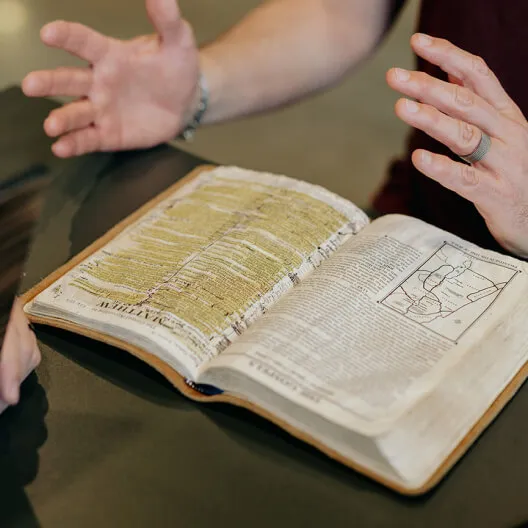


Daily Bible Devotionals


Psalm 117
“Praise the Lord, all you Gentiles! Laud Him, all you peoples! For His merciful kindness is great toward us, and the truth of the Lord endures forever. Praise the Lord!” Psalm 117:1-2 (NKJV)
You have probably heard of the literary term “oxymoron.” An oxymoron is a figure of speech in which apparently contradictory terms appear in conjunction. For instance, “Jumbo Shrimp.” How can something be jumbo and shrimpy at the same time? How about “deafening silence”? How can something silent be deafening? Or, “atom bomb”? Can something with the smallest physical component create the largest explosion? Describing today’s Psalm involves a bit of an oxymoron. Psalm 117 is atomic in size. In two short verses (the smallest chapter in the Bible) yet, it communicates a mushroom cloud of theology! Its message: Gentiles should praise the Lord because His kindness and His Word (truth) endure forever. In short, Gentiles can have a relationship with the Lord, too!
Somehow, throughout the generations, that message has gotten lost on the Jewish community. The understanding of God’s covenant promises among most religious Jewish people does not leave much room for His blessing of the Gentiles. Perhaps, some rabbis may concede that after the flood of Noah, God made general promises to all mankind, but they hold to the belief that the Jewish soul has the unique capacity to know God personally. They reject the idea that Gentiles could enter into the same relationship with the Lord. That idea of nationalism and racism permeated Jewish culture, even in the days of the Apostle Paul. Paul declared that his former zealousness for Judaism had kept him from seeing the “mystery” of the Scripture, namely, Messiah’s true mission, and that Gentiles could receive eternal salvation along with Jews who received Messiah Jesus as Lord.
“ I now rejoice in my sufferings for you, and fill up in my flesh what is lacking in the afflictions of Christ, for the sake of His body, which is the church, of which I became a minister according to the stewardship from God which was given to me for you, to fulfill the word of God, the mystery which has been hidden from ages and from generations, but now has been revealed to His saints. To them God willed to make known what are the riches of the glory of this mystery among the Gentiles: which is Christ in you, the hope of glory. Him we preach, warning every man and teaching every man in all wisdom, that we may present every man perfect in Christ Jesus. To this end I also labor, striving according to His working which works in me mightily.” Colossians 1:24-29 (NKJV)
“For I do not desire, brethren, that you should be ignorant of this mystery, lest you should be wise in your own opinion, that blindness in part has happened to Israel until the fullness of the Gentiles has come in. And so all Israel will be saved, as it is written: ‘The Deliverer will come out of Zion, and He will turn away ungodliness from Jacob; for this is My covenant with them, when I take away their sins.’” Romans 11:25-27 (NKJV)

Psalm 119
“Blessed are the undefiled in the way, who walk in the law of the Lord! Blessed are those who keep His testimonies, who seek Him with the whole heart! They also do no iniquity; they walk in His ways. You have commanded us to keep Your precepts diligently.” Psalm 119:1-4 (NKJV)
Since entire books have been written about Psalm 119, it would be impossible to offer an exhaustive commentary within the confines of this daily devotional format. So, here’s our takeaway. Psalm 119 used the Hebrew alphabet to teach a lesson on the utmost centrality of God’s Word to righteous living while using the message of the importance of God’s Word in order to teach the alphabet! In that sense, the truths of God’s Word are truly shallow enough for children to wade in, yet deeper than any theologian could fathom! We are left with the knowledge that blessing and joy are inseparable from our diligent pursuit of godliness, as detailed in the Bible.
“Blessed is the man who walks not in the counsel of the ungodly, nor stands in the path of sinners, nor sits in the seat of the scornful; but his delight is in the law of the Lord, and in His law he meditates day and night.” Psalm 1:1-2 (NKJV)
“And these words which I command you today shall be in your heart. You shall teach them diligently to your children, and shall talk of them when you sit in your house, when you walk by the way, when you lie down, and when you rise up.” Deuteronomy 6:6-7 (NKJV)
Here we find a partnership between our pursuit of God’s Word and His revelation to us; our returning and His responding. (Zechariah 1:3; Lamentations 5:21)
“Teach me, O Lord, the way of Your statutes, and I shall keep it to the end. Give me understanding, and I shall keep Your law; indeed, I shall observe it with my whole heart. Make me walk in the path of Your commandments, for I delight in it. Incline my heart to Your testimonies, and not to covetousness. Turn away my eyes from looking at worthless things, and revive me in Your way. Establish Your word to Your servant, who is devoted to fearing You. Turn away my reproach which I dread, for Your judgments are good. Behold, I long for Your precepts; revive me in Your righteousness. Psalm 119:33-40 (NKJV)
“Your word is a lamp to my feet and a light to my path. I have sworn and confirmed that I will keep Your righteous judgments. I am afflicted very much; revive me, O Lord, according to Your word. Accept, I pray, the freewill offerings of my mouth, O Lord, and teach me Your judgments. My life is continually in my hand, yet I do not forget Your law. The wicked have laid a snare for me, yet I have not strayed from Your precepts. Your testimonies I have taken as a heritage forever, for they are the rejoicing of my heart. I have inclined my heart to perform Your statutes forever, to the very end.” Psalm 119:105-112 (NKJV)
Psalm 120
“In my distress I cried to the Lord, and He heard me. Deliver my soul, O Lord, from lying lips and from a deceitful tongue. What shall be given to you, or what shall be done to you, you false tongue? Sharp arrows of the warrior, with coals of the broom tree! Woe is me, that I dwell in Meshech, that I dwell among the tents of Kedar! My soul has dwelt too long with one who hates peace. I am for peace; but when I speak, they are for war.” Psalm 120:1-7 (NKJV)
Today’s psalm begins a collection of 15 psalms known as the “Songs of Ascent.” These are psalms the Jewish people sang on their journey to worship in Jerusalem, the “city on a hill.” There were three times/year that God commanded all Jewish men to “go up” (ascend) and worship Him in Jerusalem: Passover, Shavuot (Pentecost), and Sukkot (Festival of Booths). These songs would be the soundtrack to their pilgrimage. Most of them cover a familiar pattern of conflict, reflection on God, and worship. In that sense, we can relate to these songs because they convey the same process of reflection we go through whenever we go to church with our issues. And we WILL have conflict in this life. Jesus promised as much.
“Remember the word that I said to you, ‘A servant is not greater than his master.’ If they persecuted Me, they will also persecute you. If they kept My word, they will keep yours also.’” John 15:20 (NKJV)
The Songs of Ascent help us remember that the peace that “passes understanding” is not the absence of conflict but the presence of peace in the midst of conflict.
“Let your gentleness be known to all men. The Lord is at hand. Be anxious for nothing, but in everything by prayer and supplication, with thanksgiving, let your requests be made known to God; and the peace of God, which surpasses all understanding, will guard your hearts and minds through Christ Jesus.” Philippians 4:5-7 (NKJV)
I heard one pastor say that Jesus did not come to get us out of trouble as much as He came to get into trouble with us! As we “go up” to worship, it is important that our petitions for justice (concerning unjust treatment from people who oppose Christ in us) must be measured with the understanding that Jesus, our Advocate (1 John 2:1), also prays for us. And even though we cannot see Him, He has promised never to leave or forsake us. (Psalm 23; Hebrews 13:5)
“I do not pray that You should take them out of the world, but that You should keep them from the evil one.” John 17:15 (NKJV)
So, while we are called by grace to be His witnesses to the lost and dying, His grace involves both our serving and suffering. Still, He is presently with us, in the midst of our suffering, the Guarantor of our victory in what He has called us to accomplish in His Name, for His glory and by the power of His Spirit! And there is peace in that.
Psalm 121
“I will lift up my eyes to the hills - from whence comes my help? My help comes from the Lord, Who made heaven and earth. He will not allow your foot to be moved; He who keeps you will not slumber. Behold, He who keeps Israel shall neither slumber nor sleep.” Psalm 121:1-4 (NKJV)
A while back, I got a rather frantic call from my wife, “Stephen, the refrigerator is broken; it is defrosting and leaking all over the kitchen floor!” Of course, I rushed home, but upon further inspection, I discovered the unit was cooling properly. The source of the running water was a faulty water filter for the icemaker we had recently replaced. In order to save money, we decided to buy an off-brand filter instead of the manufacturer’s filter. Now, we had a pool of water on the floor. Lesson learned!
Israel had abandoned her “manufacturer,” the God of all creation. The writer of Psalm 121, who warned against aftermarket gods, was very concerned. We must remember that this is a “song of ascent.” And as the worshipper was making his journey to Jerusalem, he looked at the hills to the right and left of the road and spied the pagan shrines way up high. Many of his countrymen had compromised their beliefs and stopped short of God’s standard, choosing to sort of worship God but to do so through pagan ways. Folks, compromised worship is never true worship! No, the Jesus follower on his pilgrimage was to be reminded that his help comes not from a man-made religion propped atop a high place but from the One Who is above all creation, the Maker of heaven and earth. God neither sleeps nor loses focus on us. He remains ever watchful, even as we are journeying through difficult circumstances.
“The Lord is your keeper; the Lord is your shade at your right and. The sun shall not strike you by day, nor the moon by night.” Psalm 121:5-6 (NKJV)
Having personally made that shade-less journey from the Judean desert up to Jerusalem, with the fierce hot sun beating down upon me, I can attest to how the average person could be convinced to cut short their trip before reaching their destination. A cool drink of water and the empty promises of pagan worship (to minister to the parched and tired flesh) would seem very enticing in that noonday sun when temperatures soar well over 100 degrees. Or, what if you departed later in the day to avoid the heat, but the moon was not full so that you may lose your way? The pilgrim was to remember that God is our shade and our keeper, day and night.
“The Lord shall preserve you from all evil; He shall preserve your soul. The Lord shall preserve your going out and your coming in from this time forth, and even forevermore.” Psalm 121:7-8 (NKJV)
Consider Jesus’ prayer over us: “I do not pray that You should take them out of the world, but that You should keep them from the evil one.” John 17:15 (NKJV)
Psalm 122
“I was glad when they said to me, ‘Let us go into the house of the Lord.’” Psalm 122:1 (NKJV)
It may surprise you, but my favorite place to worship and study the Bible (and write these Bible devotionals) is not in church. I prefer somewhere more comfortable, like a coffeehouse. When I share that with people, they often ask how I can focus in a coffeehouse with all the people talking, the beans grinding, and the espresso machines hissing away. But you see, I have four children, so I can tune out anything and focus on the voice of the Spirit! That being said, there are times when the best place to worship is in the assembly of other believers at church. Nothing compares to the experience of being in a room packed full of Christians, all of us praising and seeking the Lord together. That is precisely what David is communicating. It is not as if David could not write psalms and pray anywhere else. But when the people of God congregate, something transcendent happens, and we get a glimpse of heaven. That is what the New Testament writer of Hebrews was trying to communicate.
“And let us consider one another in order to stir up love and good works, not forsaking the assembling of ourselves together, as is the manner of some, but exhorting one another, and so much the more as you see the Day approaching.” Hebrews 10:24-25 (NKJV)
“Our feet have been standing within your gates, O Jerusalem! Jerusalem is built as a city that is compact together, where the tribes go up, the tribes of the Lord, to the Testimony of Israel, to give thanks to the name of the Lord. For thrones are set there for judgment, the thrones of the house of David.” Psalm 122:2-5 (NKJV)
The “Testimony of Israel” (aka: “tabernacle of witness”) is another name for the tabernacle, the portable tent of worship that traveled wherever the Lord led the Israelites. It is the Testimony because, from there, God spoke to Moses, Joshua, and the religious leaders, and they all bore witness of His Word. The Menorah, altars, and Ark of the Covenant were also there. It stood as a physical witness of God’s presence that the people could look upon and be strengthened in their faith, remembering that the Lord had chosen to be among them, articulate how they could serve and please Him, and be assured that He would deliver them. (See also: Acts 7:44-50; Exodus 38:21; Numbers 1:50; 17:7-8)
“Pray for the peace of Jerusalem: ‘May they prosper who love you. Peace be within your walls, prosperity within your palaces.’ For the sake of my brethren and companions, I will now say, ‘Peace be within you.’ Because of the house of the Lord our God I will seek your good.” Psalm 122:6-9 (NKJV)
As one ascended to worship the Lord in Jerusalem (after all, this is a song of Ascents), they were reminded that their peace (and the peace of the nation) would only be found in meeting with the Lord, as He instructed, in the place of His choice.
Psalm 123
“Unto You I lift up my eyes, O You who dwell in the heavens.” Psalm 123:1 (KNJV)
Sunday mornings can be some of the most stressful times for Christian families. At least it is for mine. It never ceases to amaze me how we can awaken children five days in a row throughout the week, get them dressed, fed, and safely to school on time by 8 am without a hitch. Yet it’s like WW III to get to church by 11 am on Sunday! There can be no excuse other than spiritual warfare.
But a few blocks away from church, you spy the steeple peering out from the neighborhood trees or city billboards, and your heart begins to soften. You pull into the parking lot and begin to see familiar faces, and you soften a little more. Drop off the kids and walk with friends to a life group or the sanctuary, the music starts playing, and the burdens start dropping all around you. Transcendence. You are becoming aware that you are in the presence of the ever-present God.
I love how the psalmist, on his ascent to meet with the Lord in His temple, acknowledges that God does not live in the temple, per se. He dwells in the heavens. So, no matter where you wander (or are driven), just look up. The God Who dwells in the heavens is with you, your ever-present help in time of need. (Psalm 46:1)
“Behold, as the eyes of servants look to the hand of their masters, as the eyes of a maid to the hand of her mistress, so our eyes look to the Lord our God, until He has mercy on us.” Psalm 123:2 (NKJV)
Perhaps, you have heard the phrase, “beckon call”? That phrase has been modernized from its original “beck and call.” Of course, we all know that a call is a verbal command, but the ancient word “beck” refers to a very slight motion of the hand, almost a secret signal. The ultimate sign of discipline and respect would be when a ruler’s servants knew him so well that even the slightest twitch of the finger could fulfill his wishes without a word. That is how intently we should seek the Lord and His Word daily so that we could rightly discern the times in which we live and how we should serve Him at any moment, recalling His Word stored in our hearts. We should learn to love what He loves and disdain what He hates in the moment, sensing and knowing the Spirit’s desire without having to ask.
“Have mercy on us, O Lord, have mercy on us! For, we are exceedingly filled with contempt. Our soul is exceedingly filled with the scorn of those who are at ease, with the contempt of the proud.” Psalm 123:3-4 (NKJV)
The “beck” of the Lord could signal either blessing or rebuke. That is the concern of the psalmist, who is among the devout remnant in Israel. Will the Lord’s rebuke of the national downward moral trend (toward idolatry) produce collateral damage to those who have repented? God presides over and preserves His faithful children, but His desire (thus, ours should be) is for all to repent. (2 Peter 3:9)
Psalm 124
“‘If it had not been the Lord who was on our side,’ let Israel now say – ‘If it had not been the Lord who was on our side, when men rose up against us, then they would have swallowed us alive, when their wrath was kindled against us; then the waters would have overwhelmed us, the stream would have gone over our soul; then the swollen waters would have gone over our soul.’” Psalm 124:1-5 (NKJV)
The Passover seder is an annual traditional Jewish meal where the ordered re-telling of the Passover story occurs over a special dinner. During that meal, just after the Exodus plagues against Egypt have been recounted, comes a moment of reflection called “Dayenu” (pr: die-A-new). Dayenu means, “It would have been enough for us.” The purpose of the Dayenu section is to reflect on how God delivers over and above what we could have imagined. Traditionally, there are 15 Dayenu verses recounted. After each verse, those gathered around the seder table would say, “Dayenu!” meaning, “It would have been enough!”
Five Stanzas of Leaving Slavery
1) If He had brought us out of Egypt. (Dayenu!)
2) If He had executed justice upon the Egyptians. (Dayenu!)
3) If He had executed justice upon their gods. (Dayenu!)
4) If He had slain their firstborn. (Dayenu!)
5) If He had given to us their health and wealth. (Dayenu!)
Five Stanzas of Miracles
6) If He had split the sea for us. (Dayenu!)
7) If He had led us through on dry land. (Dayenu!)
8) If He had drowned our oppressors. (Dayenu!)
9) If He had provided for our needs in the wilderness for 40 years. (Dayenu!)
10) If He had fed us manna. (Dayenu!)
Five Stanzas of Being With God
11) If He had given us Shabbat. (Dayenu!)
12) If He had led us to Mount Sinai. (Dayenu!)
13) If He had given us the Torah. (Dayenu!)
14) If He had brought us into the land of Israel. (Dayenu!)
15) If He built the Temple for us. (Dayenu!)
Christians could easily say, “Had Jesus paid our sin debt but not filled us with His Spirit, Dayenu! Had He filled us with His Spirit but not given us the Fruit of the Spirit, Dayenu! Had He given us the Fruit of His Spirit but not prepared a place for us in heaven, Dayenu!” etc. This is the same idea David conveys in Psalm 124: God has delivered His people, and it would have been enough, but He just keeps going!
“Blessed be the Lord, who has not given us as prey to their teeth. Our soul has escaped as a bird from the snare of the fowlers; the snare is broken, and we have escaped. Our help is in the name of the Lord, Who made heaven and earth.” Psalm 124:6-8 (NKJV)
Psalm 126
“When the Lord brought back the captivity of Zion, we were like those who dream. Then our mouth was filled with laughter, and our tongue with singing. Then they said among the nations, ‘The Lord has done great things for them.’ The Lord has done great things for us, and we are glad.” Psalm 126:1-3 (NKJV)
Don’t you love it when a plan comes together? Jeremiah had prophesied that the time of Israel and Judah’s captivity would be 70 years, and exactly 70 years later, King Cyrus decreed that the Jews could return to Jerusalem and rebuild the Temple.
“Thus says Cyrus king of Persia: All the kingdoms of the earth the Lord God of heaven has given me. And He has commanded me to build Him a house at Jerusalem which is in Judah. Who is among you of all His people? May his God be with him, and let him go up to Jerusalem which is in Judah, and build the house of the Lord God of Israel (He is God), which is in Jerusalem. And whoever is left in any place where he dwells, let the men of his place help him with silver and gold, with goods and livestock, besides the freewill offerings for the house of God, which is in Jerusalem. Then the heads of the fathers’ houses of Judah and Benjamin, and the priests and the Levites, with all whose spirits God had moved, arose to go up and build the house of the Lord, which is in Jerusalem. And all those who were around them encouraged them with articles of silver and gold, with goods and livestock, and with precious things, besides all that was willingly offered.” Ezra 1:2-6 (NKJV)
Upon first hearing Cyrus’ decree permitting their return to Jerusalem, the Jewish people who were inclined to return could not believe it! It was like a dream, but then they laughed and eventually sang! It is exactly how I would react if the Publisher’s Clearinghouse folks showed up at my front door with one of those huge golf tournament-sized checks!! Disbelief turns to rejoicing! Can you imagine singing this song as you were making your ascent to worship in Jerusalem, especially if, last year, you were a slave in Babylon? Unbelievable, yet completely doable with God. Even the Gentiles were amazed. And that is our lesson, isn’t it? NEVER GIVE UP ON GOD because He never gives up on you. Notice how the psalmist moves from the rejoicing of the remnant to longing for revival among those who have yet to return.
“Bring back our captivity, O Lord, as the streams in the South.” Psalm 126:4 (NKJV)
Oh, that such a spirit could grip the believers of our nation, a country so desperately in need of revival! Let our songs of rejoicing be mixed with pleas for revival, so our countrymen could rejoice in salvation, as well. Lord, let our friends and neighbors who sow tears today reap a harvest of joy by this time next year!
“Those who sow in tears shall reap in joy. He who continually goes forth weeping, bearing seed for sowing, shall doubtless come again with rejoicing, bringing his sheaves with him.” Psalm 126:5-6 (NKJV)
Psalm 127
“Unless the Lord builds the house, they labor in vain who build it; unless the Lord guards the city, the watchman stays awake in vain. It is vain for you to rise up early, to sit up late, to eat the bread of sorrows; for so He gives His beloved sleep.” Psalm 127:1-2 (NKJV)
I remember the first time I heard the words of the bluesman, the Reverend Dan Smith, “Any man, if he knows how, can take a set of tools and build him a house. But God has to build a home.” (“It Takes God To Build A Home,” Glasshouse Records 1992). I was living in a grand old home myself, in midtown Memphis, a few blocks away from the old French Quarter hotel, when that song came floating down the hallway from a roommate’s stereo. Smith was singing today’s psalm. Written by King Solomon around the time of the Temple’s dedication, Psalm 127 begins by deflecting people’s attention from the architecture and focusing them on the “Architect,” the Lord. Of course, Solomon had overseen the construction, and it would have been easy for him to attribute the Temple’s importance to his wisdom.
Solomon lets everyone know the security of the nation does not rest in its defense department but in its “Defender.” Kind David had built-up the military, but peace does not rest in an overwhelming number of horses & chariots. It rests in the “Prince of Peace,” Messiah Himself.
Or, suppose you feel that your religious devotion will save you: “eating the bread of sorrows” is a reference to observing Passover, eating the unleavened matzo bread. No, our holiness does not come from our devotion to God but in the God who is devoted to us…in that while we were yet sinners, He chose to give His life for us. (Romans 5:8)
The “houses” of Israel (that need the Lord’s building) refer to the Temple, the nation, and the family.
“Behold, children are a heritage from the Lord, the fruit of the womb is a reward. Like arrows in the hand of a warrior, so are the children of one’s youth. Happy is the man who has his quiver full of them; they shall not be ashamed, but shall speak with their enemies in the gate.” Psalm 127:3-5 (NKJV)
I love the imagery of a “quiver” of children. Children are like arrows that we attach our values and shoot into the future. If we build our homes by our own counsel, what kind of values do we shoot into the future? (Psalm 1:1-2) But if we diligently teach our children God’s Word, we not only fortify this generation, but we ensure the future welfare of our descendants, the Church, and our nation.
“And these words which I command you today shall be in your heart. You shall teach them diligently to your children, and shall talk of them when you sit in your house, when you walk by the way, when you lie down, and when you rise up.” Deut 6:6-7 (NKJV)
Psalm 128
“Blessed is every one who fears the Lord, who walks in His ways.” Psalm 128:1 (NKJV)
We know there is a direct link between our blessing and our seeking God’s Word.
“Blessed is the man who walks not in the counsel of the ungodly, nor stands in the path of sinners, nor sits in the seat of the scornful; but his delight is in the law of the Lord, and in His law he meditates day and night. He shall be like a tree planted by the rivers of water, that brings forth its fruit in its season, whose leaf also shall not wither; and whatever he does shall prosper.” Psalm 1:1-3 (NKJV)
Because blessing is so closely linked to God’s Word, we are safe to assume that walking in the counsel of the Bible is the same as “fearing the Lord” to the extent that we are obeying it (walking in His ways).
“When you eat the labor of your hands, you shall be happy, and it shall be well with you.” Psalm 128:2 (NKJV)
When we live according to God’s Word, we do not solely apply it to our lives; the Bible becomes the center of our lives, the lens through which we view the world, and the filter that governs every conversation. Even the labor of our hands (the fruit of our labor) brings us joy in the Lord because we are continuously reminded that it is God Who works on our behalf as we go about our daily tasks.
“And these words which I command you today shall be in your heart. You shall teach them diligently to your children, and shall talk of them when you sit in your house, when you walk by the way, when you lie down, and when you rise up.” Deuteronomy 6:6-7 (NKJV)
A father who seeks the Lord imparts the Word to his family. This is how God’s blessing radiates throughout the entire household.
“Your wife shall be like a fruitful vine in the very heart of your house, your children like olive plants all around your table.” Psalm 128:3 (NKJV)
Finally, we have the source of blessing, the Proverbs 31 wife: A marriage where both husband and wife are seeking the Lord.
“Behold, thus shall the man be blessed who fears the Lord. The Lord bless you out of Zion, and may you see the good of Jerusalem all the days of your life. Yes, may you see your children’s children. Peace be upon Israel!” Psalm 128:4-6 (NKJV)
Commandment 5: “Honor your father and your mother, as the Lord your God has commanded you, that your days may be long, and that it may be well with you in the land which the Lord your God is giving you.” Deuteronomy 5:16 (NKJV)
Psalm 129
"‘Many a time they have afflicted me from my youth,’ let Israel now say – ‘Many a time they have afflicted me from my youth; yet they have not prevailed against me. The plowers plowed on my back; they made their furrows long.’"Psalm 129:1-3 (NKJV)
“Yet they have not prevailed...” We would prefer a more hopeful message, one that eliminated our enemies altogether. At least, I would. All believers must cope with the problem of pain and injustice. We long for peace that passes understanding (Philippians 4:7), but we define such peace in terms of a total lack of spiritual opposition. In reality, the peace that passes understanding is not the absence of conflict; it is the presence of peace in the midst of overwhelming conflict. The apostle Paul tried to convey that exact message to the early church in Rome.
“Who shall separate us from the love of Christ [Messiah]? Shall tribulation, or distress, or persecution, or famine, or nakedness, or peril, or sword? As it is written: ‘For Your sake we are killed all day long; we are accounted as sheep for the slaughter.’ Yet in all these things we are more than conquerors through Him who loved us. For I am persuaded that neither death nor life, nor angels nor principalities nor powers, nor things present nor things to come, nor height nor depth, nor any other created thing, shall be able to separate us from the love of God which is in Christ Jesus our Lord.” Romans 8:35-39 (NKJV)
As the Jewish worshippers were approaching Jerusalem, they sang the words of this psalm, words based in both the reality of their suffering and the reality of their hope. “He who is in you is greater than he who is in the world.” (1 John 4:4b) (NKJV)
We must remember that both our suffering and our tormentors are only for a season. Every season comes to pass, which means they do not come to stay.
”The Lord is righteous; He has cut in pieces the cords of the wicked. Let all those who hate Zion be put to shame and turned back. Let them be as the grass on the housetops, which withers before it grows up, with which the reaper does not fill his hand, nor he who binds sheaves, his arms.” Psalm 129:4-7 (NKJV)
“The grass withers, the flower fades, because the breath of the Lord blows upon it; surely the people are grass. The grass withers, the flower fades, but the Word of our God stands forever.” Isaiah 40:7-8 (NKJV)
Those who curse God’s people will receive no blessing, no comfort. For them, are reserved the words of Jesus: “Turn away! I never knew you.” (Matthew 7:21-23)
“Neither let those who pass by them say, ‘The blessing of the Lord be upon you; we bless you in the name of the Lord!’” Psalm 129:8 (NKJV)
“I will bless those who bless you, and I will curse him who curses you; and in you all the families of the earth shall be blessed.” Genesis 12:3 (NKJV)
Psalm 130
“Out of the depths I have cried to You, O Lord; Lord, hear my voice! Let Your ears be attentive to the voice of my supplications.” Psalm 130:1-2 (NKJV)
Today we have another “song of ascents,” meant to be sung as the Jewish people were ascending to worship in Jerusalem, the “city on a hill.” (Matthew 5:14-16) So, picture the worshipper “ascending” to Jerusalem and crying to God from “out of the depths.” What depths? Specific to this psalmist, the depths of his personal sin! Now, that is a message to which we can all relate because we each sin and must reconcile with the Holy God. I am not speaking about being reconciled to Him for our eternal salvation; Jesus has reconciled us to God by His works, not ours. No, I am talking about walking through life with the joy and peace of knowing there is not a reckoning awaiting us as the consequence for some ongoing sin that we are harboring, yet refusing to confront and surrender to the Holy Spirit’s leading.
“If You, Lord, should mark iniquities, O Lord, who could stand?” Psalm 130:3 (NKJV)
This is the great human conundrum. How can sinful man commune with a holy God? If God solely operates within His holy judgment, we are hopeless.
“But there is forgiveness with You, that You may be feared.” Psalm 130:4 (NKJV)
God, knowing we are merely human (by virtue of His holiness), has provided a way of forgiveness for us. And He made it easy by making only ONE way of salvation through which all men everywhere must be saved: Messiah Jesus. (John 3:16; John 14:6; Acts 17:24-31; Acts 4:12) ONE way, yet accessible to ANYONE who wants it.
“I wait for the Lord, my soul waits, and in His Word I do hope. My soul waits for the Lord more than those who watch for the morning - yes, more than those who watch for the morning.” Psalm 130:5-6 (NKJV)
Since Messiah Jesus is eternal, we sometimes need reminding that He existed in eternity past, as well as the fact that He will exist in eternity-future. (John 1:1-14; Micah 5:2; 1 Corinthians 10:1-6) He is the source of salvation throughout History; before we knew Messiah Jesus as the Word-made-flesh or the Living Word, He existed as a member of the Trinity. Today’s psalmist is expecting forgiveness and salvation as he journeys to Jerusalem. How so? Because of his faith in the Word of God and its promises to repentant sinners. (Romans 10:17)
“O Israel, hope in the Lord; for with the Lord there is mercy, and with Him is abundant redemption. And He shall redeem Israel from all his iniquities.” Psalm 130:7-8 (NKJV)
The plea is for all men everywhere to repent, trust in the Living Word, and be saved!
Psalm 131
“Lord, my heart is not haughty, nor my eyes lofty. Neither do I concern myself with great matters, nor with things too profound for me. Surely I have calmed and quieted my soul, like a weaned child with his mother; like a weaned child is my soul within me. O Israel, hope in the Lord from this time forth and forever.” Psalm 131:1-3 (NKJV)
If you want to start a brawl in the women’s ministry, start asserting your opinions concerning the when’s, where’s, and extent of breastfeeding! My wife breastfed all of our children, and we have heard about every opinion on the subject from every angle imaginable. The reason I mention that is because David's use of the image of “weaning” brought to mind an experience my wife and I had at a restaurant many years ago. Our oldest son was about five, and our daughter was a toddler. A couple of moms were in conversation at the table next to ours, and our children were chatting with theirs. But as the moms talked, one of the children, about my son’s age, kept interrupting and obsessively pawing at his mom. Finally, mid-conversation, the mom snatched up her kindergarten-aged boy and started breastfeeding him. My son glanced up at us and defined the moment with one whispered word: “Awkward.”
I share that story because it illustrates the exact point that David is making: the difference between a weaned and un-weaned child sitting next to their mothers. Before a child is weaned, the experience of feeding goes way beyond nutritional needs. There is an essential personal emotional, and nurturing bond that naturally occurs through the process of breastfeeding. But, by a certain age (which may vary for each child), what was once natural and nurturing becomes more akin to anxious and abnormal cravings that signal stalled maturity. The apostle Paul and the writer of the New Testament book of Hebrews used the same imagery to describe similar dysfunctions in stalled discipleship maturity among followers of Jesus.
“And I, brethren, could not speak to you as to spiritual people but as to carnal, as to babes in Christ. I fed you with milk and not with solid food; for until now you were not able to receive it, and even now you are still not able; for you are still carnal. For where there are envy, strife, and divisions among you, are you not carnal and behaving like mere men?” 1 Corinthians 3:1-3 (NKJV)
“For though by this time you ought to be teachers, you need someone to teach you again the first principles of the oracles of God; and you have come to need milk and not solid food. For everyone who partakes only of milk is unskilled in the word of righteousness, for he is a babe.” Hebrews 5:12-13 (NKJV)
In Psalm 131, David is saying that he used to be haughty, with “lofty eyes,” but, like a weaned child, he had matured to a calm and quieted soul. His faith had grown so that his worship was no longer self-focused. Have you matured past seeking God for what He can do for you to the point where you ask how you can serve Him?
Psalm 133
“Behold, how good and how pleasant it is for brethren to dwell together in unity!” Psalm 133:1 (NKJV)
It is important to remember that Psalm 133 is a "Song of Ascents." These songs were written (or at least utilized) to prepare a person’s heart for worship at the Temple (or Tabernacle in David’s day) in Jerusalem. If you recall the narrative of King David’s life, how he was hunted by Saul and the army of Israel, it is easy to understand why David would find it important to remind the children of Israel to dwell in unity. Once David became king, he went the “extra mile” to communicate that he was more interested in a peaceful nation than getting revenge on his enemies. His psalm is akin to the war cry of the American revolutionary patriots, “United we stand, divided we fall!” Jesus also preached this message of unity.
“By this all will know that you are My disciples, if you have love for one another.” John 13:35 (NKJV)
Likewise, the apostles Paul and Peter exhorted the young church:
“Therefore if there is any consolation in Christ, if any comfort of love, if any fellowship of the Spirit, if any affection and mercy, fulfill my joy by being like-minded, having the same love, being of one accord, of one mind.” Philippians 2:1-2 (NKJV)
“Finally, all of you be of one mind, having compassion for one another; love as brothers, be tenderhearted, be courteous; not returning evil for evil or reviling for reviling, but on the contrary blessing, knowing that you were called to this, that you may inherit a blessing.” 1 Peter 3:8-9 (NKJV)
I love the image that David uses, anointing oil being poured on Aaron’s head, the first high priest of Israel. David is communicating that the willingness to forgive and serve one another is akin to a priestly role of the highest degree!
“It is like the precious oil upon the head, running down on the beard, the beard of Aaron, running down on the edge of his garments.” Psalm 133:2 (NKJV)
Furthermore, if the Israelites would act in unity (united by God’s Word), then God would bless their land. The image of blessing that David evokes is of the highest mountain in Israel, where the rainfall-runoff feeds the Jordan and waters the nation.
“It is like the dew of Hermon, descending upon the mountains of Zion; for there the Lord commanded the blessing - life forevermore.” Psalm 133:3 (NKJV)
If we humble ourselves to seek and obey God’s Word, we will serve one another and live in unity. In turn, God will bless any nation whose citizens unite under His Lordship with miraculous blessings flowing down to His people!
Psalm 134
“Behold, bless the Lord, all you servants of the Lord, who by night stand in the house of the Lord!” Psalm 134:1 (NKJV)
The Lord’s Temple in Jerusalem never closed. There was no sign that hung in the window by the entrance with a little clock on it, the hands turned to a particular time with “Be back at ____ pm” scribbled on the bottom with a dry-erase marker. No, the Temple was open day and night. That meant that the Temple was fully staffed 24-7. Because of the constant flow of ministry, the Levites who led the music were exempt from any other duty.
“These are the singers, heads of the fathers’ houses of the Levites, who lodged in the chambers, and were free from other duties; for they were employed in that work day and night.” 1 Chronicles 9:33 (NKJV)
Today’s psalm, #134, was a shout-out to the Levites on the night shift. Who knows if they were on a scheduled rotation or if the low-level guys had to work their way up to the day shift? We just know that the worship music was more of a never-ending jam session. Perhaps, some of the Levites dreaded the non-stop ministry pace. Most church staffers would. But when the Babylonians destroyed the Temple, I bet they wished they had their old jobs back. At least, it helps us to understand the depth of their great lament in Psalm 137 when the Levites who served in the temple hung their harps in the trees of Babylon because they no longer had a temple where they could serve.
“By the rivers of Babylon, there we sat down, yea, we wept when we remembered Zion. We hung our harps upon the willows in the midst of it. For there those who carried us away captive asked of us a song, and those who plundered us requested mirth, saying, ‘Sing us one of the songs of Zion!’ How shall we sing the Lord’s song in a foreign land?” Psalm 137:1-4 (NKJV)
Since this is a Psalm of Ascent, it also helps to set context for the pilgrim who arrived in Jerusalem at 3 am. There was nothing that delayed his worship. He didn’t have to search for a Motel 6 or wait for the banks to open so he could exchange his tithe for the requisite articles of worship. He and his family could go straight to the Lord!
“Lift up your hands in the sanctuary, and bless the Lord.” Psalm 134:2 (NKJV)
Imagine a packed Temple courtyard, day and night, with nothing hindering the people’s outpouring of thanks and worship!
“The Lord who made heaven and earth bless you from Zion!” Psalm 134:3 (NKJV)
Again, we have a reminder that not only were the people of Israel welcome, but the maker of heaven and earth desired for all nations to enter and worship! (Isaiah 56:3-8)
Psalm 135
“Praise the Lord! Praise the name of the Lord; praise Him, O you servants of the Lord! You who stand in the house of the Lord, in the courts of the house of our God, praise the Lord, for the Lord is good; sing praises to His name, for it is pleasant. For the Lord has chosen Jacob for Himself, Israel for His special treasure. For I know that the Lord is great, and our Lord is above all gods.” Psalm 135:1-5 (NKJV)
Today’s psalm is a call for the Israelites to give themselves wholly to worship by prompting their memories of how God’s deliverance (of Israel) from the hands of idolaters was also a judgment of idolatry itself. God accomplished two goals (delivering His people and judging foreign gods) with one motion.
The first half of Psalm 135 focuses on why Israel should worship the Lord passionately. It is not enough to simply tell people that God is great and worthy of our praise. We humans have no capacity to measure the greatness and holiness of God. We must experience desperation and deliverance before we can value the worth of grace and relish in the reality of salvation. That is why any gospel presentation must also contain the reality of our sin and the certainty of Hell. What makes the “Good News” so good is that the "bad news” is so bad! Jesus made this exact point to a self-righteous religious leader, in contrast to a woman who was aware of the greatness of her sin and the urgency of her needing forgiveness.
“Then He turned to the woman and said to Simon, ‘Do you see this woman? I entered your house; you gave Me no water for My feet, but she has washed My feet with her tears and wiped them with the hair of her head. You gave Me no kiss, but this woman has not ceased to kiss My feet since the time I came in. You did not anoint My head with oil, but this woman has anointed My feet with fragrant oil. Therefore I say to you, her sins, which are many, are forgiven, for she loved much. But to whom little is forgiven, the same loves little.’” Luke 7:44-47 (NKJV)
After recounting God’s judgment of Egypt’s gods (leading up to the Passover) and the gods of the Amorites and Canaanites, the psalmist expands the concept to include ALL other gods. It brings context to Jesus’ statements about “seeing and hearing.”
“The idols of the nations are silver and gold, the work of men’s hands. They have mouths, but they do not speak; eyes they have, but they do not see; they have ears, but they do not hear; nor is there any breath in their mouths. Those who make them are like them; so is everyone who trusts in them.” Psalm 135:15-18 (NKJV)
“Then He charged them, saying, ‘Take heed, beware of the leaven of the Pharisees and the leaven of Herod.’ And they reasoned among themselves, saying, ‘It is because we have no bread.’ But Jesus, being aware of it, said to them, ‘Why do you reason because you have no bread? Do you not yet perceive nor understand? Is your heart still hardened? Having eyes, do you not see? And having ears, do you not hear? And do you not remember?” Mark 8:15-18 (NKJV)
Psalm 136
“Oh, give thanks to the Lord of lords! For His mercy endures forever: To Him who alone does great wonders, for His mercy endures forever; to Him who by wisdom made the heavens, for His mercy endures forever; to Him who laid out the earth above the waters, for His mercy endures forever; to Him who made great lights, for His mercy endures forever - the sun to rule by day, for His mercy endures forever; the moon and stars to rule by night, for His mercy endures forever.” Psalm 136:3-9 (NKJV)
It is easy to think that today’s psalmist is speaking strictly about God the Father. That is because most of us are familiar with the Christmas nativity story of Jesus’ birth. But we must remember that before Jesus was born as a baby, He existed from eternity past. This is not some modern Christian idea. It was the understanding of the Jewish prophets that Messiah would be God, made flesh.
“But you, Bethlehem Ephrathah, though you are little among the thousands of Judah, yet out of you shall come forth to Me the One to be Ruler in Israel, Whose goings forth are from of old, from everlasting.” Micah 5:2 (NKJV), (See also: Isaiah 9:6)
When the apostle John began his gospel by boldly claiming Jesus’ deity, he was not inventing some new cultic myth. John was simply righting the Jewish understanding of the prophets’ message concerning Who Messiah would be. Messiah was not a human whom God would use to deliver His people; rather, God Himself donned humanity to deliver His people. We must read Psalm 136 thru the lens of John 1.
“In the beginning was the Word, and the Word was with God, and the Word was God. He was in the beginning with God. All things were made through Him, and without Him nothing was made that was made. In Him was life, and the life was the light of men. And the light shines in the darkness, and the darkness did not comprehend it. There was a man sent from God, whose name was John. This man came for a witness, to bear witness of the Light, that all through him might believe. He was not that Light, but was sent to bear witness of that Light. That was the true Light which gives light to every man coming into the world. He was in the world, and the world was made through Him, and the world did not know Him. He came to His own, and His own did not receive Him. But as many as received Him, to them He gave the right to become children of God, to those who believe in His name: who were born, not of blood, nor of the will of the flesh, nor of the will of man, but of God. And the Word became flesh and dwelt among us, and we beheld His glory, the glory as of the only begotten of the Father, full of grace and truth.” John 1:1-14 (NKJV) (**And we read the rest of Psalm 136 thru the lens of 1 Corinthians 10:1-4)
“Moreover, brethren, I do not want you to be unaware that all our fathers were under the cloud, all passed through the sea, all were baptized into Moses in the cloud and in the sea, all ate the same spiritual food, and all drank the same spiritual drink. For they drank of that spiritual Rock that followed them, and that Rock was Christ [Messiah].” 1 Corinthians 10:1-4 (NKJV)
Psalm 137
“By the rivers of Babylon, there we sat down, yea, we wept when we remembered Zion. We hung our harps upon the willows in the midst of it. For there those who carried us away captive asked of us a song, and those who plundered us requested mirth, saying, ‘Sing us one of the songs of Zion!’ How shall we sing the Lord’s song in a foreign land? If I forget you, O Jerusalem, let my right hand forget its skill! If I do not remember you, let my tongue cling to the roof of my mouth - if I do not exalt Jerusalem above my chief joy.” Psalm 137:1-6 NKJV
It helps set the context for the Israelite musical boycott if we recall how the Levite priestly musicians served before the Lord 24 hours/day, 7 days/week. (Psalm 134; 1 Chronicles 9:33) The demand for Jerusalem’s “greatest hits” from their Babylonian captors was more akin to mocking than a request from music aficionados. That is because all of the Levitical songs were about the power, majesty, and faithfulness of God, the same God Who allowed Israel to be taken captive! Not only did the Israelites refuse to play their harps, but they also prayed for vengeance.
“Remember, O Lord, against the sons of Edom the day of Jerusalem, who said, ‘Raze it, raze it, to its very foundation!’ O daughter of Babylon, who are to be destroyed,Happy the one who repays you as you have served us! Happy the one who takes and dashes your little ones against the rock!” Psalm 137:7-9 (NKJV)
The Jewish captives desired vengeance but knew vengeance was God’s job alone. (Deuteronomy 32:35; Romans 12:19-20) Faith in His Word was their only comfort.
“Thus says the Lord of hosts, the God of Israel, to all who were carried away captive, whom I have caused to be carried away from Jerusalem to Babylon: Build houses and dwell in them; plant gardens and eat their fruit. Take wives and beget sons and daughters; and take wives for your sons and give your daughters to husbands, so that they may bear sons and daughters—that you may be increased there, and not diminished. And seek the peace of the city where I have caused you to be carried away captive, and pray to the Lord for it; for in its peace you will have peace. For thus says the Lord of hosts, the God of Israel: Do not let your prophets and your diviners who are in your midst deceive you, nor listen to your dreams which you cause to be dreamed. For they prophesy falsely to you in My name; I have not sent them, says the Lord. For thus says the Lord: After seventy years are completed at Babylon, I will visit you and perform My good word toward you, and cause you to return to this place. For I know the thoughts that I think toward you, says the Lord, thoughts of peace and not of evil, to give you a future and a hope. Then you will call upon Me and go and pray to Me, and I will listen to you. And you will seek Me and find Me, when you search for Me with all your heart. I will be found by you, says the Lord, and I will bring you back from your captivity; I will gather you from all the nations and from all the places where I have driven you, says the Lord, and I will bring you to the place from which I cause you to be carried away captive.” Jeremiah 29:4-14 (NKJV)
Psalm 138
“I will praise You with my whole heart; before the gods I will sing praises to You. I will worship toward Your holy temple, and praise Your Name for Your lovingkindness and Your truth; for You have magnified Your Word above all Your Name. In the day when I cried out, You answered me, and made me bold with strength in my soul.” Psalm 138:1-3 (NKJV)
Boxer Mike Tyson said, “Everyone is a fighter until they get hit.” Christians may aspire to a life of humble service, but no one likes to be treated like a servant. We all want to be bold proclaimers of the gospel, but who takes the time to learn to articulately share their faith or risks relationships to see others come to faith? King David, the author of today’s Psalm, was not ashamed to proclaim the greatness of God. He did not feel the cultural pressure to be politically correct for fear of offending non-believers with his zeal for the Lord—quite the opposite. David praised the God of Israel (the One, true God) with his whole heart before the pagan gods.
It is one thing to worship the Lord in a church service, but are we so bold out there in a world where there may be no believers around you, and people may actually be hostile toward people of faith? The setting of today’s Psalm was not in the temple (or “Tabernacle” in David’s day). No, David was out among the pagans, praying “toward” God’s holy temple. It is the same level of boldness in the message that we are called to display, the kind that earns the great “Well done!” (Matthew 25:14-30)
“But sanctify the Lord God in your hearts, and always be ready to give a defense to everyone who asks you a reason for the hope that is in you, with meekness and fear; having a good conscience, that when they defame you as evildoers, those who revile your good conduct in Christ may be ashamed.” 1 Peter 3:15-16 (NKJV)
What was the source of David’s boldness? God’s Word! David was so confident in the Word of the Lord that he trusted it had the power to convert the souls of even pagan kings & nations!
“All the kings of the earth shall praise You, O Lord, when they hear the words of Your mouth. Yes, they shall sing of the ways of the Lord, for great is the glory of the Lord. Though the Lord is on high, yet He regards the lowly; but the proud He knows from afar.” Psalm 138:4-6 (NKJV)
What if David’s gospel message were to get him into trouble or even cost him his life? David was confident that the Lord could protect and revive him!
“Though I walk in the midst of trouble, You will revive me; You will stretch out Your hand against the wrath of my enemies, and Your right hand will save me. The Lord will perfect that which concerns me; Your mercy, O Lord, endures forever; do not forsake the works of Your hands.” Psalm 138:7-8 (NKJV)
Psalm 140
“Deliver me, O Lord, from evil men; preserve me from violent men, who plan evil things in their hearts; they continually gather together for war. They sharpen their tongues like a serpent; the poison of asps is under their lips. Keep me, O Lord, from the hands of the wicked; preserve me from violent men, who have purposed to make my steps stumble. – Selah” Psalm 140:1-3 (NKJV)
It is important to note that there have been evil men throughout history. And until Messiah returns, there will continue to be evil on earth. Just as David, the author of Psalm 140, was unjustly persecuted, so the “Son of David,” Jesus, was persecuted. Jesus told His disciples that anyone who follows Him will also be persecuted.
“If the world hates you, you know that it hated Me before it hated you. If you were of the world, the world would love its own. Yet because you are not of the world, but I chose you out of the world, therefore the world hates you. Remember the word that I said to you, ‘A servant is not greater than his master.’ If they persecuted Me, they will also persecute you. If they kept My word, they will keep yours also. But all these things they will do to you for My name’s sake, because they do not know Him who sent Me. If I had not come and spoken to them, they would have no sin, but now they have no excuse for their sin. He who hates Me hates My Father also. If I had not done among them the works which no one else did, they would have no sin; but now they have seen and also hated both Me and My Father. But this happened that the word might be fulfilled which is written in their law, ‘They hated Me without a cause.’” John 15:18-25 (NKJV)
This reality of persecution “for the sake of the gospel” is not popular in many pulpits these days. Preachers would rather focus on the more positive aspects of the gospel: grace, peace & love. While that type of preaching may draw a crowd, sadly, it draws a gasp in heaven because it leads people into false expectations of how the life of a believer should look. And it causes people to wrongly judge the presence of persecution in their lives (or in the lives of other believers). Under false teaching, if coming to faith means the end of hardship, then the presence of persecution must signal a departure from the faith. Persecution, then, becomes a signal of something the believer is doing WRONG when it actually signals what we are doing RIGHT!
In claiming the “promises” of Jesus, perhaps we should consider His promise of persecution/tribulation. (John 16:33) But knowing persecution is coming should not lead us to anxiety when we also know that Jesus not only predicted our persecution but also prayed for our ultimate protection & redemption.
“I have given them Your word; and the world has hated them because they are not of the world, just as I am not of the world. I do not pray that You should take them out of the world, but that You should keep them from the evil one.” John 17:14-15 (NKJV)
(Compare: Psalm 140:5-13 with Revelation 20:11-15; 21:1-8)
Psalm 141
“Lord, I cry out to You; make haste to me! Give ear to my voice when I cry out to You. Let my prayer be set before You as incense, the lifting up of my hands as the evening sacrifice. Set a guard, O Lord, over my mouth; keep watch over the door of my lips. Do not incline my heart to any evil thing, to practice wicked works with men who work iniquity; and do not let me eat of their delicacies.” Psalm 141:1-4 (NKJV)
Today’s psalm, number 141, is another composition of King David. We are very aware of both David’s triumphs against temptation and his failures to live righteously. Not that David was blame-shifting, per se, but we must quickly correct an error in his theology. God does not incline the hearts of people to do evil or practice “wicked works” or “eat of their delicacies.” While God allows situations to develop in our lives that bring us to moments of crisis, where we must choose to follow Him or cave into worldly pressure, He does not tempt us. Testing comes from God to show us the extent of our faith, but temptation is the world’s advertisement offering a means of escape from God’s testing. It’s a trap.
“Blessed is the man who endures temptation; for when he has been approved, he will receive the crown of life which the Lord has promised to those who love Him. Let no one say when he is tempted, ‘I am tempted by God’; for God cannot be tempted by evil, nor does He Himself tempt anyone. But each one is tempted when he is drawn away by his own desires and enticed. Then, when desire has conceived, it gives birth to sin; and sin, when it is full-grown, brings forth death.” James 1:12-15 (NKJV)
Again, the same scenario that Satan uses to tempt us, God intends to use to build our faith.
“My brethren, count it all joy when you fall into various trials, knowing that the testing of your faith produces patience. But let patience have its perfect work, that you may be perfect and complete, lacking nothing. If any of you lacks wisdom, let him ask of God, who gives to all liberally and without reproach, and it will be given to him. But let him ask in faith, with no doubting, for he who doubts is like a wave of the sea driven and tossed by the wind. For let not that man suppose that he will receive anything from the Lord; he is a double-minded man, unstable in all his ways.” James 1:2-8 (NKJV)
Now that we know the difference between a “trial” and “temptation” and how we should faithfully hold to the Word of God until He brings us through the trial, what happens if we succumb to temptation? What do we do then? We humble ourselves and receive correction from fellow believers. (Galatians 6:1; Proverbs 27:5-6) Confession and restoration are always better than concealing or denying our sin.
“Let the righteous strike me; it shall be a kindness. And let him rebuke me; it shall be as excellent oil; let my head not refuse it.” Psalm 141:5 (NKJV)
Psalm 142
“I cry out to the Lord with my voice; with my voice to the Lord I make my supplication. I pour out my complaint before Him; I declare before Him my trouble.” Psalm 142:1-2
“And they went to a place called Gethsemane. And he said to his disciples, ‘Sit here while I pray.’ And he took with him Peter and James and John, and began to be greatly distressed and troubled. And he said to them, ‘My soul is very sorrowful, even to death. Remain here and watch.’ And going a little farther, he fell on the ground and prayed that, if it were possible, the hour might pass from him. And he said, ‘Abba, Father, all things are possible for you. Remove this cup from me. Yet not what I will, but what you will.’” Mark 14:32-36
“When my spirit was overwhelmed within me, then You knew my path. In the way in which I walk they have secretly set a snare for me. Look on my right hand and see, for there is no one who acknowledges me; refuge has failed me; no one cares for my soul.” Psalm 142:3-4
“And immediately, while he was still speaking, Judas came, one of the twelve, and with him a crowd with swords and clubs, from the chief priests and the scribes and the elders. Now the betrayer had given them a sign, saying, ‘The one I will kiss is the man. Seize him and lead him away under guard.’ And when he came, he went up to him at once and said, ‘Rabbi!’ And he kissed him. And they laid hands on him and seized him. But one of those who stood by drew his sword and struck the servant of the high priest and cut off his ear. And Jesus said to them, ‘Have you come out as against a robber, with swords and clubs to capture me? Day after day I was with you in the temple teaching, and you did not seize me. But let the Scriptures be fulfilled.’ And they all left him and fled.” Mark 14:43-50
“I cried out to You, O Lord: I said, ‘You are my refuge, my portion in the land of the living. Attend to my cry, for I am brought very low; deliver me from my persecutors, for they are stronger than I.’” Psalm 142:5-6
“Now it was about the sixth hour, and there was darkness over all the earth until the ninth hour. Then the sun was darkened, and the veil of the temple was torn in two. And when Jesus had cried out with a loud voice, He said, ‘Father, into Your hands I commit My spirit.’ Having said this, He breathed His last. So when the centurion saw what had happened, he glorified God, saying, ‘Certainly this was a righteous Man!’” Luke 23:44-47
“Bring my soul out of prison, that I may praise Your name; the righteous shall surround me, for You shall deal bountifully with me.” Psalm 142:7
“Then, as they were afraid and bowed their faces to the earth, angels said, ‘Why do you seek the living among the dead? He is not here, but is risen!” Luke 24:5-6a
Psalm 143
“Hear my prayer, O Lord, give ear to my supplications! In Your faithfulness answer me, and in Your righteousness. Do not enter into judgment with Your servant, for in Your sight no one living is righteous.” Psalm 143:1-2 (NKJV)
Today’s psalm presents a great human dilemma. How can sinful people plea to a holy God and petition Him to judge the sin of another person? Regardless of the level of persecution, they are under, the person petitioning God also sins and deserves punishment. After all, we have all “sinned and fallen short of God’s glory,” and He will “by no means, clear the guilty.” (Romans 3:23; Number 14:18) So, where does David get the confidence to plea to the Lord and the faith to know that He will judge David’s oppressors while overlooking David’s sin? David’s faith comes from God’s Word, the Bible!
“I remember the days of old; I meditate on all Your works; I muse on the work of Your hands. I spread out my hands to You; my soul longs for You like a thirsty land. Selah” Psalm 143:5-6 (NKJV)
You see, when we read the Bible, our faith grows.
“So then faith comes by hearing, and hearing by the word of God.” Romans 10:17 (NKJV)
And the reason faith grows (when we read the Bible) is because, as we experience God’s faithfulness to His Word in ages past (God, whose character never changes – Numbers 23:19; Hebrews 13:8; James 1:17), we gain confidence to trust Him with our futures, ages yet to come. And we see this process articulated in David’s psalm today.
“Teach me to do Your will, for You are my God; Your Spirit is good. Lead me in the land of uprightness.” Psalm 143:10 (NKJV)
David sought God’s Word (Psalm 1:1-2), so he understood that God extends grace and mercy to sinful people who humbly seek Him. David expected blessing, not based on his righteousness but on God’s righteousness and His ability to keep His Word!
“See, I have set before you today life and good, death and evil, in that I command you today to love the Lord your God, to walk in His ways, and to keep His commandments, His statutes, and His judgments, that you may live and multiply; and the Lord your God will bless you in the land which you go to possess.” Deuteronomy 30:15-16 (NKJV)
“Revive me, O Lord, for Your name’s sake! For your righteousness’ sake bring my soul out of trouble. In Your mercy cut off my enemies, and destroy all those who afflict my soul; for I am Your servant.” Psalm 143:11-12 (NKJV)
Psalm 144
“Blessed be the Lord my Rock, who trains my hands for war, and my fingers for battle - my lovingkindness and my fortress, my high tower and my deliverer, my shield and the One in whom I take refuge, who subdues [a]my people under me. Psalm 144:1-2 (NKJV)
Today’s psalm begins with David declaring that the Lord trains his hands for war and his fingers for battle. Some folks may find that a strange statement, because many people (even within the Church) hold to a false idea of God, that He is a pacifist. We must remember there was a lot of warfare in the Old Testament, which the Lord commanded. While it should be the last resort, there is a time when warfare becomes the only wise choice:
“…a time to love, and a time to hate; a time of war, and a time of peace.” Ecclesiastes 3:8 (NKJV)
If you are scratching your head, wondering how a God who prefers love and peace would both train soldiers and ordain hate and warfare, it helps to understand that terms of peace are always His first option, even in the Old Testament.
“When you go near a city to fight against it, then proclaim an offer of peace to it. And it shall be that if they accept your offer of peace, and open to you, then all the people who are found in it shall be placed under tribute to you, and serve you. Now if the city will not make peace with you, but makes war against you, then you shall besiege it.” Deuteronomy 20:10-12 (NKJV)
Likewise, in the New Testament, God offers us terms of love and peace through a saving relationship with the “Son of David,” Messiah Jesus.
“Therefore, as the Holy Spirit says: ‘Today, if you will hear His voice, do not harden your hearts as in the rebellion, in the day of trial in the wilderness, where your fathers tested Me, tried Me, and saw My works forty years. Therefore I was angry with that generation, and said, “They always go astray in their heart, and they have not known My ways.” So I swore in My wrath, “They shall not enter My rest.” Beware, brethren, lest there be in any of you an evil heart of unbelief in departing from the living God; but exhort one another daily, while it is called “Today,” lest any of you be hardened through the deceitfulness of sin.’” Hebrews 3:7-13 (NKJV)
Make no mistake, just as David was trained for warfare against unbelievers, so Jesus is also readied.
“Now I saw heaven opened, and behold, a white horse. And He who sat on him was called Faithful and True, and in righteousness He judges and makes war. His eyes were like a flame of fire, and on His head were many crowns. He had a name written that no one knew except Himself. He was clothed with a robe dipped in blood, and His name is called The Word of God. And the armies in heaven, clothed in fine linen, white and clean, followed Him on white horses. Now out of His mouth goes a sharp sword, that with it He should strike the nations. And He Himself will rule them with a rod of iron. He Himself treads the winepress of the fierceness and wrath of Almighty God. And He has on His robe and on His thigh a name written: KING OF KINGS AND LORD OF LORDS.” Revelation 19:11-16 (NKJV)
Psalm 145
“I will extol You, my God, O King; and I will bless Your name forever and ever. Every day I will bless You, and I will praise Your name forever and ever. Great is the Lord, and greatly to be praised; and His greatness is unsearchable. One generation shall praise Your works to another, and shall declare Your mighty acts. I will meditate on the glorious splendor of Your majesty, and on Your wondrous works.” Psalm 145:1-5 (NKJV)
In today’s psalm, David begins as expected: extolling, blessing and praising the Lord. It is a worship song, after all. But the narrative of #145 quickly shifts to reveal that David’s personal worship impacts the entire community. The speed of the leader determines the speed of the team. The impact of David’s worship resounds way beyond the fact that David is singing so loudly that nobody can tune him out. David is telling us that if we want the next generation of believers (and the next and so on…) to worship wholeheartedly, they must learn to do so from us!
If the church of our generation ever needed a message today, it is this one! Values are not taught. They are caught! We can teach & preach doctrine to a filled sanctuary every Sunday, but the people will not value it unless they spend quality time with (and live close to) people who have a dynamic relationship with the Lord. That is what David describes: Every day, all day, forever.
“And these words which I command you today shall be in your heart. You shall teach them diligently to your children, and shall talk of them when you sit in your house, when you walk by the way, when you lie down, and when you rise up.” Deuteronomy 6:6-7
The great concern of church leaders is that proper Biblical values will not be passed down to the next generation. And the concern is not unfounded. Church attendance in our generation is on the decline. The church of tomorrow is beginning to mirror the generation that ushered in the period of the Judges after Joshua’s generation.
“When all that generation had been gathered to their fathers, another generation arose after them who did not know the Lord nor the work which He had done for Israel.” Judges 2:10
In fearful response to declining church participation, many church leaders have tried to soften the hard truths of the Gospel and focus only on the positive aspects of God: grace, love, and acceptance. But when we diminish God’s Word from our teaching, what counsel do we dilute it with?
“Blessed is the man who walks not in the counsel of the ungodly, nor stands in the path of sinners, nor sits in the seat of the scornful; but his delight is in the law of the Lord, and in His law he meditates day and night.” Psalm 1:1-2 (NKJV)
Seek the Lord, obey His Word, and share it with both your words and your lifestyle!
Psalm 147
“Praise the Lord! For it is good to sing praises to our God; for it is pleasant, and praise is beautiful. The Lord builds up Jerusalem; He gathers together the outcasts of Israel. He heals the brokenhearted and binds up their wounds.” Psalm 147:1-3 (NKJV)
Psalm 147 was written, no doubt, after the return of the exiles from Babylonian and Assyrian captivity. We remember that Jeremiah prophesied the duration of Judah’s (the Southern Kingdom) exile would be 70 years.
“For thus says the Lord: After seventy years are completed at Babylon, I will visit you and perform My good word toward you, and cause you to return to this place. For I know the thoughts that I think toward you, says the Lord, thoughts of peace and not of evil, to give you a future and a hope. Then you will call upon Me and go and pray to Me, and I will listen to you. And you will seek Me and find Me, when you search for Me with all your heart. I will be found by you, says the Lord, and I will bring you back from your captivity; I will gather you from all the nations and from all the places where I have driven you, says the Lord, and I will bring you to the place from which I cause you to be carried away captive.” Jeremiah 29:10-14 (NKJV)
The God who seemed elusive for 70 years had never left the exiles. There was never cause for panic. God’s plan was public. It was not military strength (horses) or cunning escape attempts (legs of a man) that freed the exiles. The Israelites returned to the Promised Land because God was merciful and true to His Word.
“He does not delight in the strength of the horse; He takes no pleasure in the legs of a man. The Lord takes pleasure in those who fear Him, in those who hope in His mercy.” Psalm 147:10-11 (NKJV)
For those exiles who recognized God’s work, there was genuine cause for worship!
“Praise the Lord, O Jerusalem! Praise your God, O Zion! For He has strengthened the bars of your gates; He has blessed your children within you. He makes peace in your borders, and fills you with the finest wheat.” Psalm 147:12-14 (NKJV)
Forgiveness from the Lord is a wonderful thing to experience; to realize that, by His grace, He does not hold your sin against you. But how can we be confident He will ever use us to minister again? God did not simply restore Israel to the land; He assured their security and blessed the generations to come. Shalom (peace) was restored. By the reference of God strengthening “the bars of your gates,” we know this psalm was written shortly after Nehemiah was sent by the Lord to fortify the city and begin re-establishing the community of faith.
“And it happened, when all our enemies heard of it, and all the nations around us saw these things, that they were very disheartened in their own eyes; for they perceived that this work was done by our God.” Nehemiah 6:16 (NKJV)
Psalm 148
“Praise the Lord! Praise the Lord from the heavens; praise Him in the heights! Praise Him, all His angels; praise Him, all His hosts! Praise Him, sun and moon; praise Him, all you stars of light! Praise Him, you heavens of heavens, and you waters above the heavens! Let them praise the name of the Lord, for He commanded and they were created. He also established them forever and ever; He made a decree which shall not pass away.” Psalm 148:1-4 (NKJV)
I cannot stress enough the importance of pausing whenever we hear an Old Testament account of God calling-forth creation and meditating on the fact that the Person of the Trinity known as “Messiah,” the “Word of God,” Jesus is the One responsible for creation. (John 1:1-14) This is not solely a New Testament idea, inserted into the Jewish narrative to lend credibility to Jesus. The deity of Messiah is a JEWISH prophetic truth that is revealed solely in the Person of Jesus.
“But you, Bethlehem Ephrathah, though you are little among the thousands of Judah, yet out of you shall come forth to Me the One to be Ruler in Israel, Whose goings forth are from of old, from everlasting.” Micah 5:2 (NKJV) (see also: Isaiah 9:6)
In 1814, Mary Shelley wrote the story of Victor Frankenstein, a young scientist who created a monster he could not control. The tale of Frankenstein’s monster is considered the first science fiction horror novel. Some folks believe that Frankenstein is analogous to God, Who had the power to create the heavens and earth yet lacks the ability to control it. Nothing could be further from the truth! Long before Mary Shelley was born, the anonymous author of #148 made it clear that nothing is out of control or outside of the purview of God. Alarms are not going off in heaven. God is ever awake and on His throne.
“Praise the Lord from the earth, you great sea creatures and all the depths; fire and hail, snow and clouds; stormy wind, fulfilling His word; mountains and all hills; fruitful trees and all cedars; beasts and all cattle; creeping things and flying fowl; kings of the earth and all peoples; princes and all judges of the earth; both young men and maidens; old men and children.” Psalm 148:7-12 (NKJV)
Because God is all-powerful, any power that we have is from Him. There is no room for human boasting. (Ephesians 2:8-9) He alone graciously “exalts the horn” (power) of His people. And for that, we praise Him, for He alone is worthy!
“Let them praise the name of the Lord, for His name alone is exalted; His glory is above the earth and heaven. And He has exalted the horn of His people, the praise of all His saints - of the children of Israel, a people near to Him. Praise the Lord!” Psalm 148:13-14 (NKJV)
Psalm 149
“Praise the Lord! Sing to the Lord a new song, and His praise in the assembly of saints. Let Israel rejoice in their Maker; let the children of Zion be joyful in their King. Let them praise His name with the dance; let them sing praises to Him with the timbrel and harp. For the Lord takes pleasure in His people; He will beautify the humble with salvation.” Psalm 149:1-4 (NKJV)
I understand how difficult it is to introduce a new song to a congregation who is fully satisfied with singing the same old hymns! But the “new song” that the psalmist is exhorting the people to sing is more akin to the soundtrack for new circumstances, which demand a new response to the Lord. Formerly, the Israelites sang for deliverance from exile, but once repatriated, the “old song” simply didn’t fit the new circumstances. Their “new song” was to be one of victorious return!
“Let the saints be joyful in glory; let them sing aloud on their beds. Let the high praises of God be in their mouth, and a two-edged sword in their hand, to execute vengeance on the nations, and punishments on the peoples; to bind their kings with chains, and their nobles with fetters of iron; to execute on them the written judgment - this honor have all His saints.” Psalm 149:5-9 (NKJV)
And what was the source of their victory? The Lord, Who was faithful to His Word! That same Living Word is accessible through the Person of Messiah, Jesus.
“For the word of God is living and powerful, and sharper than any two-edged sword, piercing even to the division of soul and spirit, and of joints and marrow, and is a discerner of the thoughts and intents of the heart.” Hebrews 4:12 (NKJV)
“Then I turned to see the voice that spoke with me. And having turned I saw seven golden lampstands, and in the midst of the seven lampstands One like the Son of Man, clothed with a garment down to the feet and girded about the chest with a golden band. His head and hair were white like wool, as white as snow, and His eyes like a flame of fire; His feet were like fine brass, as if refined in a furnace, and His voice as the sound of many waters; He had in His right hand seven stars, out of His mouth went a sharp two-edged sword, and His countenance was like the sun shining in its strength.” Revelation1:12-16 (NKJV)
“Now out of His mouth goes a sharp sword, that with it He should strike the nations. And He Himself will rule them with a rod of iron. He Himself treads the winepress of the fierceness and wrath of Almighty God.” Revelation 19:15 (NKJV)
“For the weapons of our warfare are not carnal but mighty in God for pulling down strongholds, casting down arguments and every high thing that exalts itself against the knowledge of God, bringing every thought into captivity to the obedience of Christ, and being ready to punish all disobedience when your obedience is fulfilled.” 2 Corinthians 10:4-6 (NKJV)
Psalm 150
“Praise the Lord! Praise God in His sanctuary; praise Him in His mighty firmament! Praise Him for His mighty acts; praise Him according to His excellent greatness! Praise Him with the sound of the trumpet; praise Him with the lute and harp! Praise Him with the timbrel and dance; praise Him with stringed instruments and flutes! Praise Him with loud cymbals; praise Him with clashing cymbals! Let everything that has breath praise the Lord. Praise the Lord!” Psalm 150:1-6 (NKJV)
Every music leader in every church worldwide dreams of a worship service where the congregants display the type of whole-self-worship described in Psalm 150! What a fitting end to our nearly five-month daily journey through the Psalms. The entire community of Israel, continually worshipping the Lord with every possible instrument at their disposal, is not a foreign idea to the people of Israel. At least it isn’t in Scripture. On the day the Lord gave His Word (through Moses) to the people, He commanded them to worship Him alone, with all they had.
“Hear, O Israel: The Lord our God, the Lord is one! You shall love the Lord your God with all your heart, with all your soul, and with all your strength.” Deuteronomy 6:4-5 (NKJV)
The worship of God’s people is not isolated to church (or temple) services. Whole-self worship was and still is to be practiced continually among His followers.
“And these words which I command you today shall be in your heart. You shall teach them diligently to your children, and shall talk of them when you sit in your house, when you walk by the way, when you lie down, and when you rise up.” Deuteronomy 6:6-7 (NKJV)
Whole-self-worship is not simply a series of prayers mumbled under our breath or a closed-room intellectual Biblical pursuit. God wants our faith to be on display so all can see. Our faith should be observable to onlookers (for God’s glory and not ours), so the things we do (hand) are evidence of the way we think (between your eyes).
“You shall bind them as a sign on your hand, and they shall be as frontlets between your eyes. You shall write them on the doorposts of your house and on your gates.” Deuteronomy 6:8-9 (NKJV)
Lest Christians write off this notion as an “Old Covenant” theology, remember that Messiah Jesus quoted this same commandment when asked which was the greatest.
“Jesus answered him, ‘The first of all the commandments is: ‘Hear, O Israel, the Lord our God, the Lord is one. And you shall love the Lord your God with all your heart, with all your soul, with all your mind, and with all your strength.’ This is the first commandment. And the second, like it, is this: ‘You shall love your neighbor as yourself.’ There is no other commandment greater than these.’” Mark 12:29-31 (NKJV)
Let everything that has breath praise the Lord and by every means at our disposal!
Proverbs 1
“The fear of the Lord is the beginning of knowledge, but fools despise wisdom and instruction.” Proverbs 1:7 (NKJV)
The challenge to writing devotionals for the Book of Proverbs is that the wisdom in the Proverbs is so plain. So, why explain the obvious? We need a commentary because rich contextual ideas are hiding in plain sight in the Proverbs. Not hidden because God wants us to be unwise or uninformed but rather because we are not as wise or informed as we may think! God assumes we are obediently reading the Bible and discussing it all day, every day (Deuteronomy 6:6-7). If we are, then Proverbs will be like parables, and we’ll see both the simple lesson, as well as the deeper meaning. Otherwise, we just walk away with some good sayings. The Proverbs begin with a message akin to the beginning of the Psalms: you either receive God’s Word or reject it. “Sort of” believing it is the same as rejecting it. The consequences may not be as immediate as flat-out rejection, but they are as inevitable!
“Blessed is the man who walks not in the counsel of the ungodly, nor stands in the path of sinners, nor sits in the seat of the scornful; but his delight is in the law of the Lord, and in His law he meditates day and night. He shall be like a tree planted by the rivers of water, that brings forth its fruit in its season, whose leaf also shall not wither; and whatever he does shall prosper. The ungodly are not so, but are like the chaff which the wind drives away.” Psalm 1:1-4 (NKJV)
If the Bible is discussed everywhere, all day, its wisdom should be commonplace.
“Wisdom calls aloud outside; she raises her voice in the open squares. She cries out in the chief concourses, at the openings of the gates in the city She speaks her words: ‘How long, you simple ones, will you love simplicity? For scorners delight in their scorning, and fools hate knowledge. Turn at my rebuke; surely I will pour out my spirit on you; I will make my words known to you. Because I have called and you refused, I have stretched out my hand and no one regarded, because you disdained all my counsel, and would have none of my rebuke, I also will laugh at your calamity; I will mock when your terror comes, when your terror comes like a storm, and your destruction comes like a whirlwind, when distress and anguish come upon you.” Proverbs 1:20-27 (NKJV) (Matthew 23:37; Acts 2:17; Joel 2:28; Isaiah 44:3)
God answers the call of repentance before the call for deliverance. (Jeremiah 29:13)
“Then they will call on me, but I will not answer; they will seek me diligently, but they will not find me. Because they hated knowledge and did not choose the fear of the Lord, they would have none of my counsel and despised my every rebuke. Therefore they shall eat the fruit of their own way, and be filled to the full with their own fancies. For the turning away of the simple will slay them, and the complacency of fools will destroy them; but whoever listens to me will dwell safely, and will be secure, without fear of evil.” Proverbs 1:28-33 (NKJV)
Proverbs 2
“When wisdom enters your heart, and knowledge is pleasant to your soul, discretion will preserve you; understanding will keep you, to deliver you from the way of evil, From the man who speaks perverse things, from those who leave the paths of uprightness to walk in the ways of darkness; who rejoice in doing evil, and delight in the perversity of the wicked; whose ways are crooked, and who are devious in their paths; to deliver you from the immoral woman, from the seductress who flatters with her words, who forsakes the companion of her youth, and forgets the covenant of her God. For her house leads down to death, and her paths to the dead; none who go to her return, nor do they regain the paths of life - so you may walk in the way of goodness, and keep to the paths of righteousness. For the upright will dwell in the land, and the blameless will remain in it; but the wicked will be cut off from the earth, and the unfaithful will be uprooted from it.” Proverbs 2:10-22 (NKJV)
Anyone familiar with the story of Solomon’s life scratches their head when reading today’s proverb. That’s because God gave Solomon the wisdom to discern His Word rightly, yet Solomon lacked the moral integrity to apply it to his own life, at least long term. In that sense, Solomon reminds me of those doctors and nurses who stand outside the hospital smoking cigarettes! It’s not like they are unaware of the cancerous life-shortening effects of smoking. They probably tell their emphysema patients, “Smoking will kill you .”They just choose to ignore the facts for themselves. How could Solomon preach so rightly yet live so wrongly?
“But King Solomon loved many foreign women, as well as the daughter of Pharaoh: women of the Moabites, Ammonites, Edomites, Sidonians, and Hittites - from the nations of whom the Lord had said to the children of Israel, ‘You shall not intermarry with them, nor they with you. Surely they will turn away your hearts after their gods.’ Solomon clung to these in love. And he had seven hundred wives, princesses, and three hundred concubines; and his wives turned away his heart. For it was so, when Solomon was old, that his wives turned his heart after other gods; and his heart was not loyal to the Lord his God, as was the heart of his father David. For Solomon went after Ashtoreth the goddess of the Sidonians, and after Milcom the abomination of the Ammonites. Solomon did evil in the sight of the Lord, and did not fully follow the Lord, as did his father David. Then Solomon built a high place for Chemosh the abomination of Moab, on the hill that is east of Jerusalem, and for Molech the abomination of the people of Ammon. And he did likewise for all his foreign wives, who burned incense and sacrificed to their gods.” 1 Kings 11:1-8 (NKJV)
It is not enough to simply know God’s Word. We must also obey and apply it! We must practice what we preach. When the preaching of God’s Word is matched with our practice of it, not only will we share it with others, but it will be Spirit-filled and change the values of the people who both hear our message and observe our lifestyles. The problem with the church at large is not the absence of good preaching. It is that people have no value for it. We must model our faith. (Luke 11:28; Matthew 23:3; Luke 6:46; Ezra 7:10; Psalm 1:1-3; Judges 2:10; 1 Samuel 3:1)
Proverbs 3
Grab your Bible & experience the Groundworks Ministries Podcast as Steve Wiggins leads us through the full chapter of Proverbs 3. Click the links below to watch or listen now!
Proverbs 4
“My son, give attention to my words; incline your ear to my sayings. Do not let them depart from your eyes; keep them in the midst of your heart; for they are life to those who find them, and health to all their flesh. Keep your heart with all diligence, for out of it spring the issues of life. Put away from you a deceitful mouth, and put perverse lips far from you. Let your eyes look straight ahead, and your eyelids look right before you. Ponder the path of your feet, and let all your ways be established. Do not turn to the right or the left; remove your foot from evil.” Proverbs 4:20-27 (NKJV)
Today’s proverb begins with a stern exhortation to keep Solomon’s instruction, his “words and sayings.” Since it is recorded as wisdom in Scripture, we can only assume that Solomon is speaking of God’s Word, which he is imparting to his son. As such, his teaching aligns with his father David’s instruction.
“Blessed is the man who walks not in the counsel of the ungodly, nor stands in the path of sinners, nor sits in the seat of the scornful; but his delight is in the law of the Lord, and in His law he meditates day and night. He shall be like a tree planted by the rivers of water, that brings forth its fruit in its season, whose leaf also shall not wither; and whatever he does shall prosper.” Psalm 1:1-3 (NKJV)
Perhaps, you have heard it preached that the heart is “deceitful above all things, and desperately wicked; who can know it?” (Jeremiah 17:9) Of course, that is true of the unredeemed heart, but the Spirit-led heart of a believer has the potential for purity and must be guarded by God’s Word and Holy Spirit. Jesus warned His disciples how unredeemed hearts may seem righteous, yet they cannot be trusted.
“These people draw near to Me with their mouth, and honor Me with their lips, but their heart is far from Me.” Matthew 15:8 (NKJV)
When we seek God’s Word, as illuminated by His Spirit, we learn to guard our hearts and minds, aligning them with the truths of God’s character and waiting on His timing.
“Be anxious for nothing, but in everything by prayer and supplication, with thanksgiving, let your requests be made known to God; and the peace of God, which surpasses all understanding, will guard your hearts and minds through Christ Jesus.” Philippians 4:6-7 (NKJV)
Focusing on God’s Word, looking straight ahead, and not straying to the “right or left” means that we should walk according to what the Bible teaches, not being more conservative than it demands nor more liberal than it allows. Surrender to His leading and trust that He will guide you in paths of righteousness. (Psalm 23:3)
“Stand in the ways and see, and ask for the old paths, where the good way is, and walk in it; then you will find rest for your souls. But they said, ‘We will not walk in it.’” Jeremiah 6:16 (NKJV)
Proverbs 5
“For the ways of man are before the eyes of the Lord, and He ponders all his paths. His own iniquities entrap the wicked man, and he is caught in the cords of his sin. He shall die for lack of instruction, and in the greatness of his folly he shall go astray.” Proverbs 5:21-23 (NKJV)
There is a popular saying, “All paths lead to God.” In one sense, that saying is true because all men everywhere will have to stand before the Lord in judgment. The more important question should not consider whether all paths lead to God, but which one of the many paths available will actually lead to Heaven, the GOOD way.
“Thus says the Lord: ‘Stand in the ways and see, and ask for the old paths, where the good way is, and walk in it; then you will find rest for your souls. But they said, ‘We will not walk in it.’” Jeremiah 6:16 (NKJV)
Of all the ways we could go, there is only ONE way that leads to salvation.
“Jesus said to him, ‘I am the way, the truth, and the life. No one comes to the Father except through Me.’” John 14:6 (NKJV)
While salvation is offered exclusively through Messiah Jesus, it is offered liberally to anyone who would receive it.
“He came unto His own, and His own did not receive Him. But as many as received Him, to them gave the right to become the children of God, to them who believe in his name: who were born, not of blood, nor of the will of the flesh, nor of the will of man, but of God. And the Word became flesh and dwelt among us, and we beheld his glory, the glory as of the only begotten of the Father, full of grace and truth.” John 1:11-14 (NKJV)
“Truly, these times of ignorance God overlooked, but now commands all men everywhere to repent.” Acts 17:30 (NKJV)
Yes, God ponders the paths of men. He studies our ways as a master chess champion who can wander through a convention hall, playing hundreds of competitors at once, knowing their next moves, yet winning every game. Jesus won the victory over our sin, yet offers the trophy to us! (Ephesians 2:8-9) He calls to us, pleading through His Word and through faithful men and women who share the gospel. God does not desire that men would perish but that all would have eternal life. (2 Peter 3:9) So, mankind must choose to believe the lying enticements of the great “harlot” (Revelation 19:1-2) or to receive eternal life-giving grace from Messiah Jesus.
“Beware, brethren, lest there be in any of you an evil heart of unbelief in departing from the living God; but exhort one another daily, while it is called ‘Today,’ lest any of you be hardened through the deceitfulness of sin.” Hebrews 3:12-13 (NKJV)
Proverbs 6
“My son, keep your father’s command, and do not forsake the law of your mother. Bind them continually upon your heart; tie them around your neck. When you roam, they will lead you; when you sleep, they will keep you; and when you awake, they will speak with you.” Proverbs 6:20-22 (NKJV)
Every Christian parent knows that children do not come from the womb pre-discipled. We are not given fully mature infant followers of Jesus. Instead, we get a starter kit containing a tiny human “larvae” and a Bible. It is up to us to build our children’s value systems and to raise them as God’s Spirit leads. The last thing any Christian parent needs to do is to throw away the manual and raise kids by the seat of their pants! And that is exactly what the Bible is: the manual for Christian living and a repair manual for when we stray from the manufacturer’s blueprint. Even when we have done all that we know to do, our children still grow up and make choices of their own, even choices that everyone knows do not honor the Lord. We cling to God’s Word when our kids stray off course.
“Train up a child in the way he should go, and when he is old he will not depart from it.” Proverbs 22:6 (NKJV)
So, when our children go “roaming” as all mature young adults must eventually do, we hope the Biblical values we endowed them with will override the allure of secular culture. Only then do we truly understand the great importance of having our children grow up in a home where God’s Word was not just a part of family life; but that the Word dominated and guided our family life. That is God’s design.
“And these words which I command you today shall be in your heart. You shall teach them diligently to your children, and shall talk of them when you sit in your house, when you walk by the way, when you lie down, and when you rise up. You shall bind them as a sign on your hand, and they shall be as frontlets between your eyes.” Deuteronomy 6:6-8 (NKJV)
“For the commandment is a lamp, and the law a light; reproofs of instruction are the way of life, to keep you from the evil woman, from the flattering tongue of a seductress. Do not lust after her beauty in your heart, nor let her allure you with her eyelids. For by means of a harlot a man is reduced to a crust of bread; and an adulteress will prey upon his precious life.” Proverbs 6:23-26 (NKJV)
The “seductress” or “harlot” that Solomon describes is not just a wanton woman. It is also a metaphor for spiritual adultery. Only God’s pure Word can keep us pure.
“Your word is a lamp to my feet and a light to my path. I have sworn and confirmed that I will keep Your righteous judgments. I am afflicted very much; revive me, O Lord, according to Your word. Accept, I pray, the freewill offerings of my mouth, O Lord, and teach me Your judgments.” Psalm 119:105-108 (NKJV)
Proverbs 7
“My son, keep my words, and treasure my commands within you. Keep my commands and live, and my law as the apple of your eye. Bind them on your fingers; write them on the tablet of your heart. Say to wisdom, ‘You are my sister,’ and call understanding your nearest kin, that they may keep you from the immoral woman, from the seductress who flatters with her words.” Proverbs 7:1-5 (NKJV)
Beware of distancing personal accountability by wandering alone. (James 1:14)
“For at the window of my house I looked through my lattice, and saw among the simple, I perceived among the youths, a young man devoid of understanding, passing along the street near her corner; and he took the path to her house in the twilight, in the evening, in the black and dark night.” Proverbs 7:6-9 (NKJV)
A wandering heart is an easy prey for a predatory spirit. (1 Peter 5:8)
“And there a woman met him, with the attire of a harlot, and a crafty heart. She was loud and rebellious, her feet would not stay at home. At times she was outside, at times in the open square, lurking at every corner. so she caught him and kissed him; with an impudent face she said to him: ‘I have peace offerings with me; today I have paid my vows. So I came out to meet you, diligently to seek your face, and I have found you. I have spread my bed with tapestry, colored coverings of Egyptian linen. I have perfumed my bed with myrrh, aloes, and cinnamon. Come, let us take our fill of love until morning; let us delight ourselves with love. For my husband is not at home; he has gone on a long journey; he has taken a bag of money with him, and will come home on the appointed day.’” Proverbs 7:10-20 (NKJV)
Wandering hearts, attuned to seduction, commit acts of sin. (Proverbs 4:23)
“With her enticing speech she caused him to yield, with her flattering lips she seduced him. Immediately he went after her, as an ox goes to the slaughter, or as a fool to the correction of the stocks, till an arrow struck his liver. As a bird hastens to the snare, he did not know it would cost his life.” Proverbs 7:21-23 (NKJV)
Sin always over-promises and under-deliverers. The consequences always outweigh the thrill.
“Now therefore, listen to me, my children; pay attention to the words of my mouth: Do not let your heart turn aside to her ways, do not stray into her paths; for she has cast down many wounded, and all who were slain by her were strong men. Her house is the way to hell, descending to the chambers of death.” Proverbs 7:24-27 (NKJV)
The only way to avoid sin (and its consequences) is to walk according to God’s Word, the “straight way,” never wandering or straying to the right or left of it. Don’t be more conservative than it demands or more liberal than it allows. (Joshua 1:7-8)
Proverbs 8
“Now therefore, listen to me, my children, for blessed are those who keep my ways. Hear instruction and be wise, and do not disdain it. Blessed is the man who listens to me, watching daily at my gates, waiting at the posts of my doors. For whoever finds me finds life, and obtains favor from the Lord; but he who sins against me wrongs his own soul; all those who hate me love death.” Proverbs 8:32-36 (NKJV)
From the get-go, it is important to understand that the person speaking in this proverb is not Messiah. It is “Wisdom.” In a sense, she (self-described v. 1-3) can be attributed to the Holy Spirit, whose ministry is to reveal the truth of God’s Word. Also, because “Wisdom” says she was “established from everlasting,” present at creation, and stood beside Messiah (Jesus) as a “master craftsman.” (v. 23-31) Wisdom & Understanding must complement each other, so we must both know God’s Word and how to apply it AND have the resolve to live according to it!
Here is a picture of someone who seeks deliverance. Even though it is delayed, by faith, that person keeps hoping, not disdaining its (as of yet) unfulfillment. For the faithful, if God said something would happen a certain way, they believe it as if it has already happened, even though the results of their faith are delayed indefinitely.
“The Lord is not slack concerning His promise, as some count slackness, but is longsuffering toward us, not willing that any should perish but that all should come to repentance.” 2 Peter 3:9 (NKJV)
We see today’s proverb played out precisely at the beginning of the New Testament book of Acts 3. A lame man is begging at the temple gate called “Beautiful” and cries out for alms (charity) to the apostles Peter and John. (Acts 3:1-3) The beggar is in the right place at the right time, and Peter quotes today’s proverb.
“And fixing his eyes on him, with John, Peter said, “Look at us.” So he gave them his attention, expecting to receive something from them. Then Peter said, “Silver and gold I do not have, but what I do have I give you: In the name of Jesus Christ of Nazareth, rise up and walk.” And he took him by the right hand and lifted him up, and immediately his feet and ankle bones received strength. So he, leaping up, stood and walked and entered the temple with them - walking, leaping, and praising God.” Acts 3:4-8 (NKJV)
“All the words of my mouth are with righteousness; nothing crooked or perverse is in them. They are all plain to him who understands, and right to those who find knowledge. Receive my instruction, and not silver, and knowledge rather than choice gold; for wisdom is better than rubies, and all the things one may desire cannot be compared with her. I, wisdom, dwell with prudence, and find out knowledge and discretion. The fear of the Lord is to hate evil; pride and arrogance and the evil way and the perverse mouth I hate. Counsel is mine, and sound wisdom; I am understanding, I have strength.” Proverbs 8:8-14 (NKJV)
Proverbs 9
“The fear of the Lord is the beginning of wisdom, and the knowledge of the Holy One is understanding. For by me your days will be multiplied, and years of life will be added to you. If you are wise, you are wise for yourself, and if you scoff, you will bear it alone.” Proverbs 9:10-12 (NKJV)
Sandwiched between a description of how Wisdom (portrayed as a woman) invites the simple man into her home to forsake foolishness and how the Foolish woman entices simple men into her home to indulge in foolishness, which leads to death, is this short passage about fearing the Lord. If the fear of the Lord is the beginning of wisdom, leading to knowledge, understanding, and life, then what does it mean to fear the Lord? That question was answered in yesterday’s proverb!
“The fear of the Lord is to hate evil; pride and arrogance and the evil way and the perverse mouth I hate. Counsel is mine, and sound wisdom; I am understanding, I have strength. By me kings reign, and rulers decree justice. By me princes rule, and nobles, all the judges of the earth. I love those who love me, and those who seek me diligently will find me.” Proverbs 8:13-17 (NKJV)
So, fearing the Lord does not mean we should be afraid of the Lord, forever hiding from His presence. “Fearing the Lord” is more akin to loving the Lord.
“You who love the Lord, hate evil! He preserves the souls of His saints; He delivers them out of the hand of the wicked.” Psalm 97:10 (NKJV)
Fearing the Lord means hating evil. When we fear the Lord, we love what He loves and hate what He hates. When we harbor love for this world (and the evil therein), we are more likely to be wooed by the enticements of the “foolish woman .”Imagine a man who marries his beautiful, godly bride yet still harbors affection for a past girlfriend. If that old girlfriend were to call, he would be inclined to re-open that relationship and forsake his vows to his wife. Now, suppose the same man loved the Lord and his wife, and he hated evil. He would have absolutely no impulse to return the advances of his past girlfriend, even if his marriage was in a rough season.
Commandment #3 states: “You shall not take the Name of the Lord your God in vain, for the Lord will not hold him guiltless who takes His Name in vain.” Exodus 20:7 (NKJV)
Taking the Lord’s Name in vain is like a woman who marries a man yet falls for the charms of another man. She would have taken her husband’s name in vain because her heart belongs to another! So, fear of the Lord is the beginning of Wisdom, but hating sin is the foundation of fearing the Lord.
“Jesus answered and said to them, “Well did Isaiah prophesy of you hypocrites, as it is written: ‘This people honor Me with their lips, but their heart is far from Me.’” Mark 7:6 (NKJV)
Proverbs 10
Grab your Bible & experience the Groundworks Ministries Podcast as Steve Wiggins leads us through the full chapter of Proverbs 10. Click the links below to watch or listen now!
Proverbs 11
“The fruit of the righteous is a tree of life, and he who wins souls is wise. If the righteous will be recompensed on the earth, how much more the ungodly and the sinner.” Proverbs 11:30-31 (NKJV)
One of the more prominent images in the Bible is that of “bearing fruit.” Just as an apple tree is known for bearing apples and an orange tree produces oranges, so we are known for bearing fruit that represents the “vine” we are attached to. Apple trees do not bear oranges, so believers should not bear the fruit of unrighteousness. “By their fruits you will know them.” (Mathew 7:20) Today’s proverb reminds us to examine ourselves (2 Corinthians 13:5) to know whether we are truly attached to Jesus, The True Vine. Here are some New Testament passages that reinforce this statement from today’s proverb.
“But when he saw many of the Pharisees and Sadducees coming to his baptism, he said to them, ‘Brood of vipers! Who warned you to flee from the wrath to come? Therefore bear fruits worthy of repentance, and do not think to say to yourselves, “We have Abraham as our father.” For I say to you that God is able to raise up children to Abraham from these stones. And even now the ax is laid to the root of the trees. Therefore, every tree which does not bear good fruit is cut down and thrown into the fire. I indeed baptize you with water unto repentance, but He who is coming after me is mightier than I, whose sandals I am not worthy to carry. He will baptize you with the Holy Spirit and fire. His winnowing fan is in His hand, and He will thoroughly clean out His threshing floor, and gather His wheat into the barn; but He will burn up the chaff with unquenchable fire.” Matthew 3:7-12 (NKJV)
“I am the true vine, and My Father is the vinedresser. Every branch in Me that does not bear fruit He takes away; and every branch that bears fruit He prunes, that it may bear more fruit. You are already clean because of the word which I have spoken to you. Abide in Me, and I in you. As the branch cannot bear fruit of itself, unless it abides in the vine, neither can you, unless you abide in Me. I am the vine, you are the branches. He who abides in Me, and I in him, bears much fruit; for without Me you can do nothing. If anyone does not abide in Me, he is cast out as a branch and is withered; and they gather them and throw them into the fire, and they are burned. If you abide in Me, and My words abide in you, you will ask what you desire, and it shall be done for you. By this My Father is glorified, that you bear much fruit; so you will be My disciples.” John 15:1-8 (NKJV)
“And I saw the dead, small and great, standing before God, and books were opened. And another book was opened, which is the Book of Life. And the dead were judged according to their works, by the things which were written in the books. The sea gave up the dead who were in it, and Death and Hades delivered up the dead who were in them. And they were judged, each one according to his works. Then Death and Hades were cast into the lake of fire. This is the second death. And anyone not found written in the Book of Life was cast into the lake of fire.” Revelation 20:12-15 (NKJV)
Proverbs 12
“Anxiety in the heart of man causes depression, but a good word makes it glad. The righteous should choose his friends carefully, for the way of the wicked leads them astray.” Proverbs 12:25-26 (NKJV)
Anxiety and depression are very common in our culture. Anxiety is a sense of unease or fear about an imminent event or something with an uncertain outcome. If anxiety is prolonged, a loss of hope sets in and a sense of despondency or dejection presses down on a person’s psyche. That is what psychologists call depression. Long before Sigmund Freud, psychoanalysis, or modern psychiatric therapy, God had already identified the conditions of anxiety and depression, along with their cure: His Word and Bible-based community. If there were ever a New Testament example of today’s proverb, it would be the apostle Paul’s prison letter to the church in Philippi.
“Be anxious for nothing, but in everything by prayer and supplication, with thanksgiving, let your requests be made known to God; and the peace of God, which surpasses all understanding, will guard your hearts and minds through Christ [Messiah] Jesus. Finally, brethren, whatever things are true, whatever things are noble, whatever things are just, whatever things are pure, whatever things are lovely, whatever things are of good report, if there is any virtue and if there is anything praiseworthy—meditate on these things. The things which you learned and received and heard and saw in me, these do, and the God of peace will be with you.” Philippians 4:6-9 (NKJV)
Paul followed today’s proverb, even down to his community of godly friendships.
“Therefore, my beloved and longed-for brethren, my joy and crown, so stand fast in the Lord, beloved. I implore Euodia and I implore Syntyche to be of the same mind in the Lord. And I urge you also, true companion, help these women who labored with me in the gospel, with Clement also, and the rest of my fellow workers, whose names are in the Book of Life. Rejoice in the Lord always. Again I will say, rejoice! Let your gentleness be known to all men. The Lord is at hand.” Philippians 4:1-5 (NKJV)
By making God’s Word the compass that guides us all day, every day (Deuteronomy 6:6-7), we will know how to navigate life’s hardships. And if we remain in Christian community, encouraging one another in our present circumstances, we will spur each other on, keeping our minds focused on the coming Kingdom. It’s worth it!
“Only let your conduct be worthy of the gospel of Christ, so that whether I come and see you or am absent, I may hear of your affairs, that you stand fast in one spirit, with one mind striving together for the faith of the gospel, and not in any way terrified by your adversaries, which is to them a proof of perdition, but to you of salvation, and that from God. For to you it has been granted on behalf of Christ, not only to believe in Him, but also to suffer for His sake, having the same conflict which you saw in me and now hear is in me.” Philippians 1:27-30 (NKJV)
Proverbs 13
“Hope deferred makes the heart sick, but when the desire comes, it is a tree of life. He who despises the word will be destroyed, but he who fears the commandment will be rewarded. The law of the wise is a fountain of life, to turn one away from the snares of death. Good understanding gains favor, but the way of the unfaithful is hard. Every prudent man acts with knowledge, but a fool lays open his folly. A wicked messenger falls into trouble, but a faithful ambassador brings health. Poverty and shame will come to him who disdains correction, but he who regards a rebuke will be honored. A desire accomplished is sweet to the soul, but it is an abomination to fools to depart from evil.” Proverbs 13:12-16 (NKJV)
One of the greatest tricks of Satan is to get Christians to believe God has promised them something that He hasn’t. Then all Satan has to do is sit around and wait for us to become despondent and blame God for not coming thru for us. We literally get angry with God when, in fact, it is Satan who convinced us that God’s Word said otherwise. Believe me, it happens to us all of the time. It is how Satan tempted Eve, and he even tried to tempt Jesus (the Living Word of God) by distorting God’s Word. Jesus resisted Satan by answering with the correct understanding of the Bible.
“Then Jesus was led up by the Spirit into the wilderness to be tempted by the devil. And when He had fasted forty days and forty nights, afterward He was hungry. Now when the tempter came to Him, he said, ‘If You are the Son of God, command that these stones become bread.’ But He answered and said, ‘It is written, “Man shall not live by bread alone, but by every word that proceeds from the mouth of God.”’ Then the devil took Him up into the holy city, set Him on the pinnacle of the temple, and said to Him, ‘If You are the Son of God, throw Yourself down. For it is written: “He shall give His angels charge over you,” and, “In their hands they shall bear you up, lest you dash your foot against a stone.”’ Jesus said to him, ‘It is written again, “You shall not tempt the Lord your God.”’ Again, the devil took Him up on an exceedingly high mountain, and showed Him all the kingdoms of the world and their glory. And he said to Him, ‘All these things I will give You if You will fall down and worship me.’ Then Jesus said to him, ‘Away with you, Satan! For it is written, “You shall worship the Lord your God, and Him only you shall serve.”’ Then the devil left Him, and behold, angels came and ministered to Him.” Matthew 4:1-11 (NKJV)
So, after we have chosen to surrender to the Lordship of Jesus and receive salvation, we still have a choice to make every day thereafter. It is a choice between “hope deferred” and “desire accomplished,” the “fountain of life” and the “snares of death,” “God’s favor,” or the “hard way.” And the deciding factor is whether you choose to seek God’s Word every day, meditate on it and allow it to govern every aspect of your life. (Deuteronomy 6:6-7) Salvation is not only about eternal life. It is also about living abundantly and joyfully on this earth, despite fierce opposition.
“The thief does not come except to steal, and to kill, and to destroy. I have come that they may have life, and that they may have it more abundantly.” John 10:10 (NKJV)
Proverbs 14
“In the fear of the Lord there is strong confidence, and His children will have a place of refuge. The fear of the Lord is a fountain of life, to turn one away from the snares of death.” Proverbs 14:26-27 (NKJV)
I sure love how the Bible defines itself! If we are to derive generationally-fortifying “strong confidence” from fearing the Lord (confidence that is a “fountain of life”), then God’s Word must clearly define what “fearing the Lord’ means.
“The fear of the Lord is to hate evil; pride and arrogance and the evil way and the perverse mouth I hate.” Proverbs 8:13 (NKJV)
Notice how hating evil (pride, arrogance, the evil way, and perverse mouth) is the beginning of wisdom, and how our understanding is proportional to our knowledge of God.
“The fear of the Lord is the beginning of wisdom, and the knowledge of the Holy One is understanding.” Proverbs 9:10 (NKJV)
That means God’s Word (and not ungodly counsel) must be the source of my knowledge and understanding of Him if I am to expect my wisdom and understanding to lead me toward the “fountain of life,” away from the “snares of death.”
“Blessed is the man who walks not in the counsel of the ungodly, nor stands in the path of sinners, nor sits in the seat of the scornful; but his delight is in the law of the Lord, and in His law he meditates day and night. He shall be like a tree planted by the rivers of water, that brings forth its fruit in its season, whose leaf also shall not wither; and whatever he does shall prosper.” Psalm 1:1-3 (NKJV)
Praise God that His Word has the power to transform not only our lives but also the generations that follow us. If we fear the Lord, teaching and modeling faith to our children, they will honor us by not departing from Him. (Proverbs 22:6) Their “place of refuge” will forever be defined by their “strong confidence” that His Word never fails. Even though difficult seasons arise, they remain faithful to our teaching.
“Honor your father and your mother, as the Lord your God has commanded you, that your days may be long, and that it may be well with you in the land which the Lord your God is giving you.” Deuteronomy 5:16 (NKJV)
Hatred of evil (motivated by our knowledge of God’s Word as revealed by His Holy Spirit) turns us away from the snares of death, leading to the fountain of life.
“And the Spirit and the bride say, ‘Come!’ And let him who hears say, ‘Come!’ And let him who thirsts come. Whoever desires, let him take the water of life freely.” Revelation 22:17 (NKJV) (Jeremiah 2:13; John 4:10)
Proverbs 15
“The Lord is far from the wicked, but He hears the prayer of the righteous.” Proverbs 15:29 (NKJV)
If the Lord is far from the wicked yet hears the prayers of the righteous, we should probably explore how He defines “wicked” and “righteous”! Let’s begin with those who are righteous; who are they, and how can we be counted among them? The GOOD NEWS is that ANYONE who turns from his sin and receives eternal life through Jesus can be saved, i.e., considered righteous.
“For God so loved the world that He gave His only begotten Son, that whoever believes in Him should not perish but have everlasting life. For God did not send His Son into the world to condemn the world, but that the world through Him might be saved.” John 3:16-17 (NKJV)
So, Jesus paid the penalty for the sins of the world; does that make us all righteous? Are there no “wicked” if Jesus has atoned for their sin? Sadly, not everyone will receive salvation because not everyone will believe on His Name.
“He who believes in Him is not condemned; but he who does not believe is condemned already, because he has not believed in the name of the only begotten Son of God. And this is the condemnation, that the light has come into the world, and men loved darkness rather than light, because their deeds were evil. For everyone practicing evil hates the light and does not come to the light, lest his deeds should be exposed. But he who does the truth comes to the light, that his deeds may be clearly seen, that they have been done in God.” John 3:18-21 (NKJV)
Notice how Jesus said, “he who does not believe is CONDEMNED ALREADY.” (emphasis mine). Everyone (before they receive salvation) is condemned; sinners from birth and considered wicked by God, according to His standard as articulated in the Bible. That is the human dilemma! How can sinful men commune with Holy God if He is far from the wicked? How can He hear our prayers if we aren’t righteous? When we turn from our sin and receive salvation by His Grace (paid for by Jesus’ righteous works, not our own: Ephesians 2:8-9), we become righteous. (2 Corinthians 5:21) The last prayer of the wicked is the first prayer of the righteous!
“For thus says the Lord: After seventy years are completed at Babylon, I will visit you and perform My good word toward you, and cause you to return to this place. For I know the thoughts that I think toward you, says the Lord, thoughts of peace and not of evil, to give you a future and a hope. Then you will call upon Me and go and pray to Me, and I will listen to you. And you will seek Me and find Me, when you search for Me with all your heart. I will be found by you, says the Lord, and I will bring you back from your captivity; I will gather you from all the nations and from all the places where I have driven you, says the Lord, and I will bring you to the place from which I cause you to be carried away captive.” Jeremiah 29:10-14 (NKJV)
Proverbs 16
“He who heeds the word wisely will find good, and whoever trusts in the Lord, happy is he. The wise in heart will be called prudent, and sweetness of the lips increases learning. Understanding is a wellspring of life to him who has it. But the correction of fools is folly. The heart of the wise teaches his mouth, and adds learning to his lips. Pleasant words are like a honeycomb, sweetness to the soul and health to the bones. There is a way that seems right to a man, but its end is the way of death.” Proverbs 16:20-25 (NKJV)
There are a dozen-or-so verses that seem to be bedrock foundations from which other Biblical ideas are weighed. They make such undeniably straightforward declarations. You may grow tired of my quoting them so frequently, but I assure you that my reminding you of these bedrock verses is not because I have not committed other verses to memory. I am quoting them often because I want you to remember them! It is not enough for us to read devotionals telling us what to think. We must learn HOW to think. I am not alone in my approach to learning.
“For this reason I will not be negligent to remind you always of these things, though you know and are established in the present truth. Yes, I think it is right, as long as I am in this tent, to stir you up by reminding you, knowing that shortly I must put off my tent, just as our Lord Jesus Christ showed me. Moreover I will be careful to ensure that you always have a reminder of these things after my decease.” 2 Peter 1:12-15 (NKJV)
That being said, we must take another look at Psalm 1.
“Blessed is the man who walks not in the counsel of the ungodly, nor stands in the path of sinners, nor sits in the seat of the scornful; but his delight is in the law of the Lord, and in His law he meditates day and night. He shall be like a tree planted by the rivers of water, that brings forth its fruit in its season, whose leaf also shall not wither; and whatever he does shall prosper.” Psalm 1:1-3 (NKJV)
Yes, I quote Psalm 1 often, especially here in the Proverbs, but it acts as a key that helps to unlock understanding so we can know WHY there are such distinguishing outcomes between those who heed God’s Word vs those trying to build their lives apart from God’s blueprint. We either align with God or fight against Him!
“The preparations of the heart belong to man, but the answer of the tongue is from the Lord. All the ways of a man are pure in his own eyes, but the Lord weighs the spirits. Commit your works to the Lord, and your thoughts will be established.” Proverbs 16:1-3 (NKJV)
“A man’s heart plans his way, but the Lord directs his steps.” Proverbs 16:9 (NKJV)
“The lot is cast into the lap, but its every decision is from the Lord.” Proverbs 16:33 (NJKJV)
Proverbs 17
Grab your Bible & experience the Groundworks Ministries Podcast as Steve Wiggins leads us through the full chapter of Proverbs 17. Click the links below to watch or listen now!
Proverbs 18
“A man’s stomach shall be satisfied from the fruit of his mouth; from the produce of his lips he shall be filled. Death and life are in the power of the tongue, and those who love it will eat its fruit.” Proverbs 18:20-21 (NKJV)
Today’s proverb focuses largely on various ways that our words are a reflection of who we are on the inside. As children, we learned the schoolyard rhyme, “Sticks and stones can break my bones, but words can never hurt me.” But that isn’t really true, is it? Words can sometimes hurt more than fists because their damaging effects strike deeper into our sense of self-worth. Jesus taught that very lesson.
“A good man out of the good treasure of his heart brings forth good; and an evil man out of the evil treasure of his heart brings forth evil. For out of the abundance of the heart his mouth speaks.” Luke 6:45 (NKJV)
Words can build up or tear down, so our highest priority should be that we know God’s Word to the extent that it controls our speech and actions. Notice how Jesus (the Word made flesh - John 1:14) used the Bible to defend against Satan’s schemes. Ever heard the saying, “You are what you eat”? Well, Jesus consumed God’s Word as if it were food. As a body draws nutrition from food, He drew it from the Bible.
“Then Jesus was led up by the Spirit into the wilderness to be tempted by the devil. And when He had fasted forty days and forty nights, afterward He was hungry. Now when the tempter came to Him, he said, ‘If You are the Son of God, command that these stones become bread.’ But He answered and said, ‘It is written, Man shall not live by bread alone, but by every word that proceeds from the mouth of God.’” Matthew 4:1-4 (NKJV)
Jesus saw it as His utmost priority to obey God’s commands in the Old Testament. Thus He lived out Job’s faithful declaration.
“Every commandment which I command you today you must be careful to observe, that you may live and multiply, and go in and possess the land of which the Lord swore to your fathers. And you shall remember that the Lord your God led you all the way these forty years in the wilderness, to humble you and test you, to know what was in your heart, whether you would keep His commandments or not. So He humbled you, allowed you to hunger, and fed you with manna which you did not know nor did your fathers know, that He might make you know that man shall not live by bread alone; but man lives by every word that proceeds from the mouth of the Lord.” Deuteronomy 8:1-3 (NKJV)
“But He knows the way that I take; when He has tested me, I shall come forth as gold. My foot has held fast to His steps; I have kept His way and not turned aside. I have not departed from the commandment of His lips; I have treasured the words of His mouth more than my necessary food.” Job 23:10-12 (NKJV)
Proverbs 19
“Better is the poor who walks in his integrity than one who is perverse in his lips, and is a fool. Also it is not good for a soul to be without knowledge, and he sins who hastens with his feet. The foolishness of a man twists his way, and his heart frets against the Lord.” Proverbs 19:1-3 (NKJV)
Our generation values people who are successful more than ones who are not. Today’s proverb touches on the differences between how people treat the rich and the poor. The world exalts the rich and famous, but God looks deeper into a person’s soul. Recall how the Lord instructed Samuel when he showed up at Jesse’s home to anoint one of Jesse’s sons as king of Israel, replacing the people’s choice for King Saul.
“But the Lord said to Samuel, ‘Do not look at his appearance or at his physical stature, because I have refused him. For the Lord does not see as man sees; or man looks at the outward appearance, but the Lord looks at the heart.’” 1 Samuel 16:7 (NKJV)
Even though a person may obtain celebrity or riches, they do not guarantee that person will be happy. King Solomon wrote a whole book of the Bible (Ecclesiastes) about that very topic. Even King Saul (who had the kingdom, power, money, and good looks) was tormented because he lacked a personal relationship with God.
“But the Spirit of the Lord [Yahweh] departed from Saul, and a distressing [evil] spirit from the Lord [Yahweh] troubled [tormented] him.” 1 Samuel 16:14 (NKJV)
It is not as though God is saying that there is any glory, strictly in being poor, per se. There are many rich people who love the Lord and use their money to build God’s kingdom. And there are many poor people who rebel against the Lord. The whole point of distinguishing between the poor and the rich in today’s proverb is to address the deep cultural prejudice against a person simply because of their lack of resources. Equally prejudiced is to ascribe value to a person merely because they are wealthy. BOTH are sin because they judge the inner man (a person’s character) solely by observing the outer man.
“Many entreat the favor of the nobility, and every man is a friend to one who gives gifts. All the brothers of the poor hate him; how much more do his friends go far from him! He may pursue them with words, yet they abandon him. He who gets wisdom loves his own soul; he who keeps understanding will find good.” Proverbs 19:6-8 (NKJV)
The key to joy has nothing to do with riches. It has EVERYTHING to do with knowing God’s Word and obeying it. Wisdom is to fear the Lord (i.e., Hate evil – Proverbs 8:13) to the point that we have understanding (depart from evil).
“And to man He said, ‘Behold, the fear of the Lord, that is wisdom, and to depart from evil is understanding.’” Job 28:28 (NKJV)
Proverbs 20
“A man’s steps are of the Lord; how then can a man understand his own way?” Proverbs 20:24 (NKJV)
On July 4, 1776, the American colonies formally declared their independence from British rule. Their letter of declaration contains a rather iconic statement: “We hold these truths to be self-evident, that all men are created equal, that they are endowed by their Creator with certain unalienable Rights, that among these are Life, Liberty and the pursuit of Happiness…” The ideas of personal independence and the freedom to pursue whatever makes us happy are deeply embedded into the value system of most American citizens, even to this day. But is that notion Biblical? While God’s Name (their Creator) is used, and it is undeniable that every human deserves a fair shot, are we truly free to do whatever we want? In short, no. We are free to choose, but we do not have the right to choose wrongly. While our fellow citizens may say, “Live and let live!” God says, “Live for Me, and Me alone!”
God has a plan for each of our lives. While we may believe we have the freedom to choose our own destiny, we are accountable to God for the choices we make. He has created all mankind with both the intent and capacity to know Him in a saving way. And for those of us who have surrendered our lives to His Lordship, He has a plan for you, a job in His Kingdom.
“For I know the thoughts that I think toward you, says the Lord, thoughts of peace and not of evil, to give you a future and a hope.” Jeremiah 29:11 (NKJV)
Many people (including many Christians) find that notion offensive. They do resist a God to Whom we must be accountable. They assume God is more like an all-loving genie who exists to fulfill our wishes. Well, we may choose to go our own way, but God always brings us back to the place where we are forced to choose between our fleshly desires and His perfect plan for us.
“A man’s heart plans his way, but the Lord directs his steps.” Proverbs 16:9 (NKJV)
Just as Abraham faithfully chose to follow God’s call to follow Him “to the place where I will show you” (Genesis 12:1), we, too, must choose to follow God through Messiah Jesus. As Abraham did, let Jesus lead you to the place He is preparing. Do not resist His leading or question His character! There is no other Way to heaven.
“‘Let not your heart be troubled; you believe in God, believe also in Me. In My Father’s house are many mansions; if it were not so, I would have told you. I go to prepare a place for you. And if I go and prepare a place for you, I will come again and receive you to Myself; that where I am, there you may be also. And where I go you know, and the way you know.’” Thomas said to Him, ‘Lord, we do not know where You are going, and how can we know the way?’ Jesus said to him, ‘I am the way, the truth, and the life. No one comes to the Father except through Me.’” John 14:1-6 (NKJV)
Proverbs 21
“A false witness shall perish, but the man who hears him will speak endlessly.” Proverbs 21:28 (NKJV)
There have always been false teachers, people who claim to speak on behalf of God yet preach ideas that contradict God’s Word and character. Jeremiah dealt with them.
“For thus says the Lord of hosts, the God of Israel: Do not let your prophets and your diviners who are in your midst deceive you, nor listen to your dreams which you cause to be dreamed. For they prophesy falsely to you in My name; I have not sent them, says the Lord.” Jeremiah 29:8-9 (NKJV)
Jesus dealt with them.
“‘Thus you have made the commandment of God of no effect by your tradition. Hypocrites! Well did Isaiah prophesy about you, saying: “These people draw near to Me with their mouth, and honor Me with their lips, but their heart is far from Me. And in vain they worship Me, teaching as doctrines the commandments of men.”’ When He had called the multitude to Himself, He said to them, ‘Hear and understand: Not what goes into the mouth defiles a man; but what comes out of the mouth, this defiles a man.’ Then His disciples came and said to Him, ‘Do You know that the Pharisees were offended when they heard this saying?’ But He answered and said, ‘Every plant which My heavenly Father has not planted will be uprooted. Let them alone. They are blind leaders of the blind. And if the blind leads the blind, both will fall into a ditch.’” Matthew 15:6b-14 (NKJV)
The early church dealt with them and predicted they would increase in the last days.
“For the time will come when they will not endure sound doctrine, but according to their own desires, because they have itching ears, they will heap up for themselves teachers; and they will turn their ears away from the truth, and be turned aside to fables.” 2 Timothy 4:3-4 (NKJV)
What is destructive about false teaching is that heresy spreads like pigment in a can of white paint. It cannot be un-stirred and must be completely thrown out. Long after the false teacher is gone, the “man who hears him” continues to apply the false theology, thus teaching it to a new generation. Heresy gets passed down as Biblical truth and affects future generations to the extent that they believe the actual truth as a lie, to the point of mocking and persecuting Bible-believing Christians. (Psalm1:1-3)
“Not everyone who says to Me, ‘Lord, Lord,’ shall enter the kingdom of heaven, but he who does the will of My Father in heaven. Many will say to Me in that day, ‘Lord, Lord, have we not prophesied in Your name, cast out demons in Your name, and done many wonders in Your name?’ And then I will declare to them, ‘I never knew you; depart from Me, you who practice lawlessness!’” Matthew 7:21-23 (NKJV)
Proverbs 22
“Incline your ear and hear the words of the wise, and apply your heart to my knowledge; for it is a pleasant thing if you keep them within you; let them all be fixed upon your lips, so that your trust may be in the Lord; I have instructed you today, even you. Have I not written to you excellent things of counsels and knowledge, that I may make you know the certainty of the words of truth, that you may answer words of truth to those who send to you?” Proverbs 22:17-21 (NKJV)
It is the father’s duty to impart Biblical values to his children, so they would imitate him and allow God’s Word to guide every aspect of their lives: all day, every day.
“And these words which I command you today shall be in your heart. You shall teach them diligently to your children, and shall talk of them when you sit in your house, when you walk by the way, when you lie down, and when you rise up.” Deuteronomy 6:6-7 (NKJV)
Not only should our pursuit of God’s Word (and the application of it) be for our personal worship, but also so that we may be prepared to “answer words of truth to those who send to you.” (Proverbs 22:21)
“But sanctify the Lord God in your hearts, and always be ready to give a defense to everyone who asks you a reason for the hope that is in you, with meekness and fear; having a good conscience, that when they defame you as evildoers, those who revile your good conduct in Christ may be ashamed.” 1 Peter 3:15-16 (NKJV)
If we make obedience to God’s Word our highest priority, our children will too.
“Train up a child in the way he should go, and when he is old he will not depart from it.” Proverbs 22:6 (NKJV)
Often interpreted that children will depart from Biblical values during their teenage years, yet return when they are older, Proverbs 22:6 is actually saying that children who properly learn Biblical values will continue in them, even into their old age.
“But King Solomon loved many foreign women, as well as the daughter of Pharaoh: women of the Moabites, Ammonites, Edomites, Sidonians, and Hittites - from the nations of whom the Lord had said to the children of Israel, ‘You shall not intermarry with them, nor they with you. Surely they will turn away your hearts after their gods.’ Solomon clung to these in love. And he had seven hundred wives, princesses, and three hundred concubines; and his wives turned away his heart. For it was so, when Solomon was old, that his wives turned his heart after other gods; and his heart was not loyal to the Lord his God, as was the heart of his father David. For Solomon went after Ashtoreth the goddess of the Sidonians, and after Milcom the abomination of the Ammonites. Solomon did evil in the sight of the Lord, and did not fully follow the Lord, as did his father David.” 1 Kings 11:1-6 (NKJV)
Proverbs 23
“Do not overwork to be rich; because of your own understanding, cease! Will you set your eyes on that which is not? For riches certainly make themselves wings; they fly away like an eagle toward heaven.” Proverb 23:4-5 (NKJV)
In Newport Beach, California, there is a shopping mall called Fashion Island. It was one of my favorite places to frequent when I lived in Southern California. Everything about the mall was perfect, from the high-end boutique shopping and restaurant options to their landscaping, koi pond and the posh movie theater with the wide leather recliners. But my favorite thing about Fashion Island was how they would valet a long line of high-end sports cars right in front of Canaletto Ristorante Veneto. When I say “high-end,” I’m not talking about Mercedes, Porsche, or BMW…the high-end autos of Middle America. I am talking about supercars: McLaren, Ferrari, Lamborghini, Bugatti, and Maserati; cars you only read about in magazines. And there they would be, just sitting in the sun, driven by the elite, men who have no problem spending $500,000 + on a car.
I recall slowly walking past the valet line with a friend from Newport Beach, marveling at these feats of automotive engineering, when I mumbled the age-old question, “What do these people do that they can afford these? And why can’t I do THAT for a living?” My friend, who is by no means poor, answered, “Don’t be fooled. These guys are all just one bad business deal or market downturn from losing it all.” Some folks simply do not feel alive unless they are living on the edge. And the only folks who know where the edge is, are those who have gone over it! While the supercar valet line is never-ending, the group of guys driving up and tossing their keys to the valet is ever-changing. That is EXACTLY the point of today’s passage from Proverbs 23. If you put your trust and security in riches, beware. Riches have a tendency to fly away and leave you completely financially and spiritually bankrupt in the process. No, we cannot rely on riches or the obsessive pursuit thereof to fill the emptiness inside. Only Messiah Jesus can do that!
Focusing on building our earthly “kingdoms” takes our focus off God and the tasks He has set apart for us within His Kingdom. When people seek God, they typically entreat Him for what He can do for them. Seldom do we consider what He requires of us in His plan for our lives! Any plan other than God’s plan is destined to fail.
“He has shown you, O man, what is good; and what does the Lord require of you but to do justly, to love mercy, and to walk humbly with your God?” Micah 6:8 (NKJV)
“Unless the Lord builds the house, they labor in vain who build it… ” Psalm 127:1a (NKJV)
“Two things I request of You (Deprive me not before I die): Remove falsehood and lies far from me; give me neither poverty nor riches - feed me with the food allotted to me; lest I be full and deny You, and say, ‘Who is the Lord?’ Or lest I be poor and steal, and profane the name of my God.” Proverbs 30:7-9 (NKJV)
Proverbs 24
Grab your Bible & experience the Groundworks Ministries Podcast as Steve Wiggins leads us through the full chapter of Proverbs 24. Click the links below to watch or listen now!
Proverbs 25
“These also are proverbs of Solomon which the men of Hezekiah king of Judah copied: It is the glory of God to conceal a matter, but the glory of kings is to search out a matter. As the heavens for height and the earth for depth, so the heart of kings is unsearchable. Take away the dross from silver, and it will go to the silversmith for jewelry. Take away the wicked from before the king, and his throne will be established in righteousness. Do not exalt yourself in the presence of the king, and do not stand in the place of the great; for it is better that he say to you, ‘Come up here,’ than that you should be put lower in the presence of the prince, whom your eyes have seen.” Proverbs 25:1-7 (NKJV)
It is better to be summoned by the king than to be asked to step aside for one more worthy. Today’s passage is from a collection of King Solomon’s proverbs, so we get a rare insight into the relationship between sanctification and promotion from a king’s perspective. This is not a pedestrian’s theory about how to impress a king. It is from a king telling you how kingdoms work at the highest level. And the wisdom is scalable, meaning that it works on both national and personal levels.
First and foremost, there is personal sanctification (setting oneself apart), the “putting-off of dross.”
“Test all things; hold fast what is good. Abstain from every form of evil. Now may the God of peace Himself sanctify you completely; and may your whole spirit, soul, and body be preserved blameless at the coming of our Lord Jesus Christ. He who calls you is faithful, Who also will do it”. 1 Thessalonians 5:21-24 (NKJV) (2 Corinthians 6:17)
Personal holiness precedes promotion. It is fairly easy to develop a reputation of righteousness to fool the common man. But God sees beyond your reputation (the part of your life that everyone can see) and looks deeper into your character (who you really are down deep). You can’t fool Jesus by simply claiming He is your Lord. If He truly is your Lord, then you must surrender to His Lordship!
“Not everyone who says to Me, ‘Lord, Lord,’ shall enter the kingdom of heaven, but he who does the will of My Father in heaven. Many will say to Me in that day, ‘Lord, Lord, have we not prophesied in Your name, cast out demons in Your name, and done many wonders in Your name?’ And then I will declare to them, ‘I never knew you; depart from Me, you who practice lawlessness!’” Matthew 7:21-23 (NKJV)
“And I say to you that many will come from east and west, and sit down with Abraham, Isaac, and Jacob in the kingdom of heaven. But the sons of the kingdom will be cast out into outer darkness. There will be weeping and gnashing of teeth.” Matthew 8:11-12 (NKJV)
We should not brag to the Lord, “Look what I did!” Rather, surrender to His lordship and earnestly (yet humbly) seek His great, “Well done…” (Matthew 25:21-23)
Proverbs 26
“As snow in summer and rain in harvest, so honor is not fitting for a fool. Like a flitting sparrow, like a flying swallow, so a curse without cause shall not alight. A whip for the horse, a bridle for the donkey, and a rod for the fool’s back. Do not answer a fool according to his folly, lest you also be like him. Answer a fool according to his folly, lest he be wise in his own eyes. He who sends a message by the hand of a fool cuts off his own feet and drinks violence. Like the legs of the lame that hang limp is a proverb in the mouth of fools. Like one who binds a stone in a sling is he who gives honor to a fool. Like a thorn that goes into the hand of a drunkard is a proverb in the mouth of fools. The great God who formed everything gives the fool his hire and the transgressor his wages. As a dog returns to his own vomit, so a fool repeats his folly. Do you see a man wise in his own eyes? There is more hope for a fool than for him.” Proverbs 26:1-12 (NKJV)
Today’s proverb deals primarily with fools; the extent to which we can trust them, and how we should deal with foolish behavior. So, it is important that we Biblically address exactly what a fool is. A fool is not necessarily a person who lacks superior intellect. Many of the world’s most educated people are foolish. A fool is not a person who makes mistakes. Even the most righteous among us make mistakes from time to time. People who are funny or silly are not necessarily foolish. No, a fool is someone who is not wise. In fact, foolishness is the opposite of wisdom. So, let’s see how the Bible defines wisdom and work backwards.
Wise people fear the Lord and obey His Word: “The fear of the Lord is the beginning of wisdom; a good understanding have all those who do His commandments. His praise endures forever.” Psalm 111:10 (NKJV)
Fearing the Lord means hating evil. “The fear of the Lord is to hate evil; pride and arrogance and the evil way and the perverse mouth I hate. Counsel is mine, and sound wisdom; I am understanding, I have strength. By me kings reign, and rulers decree justice.” Proverbs 8:13-15 (NKJV)
A wise person learns to hate evil by searching the Bible (Godly counsel) and fears the Lord by believing His Word to the extent that they live faithfully according to it.
“Blessed is the man who walks not in the counsel of the ungodly, nor stands in the path of sinners, nor sits in the seat of the scornful; but his delight is in the law of the Lord, and in His law he meditates day and night. He shall be like a tree planted by the rivers of water, that brings forth its fruit in its season, whose leaf also shall not wither; and whatever he does shall prosper.” Psalm 1:1-3 (NKJV)
So, a fool denies (or ignores) God’s Word. Therefore, they do not fear the Lord. Ergo, fools love evil; maybe not to the extent of mass-murdering evil, but any counsel other than God’s Word is evil. Fools are dangerous, must be avoided and weeded out because unchecked evil always leads to some manner of death.
Proverbs 27
“Be diligent to know the state of your flocks, and attend to your herds; for riches are not forever, nor does a crown endure to all generations. When the hay is removed, and the tender grass shows itself, and the herbs of the mountains are gathered in, the lambs will provide your clothing, and the goats the price of a field; you shall have enough goats’ milk for your food, for the food of your household, and the nourishment of your maidservants.” Proverbs 27:23-27 (NKJV)
There are two types of shepherds in the church. First, there are those who truly care for the well-being of the sheep. By doing so, they will forever have wool for their clothing and milk to drink. Then, there are those shepherds (let's call them “baaaa-d” shepherds) who only see the sheep as a source of leather and mutton. They do not care about the sheep. Bad shepherds only care about themselves. It won’t be long before their flock is completely diminished. Now, consider what God’s Word has to say about Good and Bad shepherds, and choose which one you will be.
“‘Woe to the shepherds who destroy and scatter the sheep of My pasture!’ says the Lord. Therefore, thus says the Lord God of Israel against the shepherds who feed My people: ‘You have scattered My flock, driven them away, and not attended to them. Behold, I will attend to you for the evil of your doings,’ says the Lord. ‘But I will gather the remnant of My flock out of all countries where I have driven them, and bring them back to their folds; and they shall be fruitful and increase. I will set up shepherds over them who will feed them; and they shall fear no more, nor be dismayed, nor shall they be lacking,’ says the Lord. ‘Behold, the days are coming,’ says the Lord, ‘That I will raise to David a Branch of righteousness; a King shall reign and prosper and execute judgment and righteousness in the earth. In His days Judah will be saved, and Israel will dwell safely; now this is His name by which He will be called: THE LORD OUR RIGHTEOUSNESS.’” Jeremiah 23:1-6 (NKJV)
“I am the good shepherd. The good shepherd gives His life for the sheep. But a hireling, he who is not the shepherd, one who does not own the sheep, sees the wolf coming and leaves the sheep and flees; and the wolf catches the sheep and scatters them. The hireling flees because he is a hireling and does not care about the sheep. I am the good shepherd; and I know My sheep and am known by My own. As the Father knows Me, even so I know the Father; and I lay down My life for the sheep. And other sheep I have which are not of this fold; them also I must bring, and they will hear My voice; and there will be one flock and one shepherd. Therefore, My Father loves Me, because I lay down My life that I may take it again. No one takes it from Me, but I lay it down of Myself. I have power to lay it down, and I have power to take it again. This command I have received from My Father.” John 10:11-18 (NKJV)
“He said to him the third time, ‘Simon, son of Jonah, do you love Me?’ Peter was grieved because He said to him the third time, ‘Do you love Me?’ And he said to Him, ‘Lord, You know all things; You know that I love You. ’Jesus said to him, ‘Feed My sheep.’” John 21:17 (NKJV)
Proverbs 28
“Those who forsake the law praise the wicked, but such as keep the law contend with them. Evil men do not understand justice, but those who seek the Lord understand all.” Proverbs 28:4-5 (NKJV)
As we are rounding third base and heading toward home plate, here in the Book of Proverbs, we should be thinking about what the big takeaway lesson is. Sure, there are hundreds of micro lessons and practical perspectives we can apply to fortify our faithfulness and situational wisdom, but the overall plea of the Book of Proverbs is for our life’s posture to reflect that we are God’s people and that we seek His Word (the Bible) in order to live according to it.
“Blessed is the man who walks not in the counsel of the ungodly, nor stands in the path of sinners, nor sits in the seat of the scornful; but his delight is in the law of the Lord, and in His law he meditates day and night. He shall be like a tree planted by the rivers of water, that brings forth its fruit in its season, whose leaf also shall not wither; and whatever he does shall prosper.” Psalm 1:1-3 (NKJV)
We must remember that the Hebrew word that translates as “Law” is “Torah.” And Torah means “teaching” in Hebrew. God is not calling us to a life of prideful legalism. He is telling us the way of abundant life can only be found when we submit to His teaching, as articulated in the Bible. If we seek the Lord in His Word, He will be faithful to reveal the truth of Scripture. By the revelation of God’s Spirit (given to all believers), we will be able to understand (from the Bible) how to live a life that pleases Him, even in the midst of great opposition. God loves us that much!
“Ask, and it will be given to you; seek, and you will find; knock, and it will be opened to you. For everyone who asks receives, and he who seeks finds, and to him who knocks it will be opened. Or what man is there among you who, if his son asks for bread, will give him a stone? Or if he asks for a fish, will he give him a serpent? If you then, being evil, know how to give good gifts to your children, how much more will your Father who is in heaven give good things to those who ask Him! Therefore, whatever you want men to do to you, do also to them, for this is the Law and the Prophets.” Matthew 7:7-12 (NKJV)
Foolish men forsake God’s teaching, either ignoring it or flat-out rejecting it. God calls fools “evil men”: “The fear of the Lord is to hate evil; pride and arrogance and the evil way and the perverse mouth I hate. Counsel is mine, and sound wisdom; I am understanding, I have strength.” Proverbs 8:13-14 (NKJV)
The only way to transition from foolishness to wisdom is to receive the Living Word, Messiah Jesus. When you cross that line of faith, He gives you His Holy Spirit, Who reveals the Bible in a practical way: “The fear of the Lord is the beginning of wisdom; a good understanding have all those who do His commandments. His praise endures forever.” Psalm 111:10 (NKJV)
Proverbs 29
“Where there is no vision, the people are unrestrained, but happy is he who keeps the law. A slave will not be instructed by words alone; for though he understands, there will be no response.” Proverbs 29:18-19 (NASB)
I have spent all my adult life in the music business and in local church music ministry. As a touring recording artist, I have partnered with over 1000 local churches’ efforts in all 50 US states to share the gospel and encourage believers. There is a very close relationship between music and preaching, which is evident throughout the Bible. Martin Luther said that music is “the handmaiden of theology.” Music serves theology. Music is the soundtrack for vision (proclamation of God’s Word). When the music and vision are in sync, it makes the transition from pedestrian life to corporate worship effortless. But it doesn’t matter how good the music is when the vision is off. Things just never come together, and the congregation is left with less than they hoped for, less than it could have been.
I have heard today’s verse preached from the perspective of a pastor’s vision for a church, for a building program, a small group effort, or perhaps, a way to reach young people. While that is true from an operational standpoint, this proverb is not speaking of a pastor’s vision but God’s vision as revealed in His Word, the Bible. Lack of vision (in Proverbs 29:18-19) is contrasted with keeping the Law. So, the presence of vision means aligning oneself with the Word of God. God is saying that whenever people depart from His Word and seek to do ministry for Him, yet apart from His articulated way to worship Him, it always ends badly. And we see that throughout the Bible.
Consider the days when Samuel was called by God: “Now the boy Samuel ministered to the Lord before Eli. And the WORD OF THE LORD WAS RARE (my emphasis) in those days; there was no widespread revelation. And it came to pass at that time, while Eli was lying down in his place, and when his eyes had begun to grow so dim that he could not see, and before the lamp of God went out in the tabernacle of the Lord where the ark of God was, and while Samuel was lying down, that the Lord called Samuel. And he answered, ‘Here I am!’” 1 Samuel 3:1-4 (NKJV)
Consider the generation after Joshua: “When all that generation had been gathered to their fathers, another generation arose after them who DID NOT KNOW THE LORD, NOR THE WORK WHICH HE HAD DONE (my emphasis) for Israel. Then the children of Israel did evil in the sight of the Lord, and served the Baals; and they forsook the Lord God of their fathers, who had brought them out of the land of Egypt; and they followed other gods from among the gods of the people who were all around them, and they bowed down to them; and they provoked the Lord to anger. They FORSOOK THE LORD (my emphasis) and served Baal and the Ashtoreths.” Judges 2:10-13 (NKJV)
Indeed, we are a generation that lacks vision…in our nation and in our churches. We’re reading the Bible to align our values with God’s vision. The seeds of REVIVAL!
Proverbs 30
“The words of Agur the son of Jakeh, his utterance. This man declared to Ithiel - to Ithiel and Ucal: Surely I am more stupid than any man, and do not have the understanding of a man. I neither learned wisdom nor have knowledge of the Holy One. Who has ascended into heaven, or descended? Who has gathered the wind in His fists? Who has bound the waters in a garment? Who has established all the ends of the earth? What is His name, and what is His Son’s name, if you know? Every word of God is pure; He is a shield to those who put their trust in Him. Do not add to His words, lest He rebuke you, and you be found a liar.” Proverbs 30:1-6 (NKJV)
Nobody really knows who Agur, son of Jakeh is. Neither Agur, his father, nor his sons Ithiel and Ucal are mentioned anywhere else in Scripture. Some scholars speculate that Agur is a nickname for Solomon, but that does not explain his father and children. Other scholars think he was a Gentile, living between Judea and Babylon, but that does not explain how his wisdom was included in the Jewish proverbs, which point to God’s revelation as the only true source of Wisdom. Finally, other scholars think he was an allegorical character with his name loosely translated in Hebrew as “the one who first gathered maxims together," his father’s name meaning "despised," and his son's names understood to mean “I am weary” and “I am exhausted.” Less important than who Agur was, is what he said.
His words seem to mirror Job’s, which point to God (specifically, the Godhead Person of Messiah – Jesus) as the creator of heaven and earth. (Genesis 1:1; John 1:1-14) “Where were you when I laid the foundations of the earth? Tell Me, if you have understanding. Who determined its measurements? Surely you know! Or who stretched the line upon it? To what were its foundations fastened? Or who laid its cornerstone, when the morning stars sang together, and all the sons of God shouted for joy?” Job 38:4-7 (NKJV)
“And now, O Father, glorify Me together with Yourself, with the glory which I had with You before the world was.” John 17:5 (NKJV)
We understand Agur grasped the idea of Deuteronomy 6:6-7 (“And these words which I command you today shall be in your heart. You shall teach them diligently to your children and shall talk of them when you sit in your house, when you walk by the way, when you lie down, and when you rise up.”) because he learned God’s Word from his father, and Biblical values were passed down for four generations. That is because they not only taught the Word, but he did not add to it! (Deuteronomy 4:2; 12:32) Let the same be said of us! Walk in the Word, not turning right or left!
“For I testify to everyone who hears the words of the prophecy of this book: if anyone adds to these things, God will add to him the plagues that are written in this book; and if anyone takes away from the words of the book of this prophecy, God will take away his part from the Book of life, from the holy city, and from the things which are written in this book.” Revelation 22:18-20 (NKJV)
Proverbs 31
Grab your Bible & experience the Groundworks Ministries Podcast as Steve Wiggins leads us through the full chapter of Proverbs 31. Click the links below to watch or listen now!
Ecclesiastes 1
“The words of the Preacher, the son of David, king in Jerusalem. ‘Vanity of vanities,’ says the Preacher; ‘Vanity of vanities, all is vanity.’ What profit has a man from all his labor in which he toils under the sun? One generation passes away, and another generation comes; but the earth abides forever.” Ecclesiastes 1:3-4 (NKJV)
It is important for people to believe their lives have purpose and that the energy spent working toward that purpose makes a difference in the world. We don’t necessarily need to drastically change the world. We can typically find happiness in knowing that our lives are making a positive impact in some aspect of it. Or, perhaps, we simply need to know that we matter to someone and that our presence on earth brings someone joy. That question about “what profit has a man from all his labor” was something King Solomon wrestled with. Through Solomon’s life example in Scripture (and his own words today), we learn that it is quite possible to become extremely successful and recognized and respected by throngs of people yet feel completely empty and purposeless. This was not just a personal journal thought of Solomon’s that we discovered under his pillow after he died. Solomon included this message in Psalm 12, a song of Ascents. That meant that when the Israelites were ascending to worship the Lord at the temple in Jerusalem, Solomon wanted them to deeply consider and contrast their labor in the world with their labor for the Lord.
“Unless the Lord builds the house, they labor in vain who build it; unless the Lord guards the city, the watchman stays awake in vain. It is vain for you to rise up early, to sit up late, to eat the bread of sorrows; for so He gives His beloved sleep. Behold, children are a heritage from the Lord, the fruit of the womb is a reward. Like arrows in the hand of a warrior, so are the children of one’s youth. Happy is the man who has his quiver full of them; they shall not be ashamed, but shall speak with their enemies in the gate.” Psalm 127:1-5 (NKJV)
Messiah Jesus expanded on these exact same passages to underscore the utmost importance of denying the vanity of temporary, flesh-pleasing, worldly pursuit in favor of the eternal value of temporary persecution involved in Kingdom-building.
“When he had called the people to Himself, with his disciples also, he said to them, ‘Whoever desires to come after Me, let him deny himself, and take up his cross, and follow me. For whoever desires to save his life will lose it; but whoever loses his life for My sake and the gospel's will save it. For what will it profit a man if he gains the whole world, and loses his own soul? Or what will a man give in exchange for his soul? For whoever is ashamed of Me and of My words in this adulterous and sinful generation, of him the Son of Man also will be ashamed when he comes in the glory of His Father with the holy angels.” Mark 8:34-38 (NKJV)
Vanity is investing in an earthly kingdom which leads to hell and hinders the next generation. Godliness is laboring for the gospel and ensuring our kids do, as well!
Ecclesiastes 2
“There is nothing better for a man than to eat, drink, and enjoy his work. I have seen even this is from God’s hand, because who can eat and who can enjoy life apart from Him? For to the man who is pleasing in His sight, He gives wisdom, knowledge, and joy, but to the sinner He gives the task of gathering and accumulating in order to give the one who is pleasing in God’s sight. This too is futile and a pursuit of the wind.” Ecclesiastes 2:24-26 (HCSB)
“If your only goal is to become rich, you will never achieve it.” - John D. Rockefeller
Surely, there must be more to life than the acquisition of stuff. Yet, “just a little more” seems to be the mantra of American culture. Greed and gluttony are most certainly at the epicenter of our nation’s current financial dilemma.
It’s not hard to find a rich man, but have you ever found a satisfied one? Rock stars and actors are among the most depressed people around. You see, the more we acquire, the less the “emptiness” is satisfied. Contented men and women are surely rare these days.
I am reminded of the story of a simple Mexican fisherman. One day, the Mexican was fishing on the river’s shore, minding his own affairs, when a vacationing American businessman approached him. “Sir,” the American asserted, “I have been watching you from down the river. During that time, you have caught five fish for every one I have caught; and all your fish are twice the size of mine. What is your secret?”
“Señior,” the Mexican replied, “I have been fishing here my whole life. I know all the places the fish swim throughout the day.”
Impressed, the American hired the Mexican to take him fishing for the day, and it turned out better than he had imagined. Afterwards, the American paid his guide well and asked the Mexican about his life.
Shyly, the Mexican told his new amigo he had a simple life; he woke up in the morning and caught a few fish. He kept enough to eat, and the few he had left, he sold in the market. Afterwards, he went home and enjoyed a siesta with his wife. In the evenings, he would stroll to the village square, drink wine and play guitar with his friends.
“What a tremendous wasted opportunity,” the American exclaimed. “Did you know that you could make a lot of money guiding fishing trips? And with that money, you could buy a boat and eventually a fleet of fishing vessels. Then, you could open a cannery and export the fish you haul in all over the world! You could become very rich.”
“What would I do then?” asked the Mexican.
Proudly, the American retorted, “Well, then you could retire and make your own rules. You could wake up in the morning, catch a few fish, take a siesta with your wife, and in the evenings, drink wine and play guitar with your friends at the village square…” Be content.
Ecclesiastes 3
“I have seen the task God has given humanity to keep us occupied. He has made everything suited to its time; also, He has given human beings awareness of eternity, but in such a way that they can’t fully comprehend, from beginning to end, the things He does. Know that there is nothing better for them to do than to be happy and enjoy themselves as long as they live. Still, the fact that everyone can eat and drink and enjoy the good that results from all his work is a gift from God. I know that whatever God does will last forever; there is nothing to add or subtract from it; and God has done it so that people will fear Him.” Ecclesiastes 3:10-14 (CJB)
Humanity is a collection of people under grace. That is not to say that everyone on earth follows Jesus and is saved. I am simply saying that whenever sinful people are in clear view of the all-seeing Holy God, it is only by His grace and mercy that they remain un-judged and alive. Solomon knew this quite well. In today’s passage, he observed the simple fact that a person can “eat and drink and enjoy the good results from all his work” is due to God’s grace, His gift to both believer and unbeliever.
So, why is God so gracious? Why does He delay judgment on the earth? Because He wants people to choose Him, to believe in Him, or as the Bible puts it: to FEAR Him.
“The Lord is not slow in keeping His promise, as some understand slowness. He is patient with you, not wanting anyone to perish, but everyone to come to repentance.” 2 Peter 3:9 (NIV)
And what, exactly, does it mean to “fear” God? It means to honor, respect, worship, and revere Him. Much more than the everyday pedestrian “respect” we may give another person, to “fear” the Lord is to acknowledge that He is the Creator and we are creatures; He is Lord, and we are slaves. His Way is the only way, and any course corrections we might make in order to deviate from His way would be errant and never lead us to a right relationship with Him. Fearing God is foundational to our salvation, joy, and success.
“The fear of the Lord is the beginning of knowledge: but fools despise wisdom and instruction.” Proverbs 1:7 (NKJV)
“The fear of the Lord is the beginning of wisdom; a good understanding have all those who do His commandments. His praise endures forever.” Psalm 111:10 (NKJV)
Fearing the Lord carries the attitude which proclaims, “This may not feel right, but because I trust God and believe His Word, I will live according to His instruction and in the hope of His promises, given to all who faithfully follow Him.” In fact, today’s passage claims that mankind cannot fully comprehend eternity; therefore, to fear God is also to faithfully admit that eternity lies in His hands. His alone is the power to eternally save or destroy. Yet, He chooses to extend forgiveness. Will you choose Him?
Ecclesiastes 4
“Two are better than one, because they have a good reward for their labor. For if they fall, one will lift up his companion. But woe to him who is alone when he falls. For he has no one to lift him up. Again, if two lie down together, they will keep warm; But how can one be warm alone? Though one may be overpowered by another, two can withstand him. And a threefold cord is not quickly broken.” Ecclesiastes 4:9-12 (NKJV)
I used to work on the staff of a fairly large church in Southern California. The church was located in an area of So-Cal called "The Inland Empire” (aka The IE). Forty minutes inland from Newport Beach and forty minutes from Palm Springs, the Inland Empire is a "settling" place. If you’re tired of the high premium lifestyle of Orange County, but you’re not ready to retire in the desert, you’re probably looking for a more affordable way of life in-between. That’s the IE.
For some reason, the IE is also a haven for homeless people. Almost every major street intersection hosts someone holding a sign, begging. Along many sidewalks, it is common to see a person pushing a shopping cart chocked full of their life’s possessions.
One afternoon, I was on my way to lunch with one of our church’s pastors when he remarked that he used to be homeless. I’d never had a conversation with a former homeless person. So, I asked him two questions: 1) How did you become homeless? And 2) How did you get free from what seems to be an irreversible downturn?
His answer to the first question was simple. “I became homeless because I burned all my relationships.” He said that it all began by living selfishly and unaccountably. Once he burned through all his close personal relationships, he was only left with convenient “party” relationships. Eventually, his unaccountable lifestyle led to the loss of his job. No money meant the loss of his party friends. Then he turned to desperate means of hustling for money in parking lots and theft to survive. He lived in his car. Then, the car broke down. One day, he returned from begging to find his “home” (car) had been towed. Homeless.
So, how did he journey back to the point where he was a pastor on a major church staff? Someone shared the gospel with him. And from rock bottom, he entered into a personal relationship with Messiah Jesus. He began reading the Bible and praying. He became accountable to the Lord for his thoughts and actions. That led to new personal relationships with other believers, a roommate, and eventually a job, car, wife, and kids.
We don’t have to be without a house to be homeless. Many people are spiritually and emotionally “homeless.” But it doesn’t have to be that way. Followers of Jesus always have a family to love them and a home awaiting them. (John 14:2-3)
Ecclesiastes 5
“Guard your steps when you go to the house of God. Better to draw near in obedience than to offer the sacrifice as fools do, for they ignorantly do wrong. Do not be hasty to speak, and do not be impulsive to make a speech before God. God is in Heaven and you are on earth, so let your words be few. For dreams result from much work and a fool’s voice from many words.” Ecclesiastes 5:1-3 (HCSB)
Years ago, when I was in college, I used to work summers at the Whirlpool refrigerator plant. It was a great experience, paid well, and made me glad to return to school in the fall! One phenomenon that occurs to assembly line workers is that when they go to sleep at night, they dream of working on the assembly line…and their dreams are usually focused on a scenario where they can’t keep up with the pace of the conveyor belt. It’s kind of depressing to work all day and dream about work all night. But as I said, it's a shared dream. So common that the Bible mentions it in today’s passage: Dreams result from much work.
Today’s passage also tells us that a fool’s voice results from many words. I am a professional singer, so I am always happy to hear when a young singer has spent time practicing and finally finds their voice. Nobody is happy when a fool finds his voice. Have you ever been around a person who never stops talking? Anyone can be chatty on any particular day, but there are some people who never stop! Personally, I try and avoid such people, not because I don’t want to carry on a conversation with them, but because I CAN’T carry on a conversation with them. I can’t get in a word edgewise. The Bible calls such endless speech “foolish.”
It is even more foolish when we approach the Lord with such speech. I am not saying we should not petition the Lord; we should do so often. I’m simply relaying God’s Word to you. A recent UCLA Study focusing on the rise of spirituality on college campuses discovered that only 13% of college students sought “spirituality” to learn what God required of them. The vast majority only sought “spirituality” for what God could do for them. Going before the Lord with a list of demands and accusations is equivalent to being “hasty to speak” and “impulsive to make a speech before God.”
Yes, the Lord wants us to petition and beseech Him, but we must always keep in mind the reality of our relationship with Him. He is God in Heaven, and we are His creatures on earth. From this perspective, we are more likely to guard our steps and draw near to Him in reverent obedience. Obedience to what? To His revealed Word, the Bible.
It is through God’s Word that we know Who He is and where we fit into the whole equation. It is through God’s Word that we learn what He requires of us and how to approach Him. And it is knowledge of God’s Word that quiets the heart and stills the tongue, for we babble, mostly, out of ignorance and anxiety. It is God’s Word that transforms fools into followers.
Ecclesiastes 6
“There is an evil which I have seen under the sun, and it is common among men: A man to whom God has given riches and wealth and honor, so that he lacks nothing for himself of all he desires; yet God does not give him power to eat of it, but a foreigner consumes it. This is vanity, and it is an evil affliction.” Ecclesiastes 6:1-2 (NKJV)
When I was a boy, my friend's father owned a restaurant across town. They happened to also be our next-door neighbors. I had always wanted to eat at their restaurant, but my folks would never take me. Well, one summer, when I was eight years old (4th of July weekend, to be exact), my friend’s family invited me to eat with them at their establishment. When I asked my mom and dad, they said, “No.” I was so mad! So, I walked next door, told my friend’s father that my folks said, “Yes,” got into their car, sunk down in my seat, out of view, and drove away with them. Furthermore, I took my birthday money ($20) with the intent of spending it all at the “buy one, get one free” fireworks stand my friend’s dad said they were going to visit.
Let’s just say the whole trip took longer than I had hoped. It was way past dinnertime when I arrived back home, full of good food and holding a grocery sack full of fireworks. That is when I found out that my parents had called the police, and the whole neighborhood was searching for “the lost Wiggins boy.” It was also when I found out that the Shreveport Louisiana Sheriff’s Department recommends that parents whip their children with leather belts in such circumstances. At least they did back then. But the worst part was when my parents made me watch as my brother and sister were allowed to shoot off all my fireworks. Very slowly and sadistically.
So, believe me when I tell you that I internalize today’s passage deeply. I did not feel my parents were being fair by letting my siblings enjoy the instruments of my wealth. Sometimes, we feel the same about God. We work hard, only to see someone else enjoy the fruits of our labor. We cry out, “God is not fair!” But the reality is that God is not “fair.” He is “just.” Fairness implies that everyone should get the same amount, the same income, the same house, the same health, etc. Justice promises that everyone will ultimately be weighed according to the same standard: God’s Word.
Personally, I am glad that God is not fair because that would mean that everyone would have to stand under the full force of His judgment, which brings up another attribute of God’s character: His gracious and merciful Love.
In terms of what we deserve for our labors, the Bible tells us that the “wages of sin is death.” But because God is loving and not willing that anyone would perish, He poured out His judgment upon Jesus on the Roman cross. Jesus paid a debt He did not owe in order to pay a debt we could not afford so that we could stand before God, justified.
Another concept that is misunderstood in our culture is that of wealth and peace. Our culture says that if a man works hard and obtains wealth, wealth will bring him peace. But what profits a man if he gains the whole world and loses his soul? (Mark 8:36)
Ecclesiastes 7
Grab your Bible & experience the Groundworks Ministries Podcast as Steve Wiggins leads us through the full chapter of Ecclesiastes 7. Click the links below to watch or listen now!
Ecclesiastes 8
“Then I saw the wicked buried, who had come and gone from the place of holiness, and they were forgotten in the city where they had so done. This also is vanity. Because the sentence against an evil work is not executed speedily, therefore the heart of the sons of men is fully set in them to do evil. Though a sinner does evil a hundred times, and his days are prolonged, yet I surely know that it will be well with those who fear God, who fear before Him.” Ecclesiastes 8:10-13 (NKJV)
Late Winter/early Spring of 2011, I had just arrived in Israel when news broke that the citizens of Egypt were rioting in Cairo. By the time I left Israel, Egypt’s leader Hosni Mubarak had been deposed, and a defacto government run by the Muslim Brotherhood was forming. But it did not stop there. In what would later be called “Arab Spring” (the period of time between late 2011-2014), the leaders of Tunisia, Egypt, Libya, and Yemen were ousted. Syria and Bahrain went into civil turmoil, the governments of Kuwait, Lebanon, and Oman changed, and Morocco and Jordan implemented constitutional reforms. Judgment day had come for Middle Eastern dictators! One of the things that puzzled Western political analysts for decades was how the people tolerated totalitarian authority for so long! Was there truly a God who judges sin? And if so, why did He wait so long?
“The Lord is not slack concerning His promise, as some count slackness, but is longsuffering toward us, not willing that any should perish but that all should come to repentance.” 2 Peter 3:9 (NKJV)
Yes, God is gracious and merciful, but there is a time appointed when His Justice must eclipse Grace and Mercy, or else He is not holy.
“Truly, these times of ignorance God overlooked, but now commands all men everywhere to repent, because He has appointed a day on which He will judge the world in righteousness by the Man whom He has ordained. He has given assurance of this to all by raising Him from the dead.” Acts 17:30-31 (NKJV)
Will men and women heed the warnings of the Bible? Only time will tell. But, sadly, many will be wooed into believing they have more time to repent, only to be caught off guard by events that have been predicted for thousands of years. Not just non-believers but church attenders as well. Surrender to Jesus while there is still time!
“As for you, son of man, the children of your people are talking about you beside the walls and in the doors of the houses; and they speak to one another, everyone saying to his brother, ‘Please come and hear what the word is that comes from the Lord.’ So they come to you as people do, they sit before you as My people, and they hear your words, but they do not do them; for with their mouth they show much love, but their hearts pursue their own gain. Indeed you are to them as a very lovely song of one who has a pleasant voice and can play well on an instrument; for they hear your words, but they do not do them. And when this comes to pass - surely it will come - then they will know that a prophet has been among them.” Ezekiel 33:30-33 (NKJV)
Ecclesiastes 9
“Indeed, I took all this to heart and explained it all: the righteous, the wise, and their works are in God’s hands. People don’t know whether to expect love or hate. Everything lies ahead of them. Everything is the same for everyone: there is one fate for the righteous and the wicked, for the good and the bad, for the clean and the unclean, for the one who sacrifices and the one who does not sacrifice. As it is for the good, so it is for sinner; as for the one who takes an oath, so for the one who fears an oath. This is an evil in all that is done under the sun: there is one fate for everyone. In addition, the hearts of people are full of evil, and madness is in their hearts while they live – after that, they go to the dead.” Ecclesiastes 9:1-3 (HCSB)
On a fly-over, today’s passage may seem depressing. Solomon tells us that all people can expect the same end: death. Whether you live righteously or wickedly, everyone will die. Job professed it poetically and with blunt acceptance:
“And He said: ‘Naked I came from my mother’s womb, and naked shall I return there. The Lord gave, and the Lord has taken away; blessed be the name of the Lord.’” Job 1:21 (NKJV)
But where both Job and Solomon stopped short was that they omitted the obvious follow-up question: And then what? Sure, we all die, but what happens after we die? The writer of the New Testament book of Hebrews gives the answer.
“And as it is appointed for men to die once, but after this the judgment…” Hebrews 9:27 (NKJV)
So, there is life after life. Death is not the end; it's just the end of our lives on Earth. And, while our righteousness in this life (even righteousness through Jesus) does not necessarily save us from experiencing physical death, it does ensure the believer can stand before the Lord, justified, on the Day He passes judgment. In simple terms, Heaven awaits those who can pass that judgment. And what happens to those whom the judgment of God finds guilty? The essence of “judgment” is that those who do not meet a legal standard must suffer the penalty of falling short of the law.
The point Solomon is making in today’s passage is that all the stuff we may acquire in this world is meaningless, given that nobody can take it with them to the grave. You may have been successful in business or education in this world, but how will that help you escape the judgment of God? For the unbeliever, this world is as close to Heaven as they will ever come, so I understand why they would try and get all they can now. But for the believer, this world is as close to Hell as they ever have to get. And that reality allows us to live joyfully, which may contradict our circumstances.
“Listen, my beloved brethren: has God not chosen the poor of this world to be rich in faith and heirs of the kingdom which He promised to those who love Him?” James 2:5 (NKJV)
Ecclesiastes 10
“Dead flies putrefy the perfumer’s ointment, and cause it to give off a foul odor: so does a little folly to one respected for wisdom and honor.” Ecclesiastes 10:1 (NKJV)
Over the course of my music career, my band Big Tent Revival was nominated for 5 GRAMMY awards. Of course, each time we were nominated, we dressed up and took our wives to the awards show. One particular year, the host was comedian Rosie O’Donnell. These days, Rosie’s name has become synonymous with bitterness and left-wing political views. But in the mid 90’s, she was well-loved and respected by almost everyone. She was the voice of one of the characters in the children’s movie “The Lion King” and hosted the Nickelodeon Kid’s Choice Awards.
So, there we were at the Grammys, laughing at Rosie’s good-natured banter and ribbing of the stars when it came time for the first commercial break. The moment we went to commercial, Rosie let loose (to the audience which contained many children) one of the foulest jokes I have ever heard. It was so foul that it got only nervous laughter from the mostly secular music crowd. Then she told another foul joke, and so it went for the rest of the night. The cameras came on, and she was the clean funny Rosie the world expected, but when the cameras were off, she was a completely different person. It was years before the rest of the nation would learn of her duplicity, but it was apparent to all who were in attendance that the woman was not consistent with her image. It was sad because she was so well-loved for her public persona, yet her lack of character eventually shipwrecked her career.
Solomon was talking about a similar phenomenon as the one I experienced with Rosie, a woman whose “perfume” of honor and wisdom was fouled by the “fly” of her lack of scruples. Perhaps, Solomon was even referencing his own father, King David, who (at the pinnacle of his God-ordained rule, an anointed “man after God’s own heart”) killed a close friend (Uriah) in order to sleep with his wife. Of course, that woman was Solomon’s own mother.
But what of us? It takes a lifetime to build a reputation of wisdom and honor. In order to gain people’s trust, we must display character over long periods of time. But in a Twitter rant, a viral YouTube video, a forwarded email, or a Facebook post, that good reputation can come crashing down. Fools let their emotions and feelings override their better judgment. Bad decisions during a momentary override of the Spirit’s prompting can have devastating results. Let us heed Solomon’s exhortation and be anxious for nothing, but in all things, through prayer and supplication, we should make our petitions known, seeking to be led by the Spirit and maintaining a reputation of character, as opposed to building a reputation for being a character. In this manner, we will protect ourselves against forfeiting the respect and honor due the Lord by those who bear His Name.
Ecclesiastes 11
"Rejoice, O young man, in your youth, and let your heart cheer you in the days of your youth; walk in the ways of your heart, and in the sight of your eyes; but know that for all these God will bring you into judgment. Therefore remove sorrow from your heart, and put away evil from your flesh, for childhood and youth are vanity." Ecclesiastes 11:9-10 (NKJV)
I once saw a bumper sticker that read, “Hire a college student while they still know everything.” As a parent of teenagers and young adults, I resonate with that bumper sticker! On the one hand, there is something to be admired when young people are filled with optimism and talent and work hard to achieve their goals. But when youth are endowed with talent, intelligence, opportunity, and grit yet refuse to seek the Lord’s guidance, that is a recipe for a major downfall. And that is exactly Solomon’s observation.
Notice how he says nothing about youth seeking the Lord. Rather, he describes youth who walk in the ways of their heart. That sounds so positive. But consider what the Lord says about the unredeemed heart:
“The heart is deceitful above all things, and desperately wicked; who can know it? I, the Lord, search the heart, I test the mind, even to give every man according to his ways, according to the fruit of his doings.” Jeremiah 17:9-10 (NKJV)
Or what about those youth who walk in the sight of their own eyes, as opposed to being led by the Spirit. Sounds romantic, right? But we are commanded to walk by the Spirit’s leading as we place our faith in God’s Word, not by formulating our own life’s plan based on the world as we observe it. Walking by faith and not sight is especially compelling because there is a judgment forthcoming. We will all be held accountable for how we spent our time on earth and to what extent we invested the spiritual gifts He has entrusted to us.
“For we walk by faith, not by sight. We are confident, yes, well pleased rather to be absent from the body and to be present with the Lord. Therefore we make it our aim, whether present or absent, to be well pleasing to Him. For we must all appear before the judgment seat of Christ, that each one may receive the things done in the body, according to what he has done, whether good or bad.” 2 Corinthians 5:7-10 (NKJV)
Solomon’s message is very clear: It is time to grow up, time to put away childishness, which is evil and vain for adults to pursue.
“When I was a child, I spoke like a child, I understood as a child, I thought as a child; but when I became a man, I put away childish things. For now we see in a mirror, dimly, but then face to face. Now I know in part, but then I shall know just as I also am known.” 1 Corinthians 13:11-12 (NKJV)
Ecclesiastes 12
“Let us hear the conclusion of the whole matter: Fear God and keep His commandments, for this is man’s all. For God will bring every work into judgment, including every secret thing, whether good or evil.” Ecclesiastes 12:13-14 (NKJV)
When my children were little, my wife and I noticed that we tended to be negative in how we instructed our kids. That is, when they were being good, we seldom praised them. But they sure heard when we observed them doing something they should not be doing! It seemed that “No!” was heard way more often than “Yes!” in our home.
So, we decided to institute a practice called “caught being good.” The idea is the opposite of being caught while doing bad things. Periodically, when we noticed a child sharing, obeying the first time we asked, or talking kindly to a sibling, we would say, “Caught being good!” And we would reward them, somehow. We discovered this to be a very positive motivational practice. It not only rewarded the behavior of one child, but it also encouraged ALL my children. The hope was that a positive competition for pleasing Mom and Dad would ensue. Sometimes it did.
There are many people (believers and non-believers) whose opinion of God is very negative. They do not understand that when the Bible says, “fear God,” it does not mean “be afraid of God.” Fearing God means to honor and respect Him as He deserves. Still, people’s negative opinion of Him remains.
Yes, God is the Law Giver and Judge of all mankind, but He is also more gracious and loving than people give Him credit for. He holds us accountable yet offers us liberty. He commands us to discipline ourselves and follow Him, yet He wants a personal relationship with us, to the point where He considers us “sons and daughters,” co-inheritors with Messiah.
Reading the last words of the book of Ecclesiastes, where the Lord brings into judgment every secret thing we have done, the idea of our sin being exposed and announced to all creation causes anxiety for even the most pious believer. But what about our good works being exposed, those secret God-honoring moments where we have humbly served people without seeking recognition? Should we not be motivated to be caught being good more than we are ashamed of being caught being bad? Let’s strive from this point on to live our lives in such a way that God is glorified and Messiah is magnified through our faith, which leads to good works and humbly leads others to follow Him, as well! Let’s pursue lives worthy of being exposed!
“In the same way, let your light shine before men, so that they may see your good works and give glory to your Father in heaven.” Matthew 5:16 (HCSB)
Song of Solomon 1
“The song of songs, which is Solomon’s.” Song of Solomon 1:1 (NKJV)
Today, we embark on a journey through the most misunderstood book in the Bible, second only, perhaps, to the Book of Revelation. Having recently read the Psalms, it is important to note that the Hebrew title of this book is “Song of Songs.” While there are some amazing psalms in Scripture, the sum of this book constitutes the best of the best. Consider that title compared to lordship. While there are many lords (authorities) who deserve our respect, God is the Lord of Lords. There are many kingdoms in the world, but only Jesus is the King of Kings. Ecclesiastes recognizes the Vanity of Vanities. Likewise, many places are considered holy in this world, but only the presence of God defines the Holy of Holies. In short, this is the greatest love song ever. As such, it deserves our close attention.
Song of Solomon is one of the Bible’s Poetic books (along with Job, Psalms, Proverbs, Ecclesiastes, and Lamentations) whose collective purpose is to use creative imagery, picturesque language, subtlety, and repetition to teach aspects of wisdom. Song of Solomon communicates wisdom that, when heeded, ensures joy in marriage.
Contrary to the opinions of a myriad of well-intended authors and theologians, Song of Solomon is not allegory (a story like Pilgrim’s Progress) or typology (speaking of Messiah Jesus and the Church or God and the nation of Israel). It is not a dramatic instructive reenactment of an ancient process of betrothal or a marriage ceremony. The Song of Solomon is historical-literal. It is simply a series of poems expressing the pinnacle of human affection, the pure love of an actual man and woman who are committed for life, as observed by King Solomon. Solomon was a man who sought hard after true marital love, yet he never personally experienced it.
“But King Solomon loved many foreign women, as well as the daughter of Pharaoh: women of the Moabites, Ammonites, Edomites, Sidonians, and Hittites - from the nations of whom the Lord had said to the children of Israel, ‘You shall not intermarry with them, nor they with you. Surely they will turn away your hearts after their gods.’ Solomon clung to these in love. And he had seven hundred wives, princesses, and three hundred concubines; and his wives turned away his heart. For it was so, when Solomon was old, that his wives turned his heart after other gods; his heart was not loyal to the Lord his God, as was the heart of his father David. For Solomon went after Ashtoreth the goddess of the Sidonians, and after Milcom the abomination of the Ammonites. Solomon did evil in the sight of the Lord, and did not fully follow the Lord, as did his father David. Then Solomon built a high place for Chemosh the abomination of Moab, on the hill that is east of Jerusalem, and for Molech the abomination of the people of Ammon. And he did likewise for all his foreign wives, who burned incense and sacrificed to their gods.” 1 Kings 11:1-8 (NKJV)
If you want to understand God’s plan for Biblical marriage, don’t follow Solomon’s example; take heed to his observation of these two innocent young lovers.
Song of Solomon 2
Grab your Bible & experience the Groundworks Ministries Podcast as Steve Wiggins leads us through the full chapter of Song of Solomon 2. Click the links below to watch or listen now!
Song of Solomon 3
“By night on my bed I sought the one I love; I sought him, but I did not find him. ‘I will rise now,’ I said, ‘and go about the city; in the streets and in the squares I will seek the one I love.’ I sought him, but I did not find him. The watchmen who go about the city found me; I said, ‘Have you seen the one I love?’ Scarcely had I passed by them, when I found the one I love. I held him and would not let him go, until I had brought him to the house of my mother, and into the chamber of her who conceived me. I charge you, O daughters of Jerusalem, by the gazelles or by the does of the field, do not stir up nor awaken love until it pleases.” Song of Solomon 3:1-5 (NKJV)
Just to review, Song of Solomon is one of the Bible’s Poetic books, and its purpose is to use creative imagery, picturesque language, subtlety, and repetition to teach wisdom with respect to marriage. The perspective is historic-literal. Even though the style is poetry, there is no indicator that Solomon is not writing about two actual people whom Solomon observed and exclaimed, in essence, “That’s it! Even though I have had 1000 wives and concubines, I have never experienced the kind of love these two have!”
Since the style is poetic and there is no structured timeline, per se, we must glean the micro lessons and put them together to get a vivid picture of what God is trying to communicate in the Song of Songs. Under the banner that marital love is EXCLUSIVE, we learn that exclusivity involves time (1:4) and that quality time demands not just our presence but also our attention (2:14). For love to be exclusive, there must be a sense of ownership (2:16), and that is exactly what the apostle Paul exhorts us to grasp with respect to our relationship with Jesus; after all, we are the “Bride of Messiah,” and we are exclusively His. (1 Corinthians 6:12-20)
Today, in a dream sequence narrative, we focus on a series of pursuits. It confirms the legitimacy of female pursuit, at least in an established relationship. This is quite different from the image we warn our daughters against. The girl who chases after every cute boy she sees is a sure sign of a poor self-image and signals deeper issues with an unhealthy need for male affirmation. Again, this is the “Song of Songs” (the love of loves), so this is a proper and real example of the necessity of both the man and woman to affirm that their spouse is worth pursuing.
Let’s be honest. Those of us who have been married for more than a couple of years have looked at our spouse and wondered what happened to those days of hard pursuit after one another. Was it just a phase where we wanted each other, obtained one another, and now wonder, “What else…?” Joyful marriage is not simply a goal or object to be obtained, then brushed aside for the next conquest. No, it is a choice to wake up every day and communicate to our spouses that we still desire them and that they are still worth pursuing!
We must not awaken love before its time, but we must also never let it fall asleep!
Song of Solomon 4
“Behold, you are fair, my love! Behold, you are fair! You have dove’s eyes behind your veil. Your hair is like a flock of goats, going down from Mount Gilead. Your teeth are like a flock of shorn sheep which have come up from the washing, every one of which bears twins, and none is barren among them. Your lips are like a strand of scarlet, and your mouth is lovely. Your temples behind your veil are like a piece of pomegranate. Your neck is like the tower of David, built for an armory, on which hang a thousand bucklers, all shields of mighty men.” Song of Solomon 4:1-4 (NKJV)
Really? Your hair is like a flock of goats? Your teeth are like shorn sheep after the washing and each one is present with its twin? (Something not everyone in Arkansas can brag about!) Your neck is like the tower of David, built for an armory? I suppose these were the best pick-up lines of ancient Israel. But did they work? They absolutely worked because chapter 4 is when the talk moves to EROS love: passionate physical expression.
In chapters 1-3, we witness the verbal exchanges of two youngsters in love. But at the beginning of chapter 3, we are confronted with a fairly steamy dream sequence, the middle of which contains this famous exhortation:
“I charge you, O daughters of Jerusalem, by the gazelles or by the does of the field, do not stir up nor awaken love until it pleases.” Song of Solomon 3:5 (NKJV)
I can’t recall how many times I’ve quoted this passage to my teenage kids! Dream all you want, but God has ordained certain acts for marriage.
So, we have the dream of the Shulamite girl (in chapter 3) searching the city at night.
It ends with her depiction of Solomon riding atop the shoulders of his throne bearers. His bodyguards are experts at war and armed with their swords because it is night. In this statement, we cannot ignore the bravery of a girl whose dreams take her in search of her boyfriend in the midst of the most dangerous conditions. By her description of Solomon, his perfumed couch, valiant entourage, and crown, we may be inclined to think her beloved is Solomon himself. But notice the Shulamite summons all the daughters of Jerusalem to go out and see Solomon while she searches for her beloved alone. She is saying, in essence, “Ladies, King Solomon is gorgeous, rich and powerful…but I am my beloved’s.” (2:16; 6:3) Her love is EXCLUSIVE with a sense of mutual ownership. And so is her beloved’s love for her.
They may have been dating for the first three chapters, but the dream sequence turns physical in chapter 4. A marriage has taken place. The exhortation to not “awaken love before its time” now echoes as, “I am so glad we did not awaken love before its time because this is awesome, to act on our passion without guilt or shame!” Their love is not only awakened, but (as is the case with healthy newlyweds) love has insomnia! Eros takes over. As one pastor put it, “Where in all of literature does one find a text so filled with eros, yet remain so moral?”
Song of Solomon 5
“I sleep, but my heart is awake; it is the voice of my beloved! He knocks, saying, 'Open for me, my sister, my love, my dove, my perfect one; for my head is covered with dew, my locks with the drops of the night. I have taken off my robe; how can I put it on again? I have washed my feet; how can I defile them?'” Song of Solomon 5:2-3 (NKJV)
Early into chapter 5, we enter another of the Shulamite girl’s dream sequences. Unlike her dream in chapter 3, this one is anxious and troublesome. We must remember that Song of Solomon is poetry, yet it is historical-literal, written about two actual people, whom Solomon observed and declared that they had obtained the love of loves, the “Song of Songs.” This was something he had never experienced even though he had 1000 wives and concubines.
“But King Solomon loved many foreign women, as well as the daughter of Pharaoh: women of the Moabites, Ammonites, Edomites, Sidonians, and Hittites - from the nations of whom the Lord had said to the children of Israel, ‘You shall not intermarry with them, nor they with you. Surely they will turn away your hearts after their gods.’ Solomon clung to these in love. And he had seven hundred wives, princesses, and three hundred concubines; and his wives turned away his heart. For it was so, when Solomon was old, that his wives turned his heart after other gods; and his heart was not loyal to the Lord his God, as was the heart of his father David.” 1 Kings 11:1-6 (NKJV)
It is easy to understand Solomon’s appreciation for a love so pure and undefiled and why he wanted everyone to know about and imitate it. Because of Solomon’s moral downturn, some suggest this book is simply Solomon’s dirty poetry. Its description of eros love (passionate, physically demonstrative) makes some people uneasy. In fact, I have purposely not included its graphic elements because I want to remain sensitive to people’s feelings. But the graphic nature of certain passages in Song of Solomon brings to mind how our culture has distorted eros love. James MacDonald identifies these distortions as: 1) Eros Prudish: The idea that eros is bad or dirty. Hey, if you’re married and you don’t have the ability to have fun and smile in the bedroom, that’s Victorian. Somehow eros, as God designed it, has been stolen from you. 2) Eros Prominent: Some folks ONLY think about eros. Adult bookstores outnumber Mcdonald's restaurants 4/1. Only ¾ of high school students graduate non-virgins. Our culture has become obsessed with sex. 3) Eros Promiscuous: The idea that the thrill of eros can only come from multiple partners 4) Eros Perversion: What received capital punishment 100 years ago was locked in prison 50 years ago and hidden because it made people sick 25 years ago is paraded, celebrated and government-funded today.
Song of Solomon is in the Bible for a reason, and it is not simply an example of dirty poetry from a perverse mind. God does not need to reinforce how depraved Solomon was. But He does want to show us the example of undefiled Biblical eros.
Song of Solomon 6
“(The Daughters of Jerusalem Speaking) Where has your beloved gone, O fairest among women? Where has your beloved turned aside, that we may seek him with you? (The Shulamite Speaking) My beloved has gone to his garden, to the beds of spices, to feed his flock in the gardens, and to gather lilies. I am my beloved’s, and my beloved is mine. He feeds his flock among the lilies.” Song of Solomon 6:1-3 (NKJV)
Perhaps, you have heard that love is not jealous. In fact, the Bible speaks against jealousy and positions it as opposing true love.
“Love is patient, love is kind. love does not envy, is not boastful. Is not conceited, does not act improperly,…” 1 Corinthians 13:4-5a (HCSB)
So, it was confusing to me, as a new believer, young in the faith, when I read how God, Who is love (1 John 4:8), describes Himself as “jealous.”
“You are never to bow down to another god because Yahweh, being jealous by nature, is a jealous God.” Exodus 34:14 (HCSB)
Obviously, we are talking about two kinds of jealousy. 1 Corinthians 13 speaks of an irrational, unjustifiable jealousy. There are some men who become enraged if they see their wives talking to other men in a casual social setting. Such jealousy is crazy because, in life, we interface with people of the opposite sex several times a day and have interactions that have nothing to do with intimacy. Yet there are some spouses who become anxious and fearful of losing their husband or wife through such arbitrary encounters. This type of jealousy signals deeper emotional problems.
On the other hand, there is a righteous jealousy. For instance, show me a man who sees his wife in the arms of another man yet is not jealous, and I will show you a man who does not love his wife! God is justifiably jealous when He sees His “bride” (the Church) cuddling with the idols of this world.
In today’s passage, we get a glimpse of justified jealousy. The daughters of Jerusalem ask the Shulamite where her beloved has gone. Note that these are the same “daughters of Jerusalem” whom the Shulamite directs to look upon Solomon as she searches for her beloved (3:10a-11). Because her love is exclusive, her answer is kind yet firmly direct. Essentially, “My man is where he needs to be, doing what he needs to be doing. Oh, and by the way, he is MINE, and I am HIS.”
I love that sense of ownership. I have that with my wife, and she has that with me. That does not make either of us one another’s slave driver. It simply reinforces the reality that when I am away, I can trust she is true to her marriage vows. And she knows the same of me. I also know how the idea that one’s spouse “owns” them is offensive to some Christians. Perhaps, we should revisit the “bought with a price” ownership/marriage between Jesus and His “bride,” aka us! (1 Corinthians 6:19-20)
Song of Solomon 7
“(The Beloved Speaking)…The fragrance of your breath like apples. And the roof of your mouth like the best wine.” (The Shulamite Speaking) “The wine goes down smoothly for my beloved, moving gently past the lips of sleepers. I am my beloved’s, and his desire is toward me.” Song of Solomon 7:8b-10 (NKJV)
As we are approaching third base, here in chapter 7 of Solomon’s song, before our minds drift toward the next batter (a huge slugger named Isaiah), perhaps, we should pause and recall how this relationship between the Shulamite and her Beloved has grown from dating to marriage. Because we are almost at the end of this book, and I am over halfway thru yet another decade of marriage, I cannot help but identify (in this passage) with the hope of a strong marriage that lasts a lifetime. Who, when they stand before the preacher and respond, “For better or worse, richer-or-poorer,” doesn’t assume (or at least hope for) their marriage would be passionately devoted for a lifetime? Yet so few stand the test of even seven years time. Could it be that these two lovebirds have found the secret? That their love song could be atop God’s “best of all time” playlist, on eternal repeat as “Song of Songs”? Well, God does and separated it from the Psalms.
While Song of Solomon is poetic, it is written from the perspective of historical-literal (observation of two actual people). That is of utmost importance because it tells us that the relationship we read about here is not just theoretical, only replicated in a laboratory under strictly controlled conditions. No, it is OBTAINABLE for any marriage! Imagine overhearing an older couple talking to each other in this manner; the "wine" of their love getting better with age. I want that. Who doesn’t? Well, then, go for it! Marital love is supposed to be a forever thing. It is only distorted when the world entices us with hollow advertisements promising the thrill of a perverted and unfaithful alternative. Consider this: What do your kids think about marriage by watching yours? Obtainable faithful love is available for anyone who wants to receive it and reciprocate. Of course, it is displayed best by Jesus, our “Bridegroom.”
“This is a great mystery, but I speak concerning Christ and the church. Nevertheless let each one of you in particular so love his own wife as himself, and let the wife see that she respects her husband.” Ephesians 5:32-33 (NKJV)
Song of Solomon 8
“(Shulamite: To the Daughters of Jerusalem) His left hand is under my head, and his right hand embraces me. I charge you, O daughters of Jerusalem, do not stir up nor awaken love until it pleases. (A Relative Speaks) Who is this coming up from the wilderness, leaning upon her beloved? I awakened you under the apple tree. There your mother brought you forth; there she who bore you brought you forth.” Song of Solomon 8:3-5 (NKJV)
We all have that awkward “relative” who shows up, seemingly out of nowhere, and makes an uninvited statement. Clark Griswold had cousin Eddie in Christmas Vacation. Napoleon Dynamite had Uncle Rico. Today’s chapter ends the Song of Solomon with a powerful statement about the importance of legacy. And that statement comes out of the blue from a person described simply as “Relative.”
As the Shulamite is exhorting the daughters of Jerusalem (for the third time) concerning the utmost importance of not stirring-up or awakening love until it pleases, her relative speaks up, “Hey! I remember the day you were born! Look at how godly you have grown up and how joyful you are because your relationship with the Lord has remained intact!” No, the relative does not say it that plainly. We must recall that the Song of Solomon is poetry, so it compels us to think more abstractly with Scripture, as did the parables Jesus told. But a major theme of the last chapter underscores the importance of the Shulamite being “sealed” on her heart and arm, a direct Scriptural reference to being governed by God’s Word.
“And these words which I command you today shall be in your heart. You shall teach them diligently to your children, and shall talk of them when you sit in your house, when you walk by the way, when you lie down, and when you rise up. You shall bind them as a sign on your hand, and they shall be as frontlets between your eyes. You shall write them on the doorposts of your house and on your gates.” Deuteronomy 6:6-9 (NKJV)
Furthermore, the talk of beautifully adorned walls and towers, matched with the Shulamite’s exhortation/warning to the daughters of Jerusalem (including her own sister), are further indicators that the “love of loves” is not a chance thing; rather, it is the product of discipleship, passed down through the generations. The Shulamite is acting as a “watchman” for future generations of Israelite girls.
“So you, son of man: I have made you a watchman for the house of Israel; therefore you shall hear a word from My mouth and warn them for Me. When I say to the wicked, ‘O wicked man, you shall surely die!’ and you do not speak to warn the wicked from his way, that wicked man shall die in his iniquity; but his blood I will require at your hand. Nevertheless if you warn the wicked to turn from his way, and he does not turn from his way, he shall die in his iniquity; but you have delivered your soul.” Ezekiel 33:7-9 (NKJV)
The ”Love of Loves” is obtainable to ANYONE who will seek the Bible and live it out!
Isaiah 2
“Stop regarding man in whose nostrils is breath, for of what account is he?” Isaiah 2:22 (ESV)
It is hard to imagine a greater contrast than that between the two pictures portrayed in today’s chapter. One is of unprecedented blessing, and the other of fearful judgment. Little wonder that the chapter ends with a plea to give up on man. It literally means, “Stop trusting in man.”
The verse is worthy of closer examination because it summarizes the burden of the prophet: “Put no more trust in man, WHO HAS ONLY the breath in his nostrils. Of what account is he?”
The words "trust" and "of what account" correspond exactly to the words “rejected” and “esteemed” in Isaiah 53.
“He was despised and rejected by men, a man of sorrows and acquainted with grief; and as one from whom men hide their faces he was despised, and we esteemed him not.” Isaiah 53:3 (ESV)
Israel (not all Jews, but the vast majority) gave up on the very One they should have relied upon: Messiah. Throughout history, the sinner’s epitaph (Jew or Gentile) is that they trusted in everything (and everyone) except God’s Way.
Isaiah has depicted the glories and woes that are coming for Israel. Could the same be predicted for the Church-at-Large today? That really is the big question, isn’t it? There are those who will make their way to a celebration in “Zion;” they are the redeemed of the Lord. But there are others who have rejected Jesus, God’s Messiah (anointed One), to their doom. Salvation is offered to Jews and Gentiles alike through Messiah Jesus, just as damnation awaits all who reject Him, Jew or Gentile. The determining factor in salvation (or damnation) has nothing to do with genetics: Who's your daddy? Rather, salvation is by God’s grace when we faithfully believe on Messiah: Who's your Father?
“For by grace you have been saved through faith. And this is not your own doing; it is the gift of God, not a result of works, so that no one may boast.” Ephesians 2:8-9 (ESV)
The wise will sit up and learn the lesson:
“O house of Jacob, come, let us walk in the light of the Lord.” Isaiah 2:5 (ESV)
Are you walking in His Light? Have you chosen to trust Him Who was rejected by men yet accepted by God? He Who was of no account to men, yet is esteemed by God, graciously imputes His righteousness into the bankrupt spiritual accounts of all who will receive Him.
Isaiah 3
“For Jerusalem stumbled, and Judah is fallen, because their tongue and their doings are against the Lord, to provoke the eyes of His glory. The look on their countenance witnesses against them, and they declare their sin as Sodom; they do not hide it. Woe to their soul! For they have brought evil upon themselves.” Isaiah 3:8-9 (NKJV)
Just because I have written songs for a living, which involve melodically rhyming words and ideas, does not mean that I like poetry. I have never purchased a book of poetry, nor do I have any plans to. So, I identify with the frustration of many folks who had to endure the past six months of the “Poetic Books” of the Bible. The cry is typically, “When can we get back to something with a concrete narrative?” Abstract thinking is not easy for most people; they like stories. The problem is the story we pick up on in Isaiah is not a continuation of the positive deliverance stories we left with Nehemiah and Esther. After a sizable measure of wisdom and poetry, we are dumped smack into a serious prediction of destruction. It was this exact destruction that led to the cries for deliverance in Nehemiah's and Esther’s day. We are going way back in Israel’s history, so we know God doesn’t bluff.
God knows His people need a poetic reminder of His graceful wisdom and melodious majesty before they are bombarded with the hard, sin-revealing truths of the rest of the Old Testament. The prophetic “party pooper” is Isaiah. And that is what prophet preaching is: sobriety in the midst of a drunken stupor. Who welcomes the voice of wisdom and righteousness, saying, “Someone has to pay this tab you guys are running up at the bar!?” The wine the people drank was worldliness, and Isaiah was one of several men whom the Lord called to collect on the people’s sin debt.
Today’s message from Isaiah is simple: because the Church (Jerusalem) has stumbled, the nation (Judah) is fallen. And that is about as relevant a message as you can hear in our generation! Yet, in the midst of judgment, God’s people are still offered a word of encouragement; encouragement for true believers, not false ones.
“Say to the righteous that it shall be well with them, for they shall eat the fruit of their doings. Woe to the wicked! It shall be ill with him, for the reward of his hands shall be given him. As for My people, children are their oppressors, and women rule over them. O My people! Those who lead you cause you to err, and destroy the way of your paths.” Isaiah 3:10-12 (NKJV)
The Word of God through Isaiah is often misunderstood as preaching on behalf of a God Who cannot be pleased. That is simply untrue. Isaiah’s words must not be misconstrued as anything other than God’s grace. God’s first choice for His people is ALWAYS to plead for their repentance. (2 Peter 3:9)
“The Lord stands up to plead, and stands to judge the people.” Isaiah 3:13 (NKJV)
God’s grace is worthless unless it offers shelter from a certain impending judgment.
Isaiah 4
“In that day the Branch of the Lord shall be beautiful and glorious; and the fruit of the earth shall be excellent and appealing for those of Israel who have escaped.” Isaiah 4:2 (NKJV)
Isaiah’s message was clear: judgment is coming upon Judah and Jerusalem. Why? While they had continued in certain religious practices commanded by the Lord, they had largely abandoned His Word. Their worship consisted of rote religious actions, but it was void of a personal daily pursuit of God in His Word as led by His Spirit. If we understand Isaiah’s exhortation, we can make the connection to Messiah Jesus’ Words to his disciples:
“I am the true vine, and My Father is the vinedresser. Every branch in Me that does not bear fruit He takes away; and every branch that bears fruit He prunes, that it may bear more fruit. You are already clean because of the word which I have spoken to you. Abide in Me, and I in you. As the branch cannot bear fruit of itself, unless it abides in the vine, neither can you, unless you abide in Me. I am the vine, and you are the branches. He who abides in Me, and I in him, bears much fruit; for without Me you can do nothing. If anyone does not abide in Me, he is cast out as a branch and is withered; and they gather them and throw them into the fire, and they are burned. If you abide in Me, and My words abide in you, you will ask what you desire, and it shall be done for you. By this My Father is glorified, that you bear much fruit; so you will be My disciples.” John 15:1-8 (NKJV)
While we can focus on the negative aspects of Isaiah’s preaching, namely the judgment of the Lord against apostasy-laden Hebrew worship, we are amiss if we do not also recognize the great grace offered in the midst of Isaiah’s pronouncement.
“And it shall come to pass that he who is left in Zion and remains in Jerusalem will be called holy – everyone who is recorded among the living in Jerusalem. When the Lord has washed away the filth of the daughters of Zion, and purged the blood of Jerusalem from her midst, by the spirit of judgment and by the spirit of burning, then the Lord will create above every dwelling place of Mount Zion, and above her assemblies, a cloud and smoke by day and the shining of a flaming fire by night. For over all the glory there will be a covering.” Isaiah 4:3-5 (NKJV)
Yes, judgment will come. And Jeremiah will be the “on the scene reporter” (many years later) telling the people of Jerusalem that the Word prophesied by Isaiah is coming true in their day. But the message of encouragement (even giving a 70-year time limit for exile) in Jeremiah 29 echoes the hope of Isaiah 4. For the remnant, those bent on repenting and returning to the Word of the Lord will again inhabit Jerusalem, experiencing the same signs of the Lord’s presence that accompanied Moses and the exiles from Egypt. And for believers of Jesus, we expect the same signs of His presence in the New Jerusalem. (Revelation 21:1-4)
Isaiah 5
“Now let me sing to my Well-beloved a song of my Beloved regarding His vineyard: My Well-beloved has a vineyard on a very fruitful hill. He dug it up and cleared out its stones, and planted it with the choicest vine. He built a tower in the midst, and also made a winepress in it; so He expected it to bring forth good grapes, but it brought forth wild grapes. And now, O inhabitants of Jerusalem and men of Judah, judge, please, between Me and My vineyard.” Isaiah 5:1-3 (NKJV)
Isaiah’s prophetic words were echoed by Jesus many generations later:
"Listen to another parable: There was a man, a landowner, who planted a vineyard, put a fence around it, dug a winepress in it, and built a watchtower. He leased it to tenant farmers and went away.” Matthew 21:33 (HCSB)
What are Isaiah and Jesus talking about, and why was God so disappointed with His vineyard?
“For the vineyard of the Lord of hosts is the house of Israel, and the men of Judah are His pleasant plant. He looked for justice, but behold, oppression; for righteousness, but behold, a cry for help.” Isaiah 5:7 (NKJV)
“When the season for fruit drew near, he sent his servants to the tenants to get his fruit. And the tenants took his servants and beat one, killed another, and stoned another. Again he sent other servants, more than the first. And they did the same to them. Finally he sent his son to them, saying, ‘They will respect my son.’ But when the tenants saw the son, they said to themselves, ‘This is the heir. Come, let us kill him and have his inheritance.’ And they took him and threw him out of the vineyard and killed him. When therefore the owner of the vineyard comes, what will he do to those tenants? They said to him, ‘He will put those wretches to a miserable death and let out the vineyard to other tenants who will give him the fruits in their seasons.’” Matthew 21:34-41 (ESV)
In the days of Jesus’ earthly ministry, Israel’s religious leaders held to a belief that Messiah would soon deliver them. They believed that Messiah would levy justice upon Israel’s oppressors (Rome) and reward Israel’s faithfulness. So, when Jesus quoted Isaiah in such a direct way, He knew that the religious leaders would recognize the parallel stories. He was making the statement that Israel’s religious leaders were not to expect Messiah to reward their perceived good deeds. Rather, they should expect justice and harsh rebuke against themselves for having turned from His Word and oppressing the people. The “cry for help” the Lord answered was not to deliver His people from Roman oppression but from Jewish religious oppression. This was not Judaism as He prescribed. It was what Judaism had become by following the vain interpretations and traditions of men, traditions that held a form of Godliness but ultimately blocked the path of true worship.
Isaiah 6
“So I said, ‘Woe is me, for I am undone! Because I am a man of unclean lips, and I dwell in the midst of a people of unclean lips; for my eyes have seen the King, the Lord of hosts.’ Then one of the seraphim flew to me, having in his hand a live coal, which he had taken with the tongs from the altar. And he touched my mouth with it and said: ‘Behold, this has touched your lips; your iniquity is taken away, and your sin is purged.’ Also I heard the voice of the Lord saying: ‘Whom shall I send, and who will go for Us?’ Then I said, ‘Here am I! Send me.’” Isaiah 6:5-8 (NKJV)
Excuses, excuses. Everybody has one. Moses had one:
“But Moses replied to the Lord, "Please, Lord, I have never been eloquent--either in the past or recently or since You have been speaking to Your servant--because I am slow and hesitant in speech." Exodus 4:10 (HCSB)
Jeremiah had one:
“But I protested, ‘Oh no, Lord, God! Look, I don't know how to speak since I am only a youth.’” Jeremiah 1:6 (HCSB)
10 of the 12 spies who scouted the land of Canaan after the exodus had one:
“But the men who had gone up with him (Caleb) said, ‘We are not able to go up against the people, for they are stronger than we.’” Numbers 13:31 (NKJV)
And the list goes on. So, what is YOUR excuse? What excuse do you give for not living faithfully, as God calls us? Do you not realize that where God GUIDES, God PROVIDES? He does not call you because He needs your giftedness and in order to accomplish His purposes. God has gifted you because you need His provision in order to be successful in the things He calls you to accomplish.
So, like Isaiah, we must first realize we are unworthy in His presence and confess that sin to Him. Then He cleanses us from all unrighteousness (1 John 1:9) when we place our faith in Him, and He fills us with His Holy Spirit. (Romans 15:13) Then He calls us specifically equipped for the work He has called us to. (Hebrews 13:20-21) And when we obey and heed His call, He literally works through us (even as He is working on us through sanctification) to accomplish the goal to which we are called.
“I am sure of this, that He who started a good work in you will carry it on to completion until the day of Christ [Messiah] Jesus.” Philippians 1:6 (HCSB)
So, what is your excuse for not stepping up and shouting, “Here am I! Send me!?”
Isaiah 7
“Therefore the Lord Himself will give you a sign: Behold, the virgin will conceive and give birth to a son, and she will name Him Immanuel. He will eat curds and honey at the time He knows enough to refuse evil and choose good. For before the boy knows enough to refuse evil and choose good, the land whose two kings you dread will be abandoned.” Isaiah 7:14-16 (NASB)
Ahaz, the king of Judah, was in a desperate situation. The apostate Northern Kingdom of Israel had partnered with their pagan neighbors, Syria. Furthermore, the two were advancing toward Jerusalem, intent on sacking it. While he was searching for a military or political solution, God sent Ahaz a spiritual solution in the person of Isaiah. God was willing to deliver Judah by His grace, but only if Ahaz would believe His message (through His messenger) by faith. Ahaz had a choice to make, and there would be harsh consequences if he chose wrongly.
“If you will not believe, surely you shall not be established.” Isaiah 7:9b (NKJV)
As a sign that Isaiah’s prophecy was from God, the Lord promised to give confirming markers of progress along the path to Judah’s deliverance. Since Judah’s greatest enemy was not Israel or Syria (rather, it was their own sinfulness), the Lord began with a prediction of the distant future, a virgin birth. Then, the prophet works his way toward Judah’s more immediate threat: Israel and Syria.
Focusing for a moment on Judah’s (and the world’s) ultimate need for personal salvation and victory over sin, God gives, as a sign, the miracle of Messiah’s virgin birth. The title “Immanuel,” translated as “God with us,” does not merely mean “God is on our side, so He sent us a leader.” “Immanuel” speaks of the deity of Messiah. Consider the prophet Micah’s announcement concerning the coming Messiah, the place of His birth, and Who He is:
“But you, Bethlehem Ephrathah, though you are little among the thousands of Judah, yet out of you shall come forth to Me The One to be Ruler in Israel, Whose goings forth are from old, from everlasting.” Micah 5:2 (NKJV)
Eternal in origin, yet born as a human child, Messiah Jesus had to grow up and learn as any boy. The Living Word of God (John 1) had to learn the Word of God to “refuse evil and choose good.” But, by the time He reached the age of accountability, He was fully trained, and no sin was found in Him. (2 Corinthians 5:21)
Messiah’s humble upbringing, referenced as “eating curds and honey,” is in stark contrast to how the haughty leaders of Israel and Syria would be forced into humility. “It shall be in that day that a man will keep alive a young cow and two sheep; so it shall be, from the abundance of the milk they give, that he will eat curds; for curds and honey everyone will eat who is left in the land.” (Isaiah 7:21-22) It serves as a lesson to us: Be humble before the Lord through Jesus, or be humbled by the Lord!
Isaiah 9
“Nevertheless, the gloom of the distressed land will not be like that of the former times when He humbled the land of Zebulun and the land of Naphtali. But in the future, He will bring honor to the Way of the Sea, to the land east of the Jordan, and to Galilee of the nations. The people walking in darkness have seen a great light; a light has dawned on those living in the land of darkness. You have enlarged the nation and increased its joy. The people have rejoiced before You as they rejoice at harvest time and as they rejoice when dividing spoils.” Isaiah 9:1-2 (HCSB)
Light shines through Isaiah’s words in several ways.
1) The People of God. Isaiah refers to “the people” and “the nation.” He means the people of God, the remnant from within Judah. Though the Lord will shame them through Assyrian oppression, He will not forsake Judah entirely. He will gather them again and, through them, bring to pass His promise.
2) The Light of Jesus. When Jesus was forced to move from Nazareth to Capernaum (in the region of Naphtali and Zebulon), Matthew says that this was the fulfillment of Isaiah’s prophesy. (Matthew 4:14-16; Luke 4:14-30) The point of Matthew’s quotation was to indicate that people who had been living in darkness now had the light of God’s Son in their midst. “Galilee of the Gentiles,” so long despised by the Jews, was earmarked for evangelism by Messiah Jesus.
3) The Impossible is Possible with God. Isaiah knew His Bible! He remembered that in the time of the judges, God had whittled down Gideon’s army from 32,000 to 10,000 to 300 to do battle with the Midianites. He was anxious to demonstrate the principle: not by might, nor by power, but by His Spirit. A surprise attack on the Midianite camp was enough to send them packing. This is a message Isaiah takes up again and again. Three pictures are brought together in verse 4 to remind Judah that Assyria’s oppression is nothing new. They had also been this way in Egypt 700 years earlier. Here, Judah is compared to an ox. Poor Judah – to be a beast of burden. But things can change! The zeal of the Lord Almighty can change things if Judah would only listen.
4) An End to Warfare. Assyrian men are seen lying dead from battle with blood-stained clothes. Everywhere there is a stench of battle. The enemy has been totally destroyed and disarmed. The refuse of war is burnt, and there is peace. It reminds us of the end of the Revelation. And what was the cause of all this? The birth of a child to the royal house of David.
The World promises the light of hope but can only deliver darkness. The World is OUR Assyria. The child, Jesus, however, brings peace and light. Peace is the first fruit of our justification. (Romans 5:1)
Isaiah 10
“On that day the remnant of Israel and the survivors of the house of Jacob will no longer depend on the one who struck them, but they will faithfully depend on the Lord, the Holy One of Israel. The remnant will return, the remnant of Jacob, to the Mighty God. Israel, even if your people were as numerous as the sand of the sea, only a remnant of them will return.” Isaiah 10:20-22a (HCSB)
God hates pride. It was pride in the later years of King Uzziah that caused judgment to fall upon him. Judah, too, was filled with arrogance, thinking they knew better than God’s prophet. And disgrace was sure to follow. (Proverbs 11:2)
But once more, Isaiah brings into focus the mercy of God. A remnant will return. The clouds of God’s anger against sin are lined with the silver thread of His covenant promise: a Remnant will come forth.
The idea of a “Remnant” is something we believers should strongly consider…especially when sharing the gospel with Jewish non-believers. Some Church leaders suggest we should not bother sharing the gospel with the Jewish people because God’s Word says that all of Israel will be saved. But shouldn’t we consider Paul’s words, (directed by the Holy Spirit) when determining exactly what spiritual “Israel” means to the Lord?
“But it is not as though the word of God has failed. For not all who are descended from Israel are Israel. Neither are they all children because they are Abraham’s descendants. On the contrary, your offspring will be traced through Isaac. That is, it is not the children by physical descent who are God’s children, but the children of the promise are considered to be the offspring.” Romans 9:6-8 (HCSB)
Those who are “Israel” are not strictly those of physical descent from either Abraham or Jacob…rather, they are those who faithfully BELIEVE the promise of God, that is, in the promise of Messiah Jesus, whom Isaiah called “Immanuel.” Today’s passage defines the “Remnant” as those who faithfully depend on the Lord, the faithful One of Israel, Immanuel, Jesus. Consider the apostle John’s words within the context of Isaiah’s prophecy. The Remnant is expanded to contain both Jew and Gentile: EVERYONE who believes. Also, those appointed for destruction are people of unbelief: Jew and Gentile.
“For God loved the world in this way: He gave His One and Only Son, so that everyone who believes in Him will not perish but have eternal life. For God did not send His Son into the world that He might condemn the world, but that the world might be saved through Him. Anyone who believes in Him is not condemned, but anyone who does not believe is already condemned, because he has not believed in the name of the One and Only Son of God. This, then, is the judgment: the light has come into the world, and people loved darkness rather than the light because their deeds were evil. For everyone who practices wicked things hates the light and avoids it, so that his deeds may not be exposed. But anyone who lives by the truth comes to the light, so that his works may be shown to be accomplished by God.” John 3:16-21 (HCSB)
Isaiah 11
“On that day the root of Jesse will stand as a banner for the peoples. The nations will seek Him, and His resting place will be glorious. On that day the Lord will extend His hand a second time to recover – from Assyria, Egypt, Pathros, Cush, Elam, Shinar, Hamath, and the coasts and Islands of the west – the remnant of His people who survive.” Isaiah 11:10-11 (HCSB)
Early in the days of Israel’s wilderness wanderings, the Israelites found themselves on the verge of war with the Amalekites. Joshua was asked to assemble an army while Moses climbed a nearby hill. With God’s staff in his hands, he lifted up his arms with Aaron and Hur helping him. So long as his arms were held upward, the Amalekites were defeated. Afterward, Moses built an altar and named it “The Lord is my banner.” It marked a place where Moses and the people of God had witnessed God fighting on their behalf.
When God’s banner is planted in the ground, God’s people have no cause to worry. He fights for His people. As King Jehoshaphat was told, later in Israel’s history...
“This is what the Lord says to you: ‘Do not be afraid or discouraged because of this vast army. For the battle is not yours, but God’s.’” 2 Chronicles 20:15b (NIV)
The writer of Chronicles tells us that Ahaz ignored Isaiah and asked the king of Assyria for help. Then, things got worse.
“In his time of trouble King Ahaz became even more unfaithful to the Lord.” 2 Chronicles 28:22 (NIV)
What Ahaz refused to see was that Israel’s battle was primarily a spiritual one. The truth is that ALL battles are primarily spiritual, even though our battles involve human interaction. So, because Ahaz refused to fear the Lord, victory was not secured through his strategic military alliances. He should have trusted the Lord because victory is only found in Him. That oversight cost Ahaz (and Judah) dearly.
Perhaps, you are facing an overwhelming adversary. The only way you will find enduring victory is by humbling yourself and surrendering to the Lord’s will, revealed in His Word. Remember that the battle is the Lord’s. He plants His banner as a symbol of His conquests. He is interested in winning YOU before He wins the world through you. Do not resist the Lord! Let Him plant His banner of love and Lordship deep into your heart, soul, and strength.
When the people of God find themselves in any trouble, the Bible reminds them of His past victories and promises of future victories. His Word acts as a banner fluttering in the breeze. The very sight of it reminds us that our strength comes from His mighty power and strengthens our faithful resolve.
“So then faith comes by hearing, and hearing by the word of God.” Romans 10:17 (NKJV)
Isaiah 12
“Then you will say on that day, ‘I will give thanks to You, Lord; for although You were angry with me, Your anger is turned away, and You comfort me. Behold, God is my salvation, I will trust and not be afraid; for the Lord God is my strength and song, and He has become my salvation.’ Therefore you will joyously draw water from the springs of salvation. And on that day you will say, ‘Give thanks to the Lord, call on His name. Make known His deeds among the peoples; make them remember that His name is exalted.’” Isaiah 12:1-4 (NASB)
The sight of the mighty Warrior (in Isaiah 11 and 12) is awesome. The effect of God’s judgment cuts Judah down to a stump. There are times when the Church has almost been extinguished. There may have been times when you felt you were personally on the verge of extinction! But the roots remain, and from them, fresh signs of life grow once more. Those who know the salvation of which Isaiah speaks know how thankful we should be and how full of joy it makes us, so much so that we burst out in song!
Today’s chapter is actually two songs, back-to-back. After so many allusions to the coming Messiah, Jesus, the prophet bursts out into song. The lesson here is that, although God has been offended with his people, He was also satisfied that the chastisement He inflicted on them was sufficient. We should be encouraged that, although we may feel the rebuke of the Lord, it will be for only a season, and we will be comforted by Him as soon as He has disciplined us. Now, that’s something to sing about!! You see, salvation is what we are most in need of, and typically, we only compartmentalize “salvation” as the eternal alternative to “damnation.” We often forget our day-to-day need for deliverance, not just for the afterlife, but to get through this life.
Throughout his prophetic book, Isaiah makes use of a widely used Biblical symbol: water. (41:17-18; 55:1; 55:10)
“With joy you will draw water from the wells of salvation.” Isaiah 12:3 (ESV)
Possibly the most well-known use of this imagery is found in the words of Jesus Himself to the Samaritan woman at the well. In fact, the whole account is Jesus’ most in-depth address to the divided kingdom era (of which Isaiah was addressing with his prophecy) and His willingness to forgive Israel’s spiritual adultery.
“Jesus said, ‘Everyone who drinks from this water will get thirsty again. But whoever drinks from the water that I will give him will never get thirsty again – ever! In fact, the water I give him will become a well of water springing up within him for eternal life.’” John 4:13-14 (HCSB)
What the Samaritan woman needed most of all was the water of salvation to relieve the spiritual thirst in her soul. This has always been what we sinners need in every age. This was the content of Isaiah’s songs of trust and joyful thanksgiving.
Isaiah 13
“Look, the day of the Lord is coming – cruel, with rage and burning anger – to make the earth a desolation and to destroy the sinners on it. Indeed, the stars of the sky and its constellations will not give their light. The sun will be dark when it rises, and the moon will not shine. I will bring disaster on the world, and their own iniquity, on the wicked. I will put an end to the pride of the arrogant and humiliate the insolence of tyrants.” Isaiah 13:9-11 (HCSB)
Isaiah 13 introduces us to an important Biblical expression: The Day of The Lord. The first occurrence refers to a not-too-distant horizon, the invasion of Babylon, some 150 years away. But the second instance is quite different.
It is vital to understand that events actually separated by long periods of time are seen from an “Old Testament” perspective as following close after each other. It’s like a “condensation” of time, where events are condensed and couched next to each other but actually occur decades or millennia apart. This perspective is similar to what we experience when looking at two objects from a long distance away: they “appear” close together when in fact, they are not.
The prophecy of Joel regarding Shavuot (the Festival of Weeks, i.e., the Day of Pentecost) is an example of this.
“After this I will pour out My Spirit on all humanity; then your sons and your daughters will prophesy, your old men will have dreams, and your young men will see visions. I will pour out My Spirit on the male and female slaves in those days.” Joel 2:28-29 (HCSB)
Immediately after the prophecy of the outpouring of the Spirit, Joel gives an apocalyptic account of the coming of “the day of the Lord.”
“And I will show wonders in the heavens and in the earth: blood and fire and pillars of smoke. The sun shall be turned into darkness, and the moon into blood, before the coming of the great and awesome day of the Lord.” Joel 2:30-31(NKJV)
The Day of the Lord can sometimes refer to a day that is in the near future, but usually, it is a phrase used by prophets to describe the final day of consummation when the wicked will be punished. Question: when the events the prophets predict come to pass EXACTLY as prophesied, why is it that we doubt the probability of those events yet to pass?
Again, two things confound a fool: 1) how slow God is to act, and 2) how quickly He shows up! Are you prepared for the Day of The Lord?
Isaiah 14
“For the Lord will have compassion on Jacob and will choose Israel again. He will settle them on their own land. The foreigner (aliens) will join them and be united with the house of Jacob. The nations will escort Israel and bring it to its homeland. Then the house of Israel will possess them as male and female slaves in the Lord’s land. They will make captives of their captors and will rule over their oppressors.” Isaiah 14:1-2 (HCSB)
Years ago, I was on a trans-continental flight sitting next to a teenage girl who was really, really into the rock band Van Halen. She was playing her Walkman sooooo loud that it was annoying passengers three rows away. I decided to do what I always do: tune out the world and read my Bible. Believe it or not, she turned off the Walkman and asked me about what I was reading. We chatted a bit, and then she blurted, “I’ve always wondered about the UFOs in the Bible.” “UFOs?” I asked. “Yeah, the Bible talks about the aliens living among the Israelites…” True story.
Sorry to disappoint all you Star Trek (or Van Halen) fans, but that’s not the kind of “aliens” the Bible is referring to. Tucked away in this section of prophecy is a striking allusion to the future of God’s Church. In the midst of this battle scene, where we can almost hear the command to attack in 13:4-5, leading to the overthrow of Babylon (13:17-22), is today’s passage, a word of promise to God’s people.
What amounts to a wholesale judgment on God’s enemies (represented by Babylon) turns out to be a blessing of deliverance for God’s people (Jacob). God used Babylon to purge His people of sin and purify to Himself a people who will serve Him.
Once Babylon has served its purpose of purging, it will be destroyed, making a way for the Savior to come. God’s treatment of these pagan nations, once used as tools in His hand, now rejected, may seem cruel. But the reality is that they experienced God’s power, provision, and enabling, yet rejected the God Who provided their positions of prominence.
This little section is a cameo sketch of a theme that will occupy twenty-seven chapters (40-66) of Isaiah’s prophecy. Even now, in the midst of words of terrible doom, God wants His own children to take refuge in Him. He has not forgotten His promise, no matter how difficult times are or may become. He has planned compassion for that remnant of Jacob (Israel who turn to Him through Messiah Jesus) and those “aliens,” Gentiles who will come to faith through Jesus as well.
What a glorious future lies in store for God’s children, both Jew and Gentile, who have received His covenant promise of salvation through faith in His Son, the Messiah Jesus!
No results found.
Join Our Mailing List
Stay current with what's happening at Groundworks Ministries.
